Darkness, Candles, and Things Unsaid

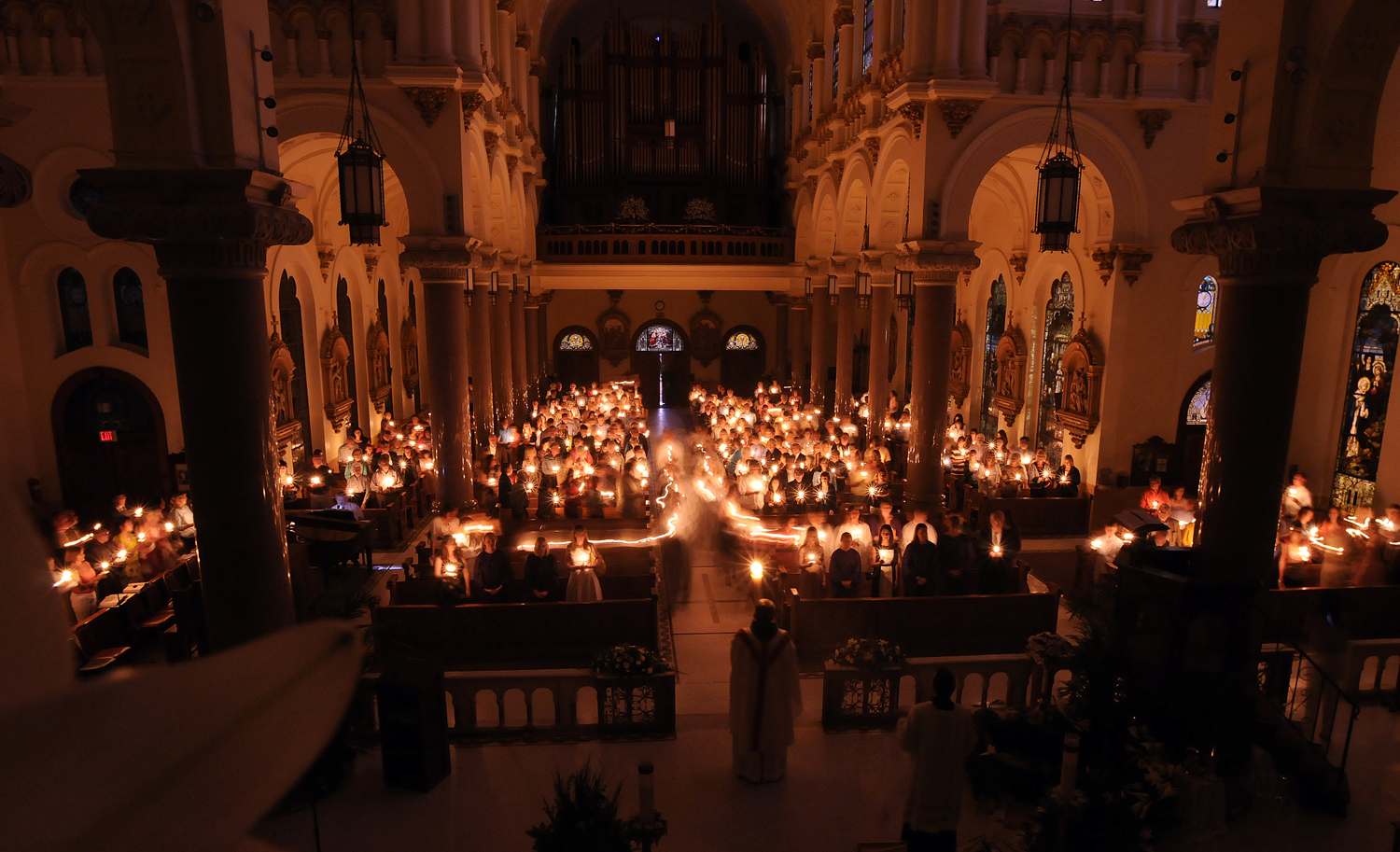
Easter Vigil at Sacred HeartI am always amazed at the sayings that are attributed to St. Francis of Assisi.  Today, I was asked if the following saying was from Francis: “All the darkness in the world cannot extinguish the light of a single candle.”  Nice, but at first blush it does not possess the language or sense of language for which Francis is known. The language is not even particularly medieval, but then maybe this is just a modernized version of the saint’s words.

If you search the internet, you will find this “quote” has pretty wide distribution and uniform attributed to St. Francis.  Most have no citation; but some do.  The only source given was “The Little Flowers of St. Francis.”  You can find the Little Flowers in volume 3 (pp. 566-658) of Francis of Assisi: Early Documents  –  Armstrong, Regis, J.A. Wayne Hellmann, and William Short, eds. (New York: New City Press, 1999–2004).

What you can’t find is the quote, or an account for which the quote could be a reduction. I could be wrong.  If someone has the specific citation (text and chapter) that would be an interesting thing to know.   I know I should just let these things go, but…. let the saint speak for himself … I’m just saying.

Boundaries, Faith, and Gratitude – Boundaries

all-kinds-doorsThey stood at a distance from him 13 and raised their voice, saying, “Jesus, Master! Have pity on us!” 14 And when he saw them, he said, “Go show yourselves to the priests.” As they were going they were cleansed. 15 And one of them, realizing he had been healed, returned, glorifying God in a loud voice; 16 and he fell at the feet of Jesus and thanked him. He was a Samaritan. 17 Jesus said in reply, “Ten were cleansed, were they not? Where are the other nine? 18 Has none but this foreigner returned to give thanks to God?”

The telling of this encounter seems straight forward: (a) Jesus encounters a group of lepers on the road to Jerusalem, (b) they ask for his mercy,  (c) they are cured, but (d) only one returns to thank Jesus and that one is a Samaritan. A simple miracle story, yes? A narrative about faith as the foundation of healing? Such simple summaries, even if true, miss several key aspects of the encounter and the chance to reflect further on our own life of faith in Jesus. Continue reading

On Mission and Crossing Over Boundaries

saint-francis-of-assisi-cimabueAmong founders of religious orders, Francis of Assisi is the first who consciously included mission ad gentes (to the people of the world) as part of the order’s Rule of Life. Francis was clear about the ad gentes nature of mission in the Franciscan tradition: “But I tell you in truth that the Lord chose and sent the brothers for the benefit and salvation of the souls of all people in the whole world and they should be received not only in the land of the believers, but also in that of non-believers.” (Assisi Compilation, 108)

Clearly Francis held to the idea of the universality of mission, yet some people might find Francis’ distinction of the world as the twined categories of believer and non-believer to be somehow less than welcoming or out of sorts with our sensibility of what it means to be Franciscan. Yet note how Chapter 16 of the “Early Rule” (1221 CE) is named by Francis: “Chapter XVI: Those going among the Saracens and other Nonbelievers.” I mention this as a way of pointing you back to the first reflection where it was noted that the way you think about Jesus, church, when and how God’s reign is fully inaugurated, the nature of salvation, how the Church values human beings, and the role and value of culture – all these things affect the way in which one understands and carries out mission. As questions, these six topics remain present, even urgent, in every age because how they are answered is how Christianity finds its concrete identity as it constitutes itself in fidelity to Jesus’ mission. Continue reading

Boundaries, Faith, and Gratitude – Context

Luke 17:11-19

11  As he continued his journey to Jerusalem, he traveled through Samaria and Galilee. 12 As he was entering a village, ten lepers met (him). They stood at a distance from him 13 and raised their voice, saying, “Jesus, Master! Have pity on us!” 14 And when he saw them, he said, “Go show yourselves to the priests.” As they were going they were cleansed. 15 And one of them, realizing he had been healed, returned, glorifying God in a loud voice; 16 and he fell at the feet of Jesus and thanked him. He was a Samaritan. 17 Jesus said in reply, “Ten were cleansed, were they not? Where are the other nine? 18 Has none but this foreigner returned to give thanks to God?” 19 Then he said to him, “Stand up and go; your faith has saved you.” Continue reading

Undressing at the Crossroads

Back in March, we all rejoiced as the white smoke billowed and jubilation erupted in St. Peter’s Square and around the world –habemus papem!  We have a pope.  When the name of the new pope was announced, given that he was a Jesuit, I assumed it was in honor of St. Francis Xavier, the great Jesuit missionary and saint.  That would have been a great choice to tap the tradition of his own order for a new evangelization.  But from the beginning, it was clear that there was something different here – “See I am doing something new.”  Even the first appearance on the loggia of St. Peter’s was different. Here was our new pope – and instantly I was struck by his appearance.  It was as though he was wearing the minimally acceptable papal wardrobe – and the pectoral cross seemed plain – and his demeanor unassuming. Continue reading

Scandal, Faith and Forgiveness – context

Calling disciplesLuke 17:5-10   1 He said to his disciples, “Things that cause sin will inevitably occur, but woe to the person through whom they occur. 2 It would be better for him if a millstone were put around his neck and he be thrown into the sea than for him to cause one of these little ones to sin. 3 Be on your guard! If your brother sins, rebuke him; and if he repents, forgive him. 4 And if he wrongs you seven times in one day and returns to you seven times saying, ‘I am sorry,’ you should forgive him.”

[The Sunday gospel reading begins here] 5 And the apostles said to the Lord, “Increase our faith.” 6 The Lord replied, “If you have faith the size of a mustard seed, you would say to (this) mulberry tree, ‘Be uprooted and planted in the sea,’ and it would obey you. 7 “Who among you would say to your servant who has just come in from plowing or tending sheep in the field, ‘Come here immediately and take your place at table’? 8 Would he not rather say to him, ‘Prepare something for me to eat. Put on your apron and wait on me while I eat and drink. You may eat and drink when I am finished’? 9 Is he grateful to that servant because he did what was commanded? 10 So should it be with you. When you have done all you have been commanded, say, ‘We are unprofitable servants; we have done what we were obliged to do.’” Continue reading

Empathy

empathy2Three short verses that paint quite a picture.  “There was a rich man who dressed in purple garments and fine linen and dined sumptuously each day. And lying at his door was a poor man named Lazarus, covered with sores, who would gladly have eaten his fill of the scraps that fell from the rich man’s table. Dogs even used to come and lick his sores.”  Three short verses that have been captured in artwork across the ages. Three short verses have enough vividness to conjure an image in our own mind’s eye.  Can you conjure the image for yourself? “There was a rich man who dressed in purple garments and fine linen and dined sumptuously each day. And lying at his door was a poor man named Lazarus, covered with sores, who would gladly have eaten his fill of the scraps that fell from the rich man’s table. Dogs even used to come and lick his sores.”  What part of the imagery draws your mind’s eye? Is it the rich man?  Does he look smug? Happy? Oblivious?  Unaware? Occupied with more weighty matters? Continue reading

Lazarus and the Rich Man – Act 3

Act 3 – The Dialogues

To a first century hearer of the parable, the fates of the two would have been surprising for it went against the grain of the common wisdom: blessings in this life were a sign of God’s favor while illness, poverty, and hardship were a sign of God’s curses. Yet the one well “blessed” in his lifetime is now tormented in the netherworld (see the Note on 16:23 below) where he can see Lazarus and Abraham across the great chasm that divides them (v.26).

The First Exchange.  Some things never change. The rich man, who surprisingly knows Lazarus’ name, making his lack of charity perhaps worse, still thinks of Lazarus as someone below his station in life, someone to serve his personal needs: “Send Lazarus to dip the tip of his finger in water and cool my tongue, for I am suffering torment in these flames” (v.24). The rich man stills thinks of himself as a “son of Abraham” since he addresses Abraham as “Father” (cf.  13:16; 19:9) Continue reading

Lazarus and the Rich Man – Act 2

Act 2 – The Rich Become Poor and the Poor Become Rich

The Act is briefly told and simply describes the fate of our two characters. “When the poor man died, he was carried away by angels to the bosom of Abraham. The rich man also died and was buried, 23 and from the netherworld, where he was in torment…” (vv.22-23a). We are not told how Lazarus died. Was it starvation? Again we are reminded of Jesus’ admonition to the Pharisees. “Then he said to the host who invited him, “When you hold a lunch or a dinner, do not invite your friends or your brothers or your relatives or your wealthy neighbors, in case they may invite you back and you have repayment. Rather, when you hold a banquet, invite the poor, the crippled, the lame, the blind; blessed indeed will you be because of their inability to repay you. For you will be repaid at the resurrection of the righteous.” (14:12-14).  Was it exposure and hypothermia while the rich man slept nearby? Infected sores while the rich enjoyed baths and healing ointments? Perhaps weakened and unable to defend himself, the dogs took his life. Continue reading

Lazarus and the Rich Man – Act 1

Act 1 – The Tableau

The first three verses contain a sharp contrast in description between Lazarus and the unnamed “lover of money.”

  • The rich man is clothed in purple and fine linen where Lazarus is covered with sores or ulcers
  • The rich man “dined sumptuously each day” while Lazarus longed to eat what fell from the table, but can’t.
  • The rich man lives a privileged life while Lazarus ebeblêto pros ton pulôna, literally, “had been thrown before the gate” of the rich man’s house.

It is perhaps noteworthy that the first word in a Greek phrase is a position of stress, as is the last word in a phrase.  Even the Lucan grammar seems to stress the contrast between the two men: Continue reading