
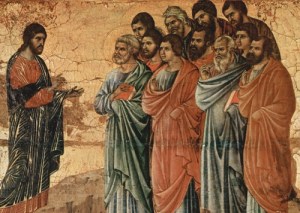
 The reading from today’s gospel (with a few extra verses) and St. Francis of Assisi’s answer to the question.
20 Jesus came with his disciples into the house. Again the crowd gathered, making it impossible for them even to eat. 21 When his relatives heard of this they set out to seize him, for they said, “He is out of his mind.” … 31 His mother and his brothers arrived. Standing outside they sent word to him and called him. 32 crowd seated around him told him, “Your mother and your brothers* [and your sisters] are outside asking for you.” 33 But he said to them in reply, “Who are my mother and [my] brothers?” 34 And looking around at those seated in the circle he said, “Here are my mother and my brothers. 35[For] whoever does the will of God is my brother and sister and mother.” (Mark 3) Continue reading
 Today the Church celebrates the
  In the quiet of the morning, I took a moment to ponder the gospel for today. Today is one of those days I wonder why this particular reading – with its start and end – was chosen. No need to link you to
 I have always like numbers. I have always wondered about numbers. Often, we don’t think about them, just using them for their great functional attributes – keeping score, setting goals, etc. But sometimes we should ask how/why numbers are used. For example, why were Levi’s 501s and WD-40 given those names? Levi Strauss lost all of its records in the 1906 San Francisco earthquake and fire. It does not know why 501s are so named. WD-40? It was the name from the product development lab: Water Displacement, 40th formula.
 The other day, a friend and colleague forwarded to me an email that she had received containing a wonderful reflection by Fr. John Predmore, S.J., Director of Ignatian Ministries at Boston College High School. The article matched so much of my experience in celebrating the Mass as a priest and in my many years as a lay person at Mass in the years before. A resonance that was only amplified by last week’s leading an RCIA session on “The Mass and Eucharist” during which I talked about full, active, and conscious participation in the Mass. I reached out to Fr. John who graciously gave me permission to post this for your enrichment.
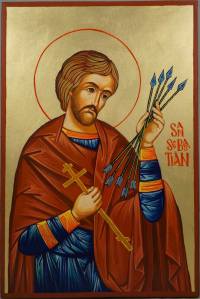 Today’s liturgical possibilities include an optional memorial for St. Sebastian who is the patron saint of athletes. Relatively little is known about St. Sebastian, a Christian martyr of the 3rd century. It is believed that he was an officer in the imperial bodyguard and Christian, but not openly so. When his faith was discovered the Diocletian, the Roman emperor, sentenced him to death. Sebastian was tied to a tree, executed by archers and left for dead. However, he had not died. He was found alive and nursed back to health. When at last he was able, he publicly announced his faith, denounced Diocletian for his persecution of Christians, and for this was martyred as he was beaten to death by the emperor’s guard. It is his virtues and gifts of strength, stamina, perseverance, courage and justice in the face of adversity and a superior opponent – and yet he gave his all.
 St. Paul writes, “I ask that supplications, prayers, petitions, and thanksgivings be offered for everyone, for kings and for all in authority, that we may lead a quiet and tranquil life in all devotion and dignity” (1 Timothy 2:1–2). It is, therefore, appropriate to offer prayers in liturgical settings for our civic leaders, as the prayers of the needs of the faithful and the world are lifted up and offered to the Lord. The inauguration of the President of the United States is a particularly significant moment which draws the attention of all citizens of our land. It is fitting that the prayer of the Church, particularly gathered at the Eucharist, be attuned to the occasion. (
 friarmusings