
 So I send you… an excursus. “Peace be with you. As the Father has sent me, so I send you.” 22 And when he had said this, he breathed on them and said to them, “Receive the holy Spirit. 23 Whose sins you forgive are forgiven them, and whose sins you retain are retained.”
The Christmas and Easter stories are two points in the gospel narratives in which we are most likely to conflate materials into one single narrative. There are lots of examples… Continue reading
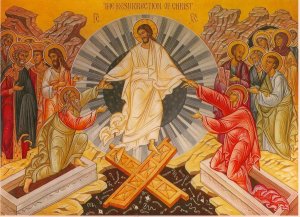 In the Book of Job, chapter 14, Job is pondering the deeper things of life. He is asking the age old question in the face of pending or possible death? Will a person, once dead, live again? (יִ֫חְיֶ֥ה cf. Job 14:14). The question has now been answered. The tomb is empty. The defining conviction of Christian hope is that because Jesus was raised from the dead, the grave is not the final reality of human experience. “Why do you seek the living one among the dead? He is risen.
  Luke 23:47 The centurion who witnessed what had happened glorified God and said, “This man was innocent beyond doubt.” 48 When all the people who had gathered for this spectacle saw what had happened, they returned home beating their breasts; 49 but all his acquaintances stood at a distance, including the women who had followed him from Galilee and saw these events. 50 Now there was a virtuous and righteous man named Joseph who, though he was a member of the council, 51 had not consented to their plan of action. He came from the Jewish town of Arimathea and was awaiting the kingdom of God. 52 He went to Pilate and asked for the body of Jesus. 53 After he had taken the body down, he wrapped it in a linen cloth and laid him in a rock-hewn tomb in which no one had yet been buried. 54 It was the day of preparation, and the sabbath was about to begin. 55 The women who had come from Galilee with him followed behind, and when they had seen the tomb and the way in which his body was laid in it, 56 they returned and prepared spices and perfumed oils. Then they rested on the sabbath according to the commandment.
  It is a sometimes very difficult pastoral situation, when a person has been truly wronged by the events that have unfolded with in a marriage, and I know that ultimately – in one form or another – I will let the person know that there are no innocent parties. Indeed some are infinitely more innocent, but in the end there is rarely complete innocence.
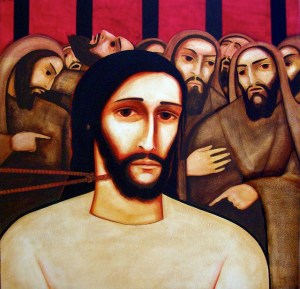 Up to this point in the narrative the chief priests, scribes, and leaders have been the ones who have been active throughout the arrest, hearing and trials of Jesus. While in the privacy of the Sanhedrin gathering, the charges brought against Jesus by this group were religious. Once the assembly moved to the public forum involving Pilate, the charges became secular – “misleading our people; he opposes the payment of taxes to Caesar and maintains that he is the Messiah, a king.” (23:2) In the start of this section, “the people” are now present. Previously the people have supported Jesus (cf. 19:47-48, 20:1, 20:6, 20:19, 21:38) – what will they do now?
 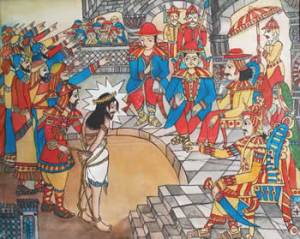 Alan Culpepper commented that reading the arrest and trials of Jesus is, for him, like watching film footage of John Kennedy’s motorcade winding through Dallas in 1963 or the 1986 launch of the Challenger space shuttle. We know what is coming, we know we have no power to undo them, but are compelled to watch because we honor the loss of great people doing what was theirs to do.
 Where in the scene of Peter’s Denial (Luke 22:54-65), the focus and center of the narrative was Peter, here the focus returns to Jesus. Is this trial (hearing, meeting) by the religious authorities of Jerusalem, the role of Jesus as prophet and Messiah is at the forefront of the narrative. Jesus had foretold the primary events of this scene—both Peter’s threefold denial before the crowing of the cock (v. 34; vv. 56–61) and his own maltreatment (esp. 18:32; cf. 20:10–11 and 22:63–65).
  The arrest of Jesus leads into three successive and connected scenes: Peter’s denial (vv. 54-62), the mocking of Jesus (vv. 63-65), and the trial before the religious authorities (vv. 66-71). What is interesting is that in the midst of the Passion narrative of Jesus, there is the scene in all four gospels that concentrate on Peter and his response. Luke’s account is unique in the following respects: sequence – in that the denials occur in the courtyard before the mocking and interrogation; structure – Luke does not connect the denial as a caused by the trial; and detail – such as the servant girl sitting at the fireside where there is light to clearly recognize Peter – and most vividly, it is Luke that reports Jesus looked Peter “dead in the eye,” bringing the full gravitas of the denials to Peter.
  Of course we all know that after the meal with his disciples that Jesus went to the Garden of Gethsemane. Actually, no gospel says that. Matthew and Mark wrote that he went to a garden. John says he went to Gethsemane. Fuse them all together and you get the “Garden of Gethsemane.” What does Luke say? Luke only calls it “the place.” There is no garden specifically mentioned nor is Gethsemane. Is it important? Well, it is a reminder to be attentive to the text before you and not meld the familiar stories and scenes from other sacred writers. Each sacred writer has something distinctive that can be missed if one fuses all the details from other accounts.
