
Hear and follow: knowing

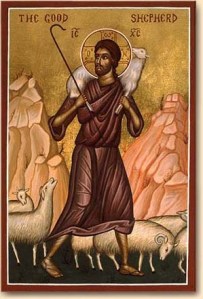
I AM the Good Shepherd3Jesus Knows – Do We Follow? 27 My sheep hear my voice; I know them, and they follow me. 28 I give them eternal life, and they shall never perish. No one can take them out of my hand. 29 My Father, who has given them to me, is greater than all, and no one can take them out of the Father’s hand.

John makes a connection between the sheep who hear the voice of Jesus and believing. Brian Stoffregen notes that Jesus makes the following statements about his sheep in John 10:27-29 (in a more literal translation of the Greek) Continue reading →

Hear and follow: Messiah

I AM the Good Shepherd3A key element of our Sunday gospel passage is an indication of who is part of the flock of believers. The people know Jesus and they, like folks in every age, want straight answers:

24 So the Jews gathered around him and said to him, “How long are you going to keep us in suspense? If you are the Messiah, tell us plainly.” 25 Jesus answered them, “I told you and you do not believe. The works I do in my Father’s name testify to me. 26 But you do not believe, because you are not among my sheep.” (John 10:24-26)

Continue reading →

Hear and follow: context

I AM the Good Shepherd327 My sheep hear my voice; I know them, and they follow me. 28 I give them eternal life, and they shall never perish. No one can take them out of my hand. 29 My Father, who has given them to me, is greater than all, and no one can take them out of the Father’s hand. 30 The Father and I are one.”  (John 10:27-30)

Context. The pastoral imagery of John 10 is always a part of the readings for the 4th Sunday of Easter:

  • Year A – John 10:1-10 (sheepfold, gatekeeper, sheep recognizing the voice)
  • Year B – John 10:11-18 (“I am the good shepherd”)
  • Year C – John 10:27-30

Continue reading →

Follow me: love

Jesus-in-John-2015 When they had finished breakfast, Jesus said to Simon Peter, “Simon, son of John, do you love me more than these?” He said to him, “Yes, Lord, you know that I love you.” He said to him, “Feed my lambs.” 16 He then said to him a second time, “Simon, son of John, do you love me?” He said to him, “Yes, Lord, you know that I love you.” He said to him, “Tend my sheep.” 17 He said to him the third time, “Simon, son of John, do you love me?” Peter was distressed that he had said to him a third time, “Do you love me?” and he said to him, “Lord, you know everything; you know that I love you.” (Jesus) said to him, “Feed my sheep.

This encounter of Peter with his risen Lord is filled with beautiful material. Jesus offers Peter a public opportunity to profess repentance through love, surely a striking example of what it is that reestablishes our relationship with the Lord after sin. The One who Peter denied at the charcoal fire, restores Peter at another charcoal fire. The threefold denial is forgiven by this threefold profession of love. Continue reading →

Follow me: ashore

Jesus-in-John-207 So the disciple whom Jesus loved said to Peter, “It is the Lord.” When Simon Peter heard that it was the Lord, he tucked in his garment, for he was lightly clad, and jumped into the sea. 8 The other disciples came in the boat, for they were not far from shore, only about a hundred yards, dragging the net with the fish. 9 When they climbed out on shore, they saw a charcoal fire with fish on it and bread. 10 Jesus said to them, “Bring some of the fish you just caught.” 11 So Simon Peter went over and dragged the net ashore full of one hundred fifty-three large fish. Even though there were so many, the net was not torn. 12 Jesus said to them, “Come, have breakfast.” And none of the disciples dared to ask him, “Who are you?” because they realized it was the Lord. 13 Jesus came over and took the bread and gave it to them, and in like manner the fish. 14 This was now the third time Jesus was revealed to his disciples after being raised from the dead. Continue reading →

Follow me: fishing

Jesus-in-John-20Futile Fishing. 1 After this, Jesus revealed himself again to his disciples at the Sea of Tiberias. He revealed himself in this way. 2 Together were Simon Peter, Thomas called Didymus, Nathanael from Cana in Galilee, Zebedee’s sons, and two others of his disciples. 3 Simon Peter said to them, “I am going fishing.” They said to him, “We also will come with you.” So they went out and got into the boat, but that night they caught nothing.

Many quickly pass over the beginning of this passage to move to the miraculous catch signaling the presence of Jesus on the shoreline. But to do so would be to miss the “apostolic roll call.” Continue reading →

Follow me: context

Jesus-in-John-201 After this, Jesus revealed himself again to his disciples at the Sea of Tiberias. He revealed himself in this way. 2 Together were Simon Peter, Thomas called Didymus, Nathanael from Cana in Galilee, Zebedee’s sons, and two others of his disciples. 3 Simon Peter said to them, “I am going fishing.” They said to him, “We also will come with you.” So they went out and got into the boat, but that night they caught nothing. 4 When it was already dawn, Jesus was standing on the shore; but the disciples did not realize that it was Jesus. 5 Jesus said to them, “Children, have you caught anything to eat?” They answered him, “No.” 6 So he said to them, “Cast the net over the right side of the boat and you will find something.” So they cast it, and were not able to pull it in because of the number of fish. 7 So the disciple whom Jesus loved said to Peter, “It is the Lord.” When Simon Peter heard that it was the Lord, he tucked in his garment, for he was lightly clad, and jumped into the sea. Continue reading →

Risen: life

doubting-Thomas-DuccioThe Ninth Beatitude. In response, Jesus told Thomas, Because you have seen me, you have believed; blessed are those who have not seen and yet have believed. Thomas came to believe because he saw the risen Lord, but Jesus did not praise Thomas’ pathway to faith; rather, he pronounced a blessing upon those who have not seen the risen Jesus yet have believed in him nevertheless. These are those who hear or read the witness to Jesus borne by the disciples and confirmed by the Spirit (15:26–27). This is the second pronunciation of blessing by Jesus in the form of a beatitude in the Fourth Gospel (cf. 13:17: “If you understand this, blessed are you if you do it.”) Continue reading →

Risen: believing

doubting-Thomas-Duccio“…do not be unbelieving, but believe.”  24 Thomas, called Didymus, one of the Twelve, was not with them when Jesus came. 25 So the other disciples said to him, “We have seen the Lord.” But he said to them, “Unless I see the mark of the nails in his hands and put my finger into the nailmarks and put my hand into his side, I will not believe.” 26 Now a week later his disciples were again inside and Thomas was with them. Jesus came, although the doors were locked, and stood in their midst and said, “Peace be with you.” 27 Then he said to Thomas, “Put your finger here and see my hands, and bring your hand and put it into my side, and do not be unbelieving, but believe.” 28 Thomas answered and said to him, “My Lord and my God!”  Continue reading →

Risen: the Spirit given

doubting-Thomas-Duccio“Receive the holy Spirit” 22 And when he had said this, he breathed on them and said to them, “Receive the holy Spirit. 23 Whose sins you forgive are forgiven them, and whose sins you retain are retained.”

The sacred writer had already introduced the giving of the Holy Spirit in John 7 in a scene during the Feast of Tabernacles in which the Spirit is promised at a future time when Jesus was glorified. In the Fourth Gospel it is at the crucifixion that Jesus is glorified in that his willing obedience manifests the nature of God, which is love. It is there on the cross that Jesus deliver the Spirit into the world (19:30), symbolized immediately afterward by the flow of the sacramental symbols of blood and water. Continue reading →