Doing the father’s will: change

Working-landWhen Jesus asks, “What do you think?” (21:28) one has to hear the question in the context of their previous refusal to answer a question about the person and ministry of John the Baptist. Jesus does not allow the Jerusalem leadership’s previous strategic silence to pass into obscurity. Since the new question is about characters in a story, it is indirect, and the leaders cannot avoid answering it. Their own answer will likely expose the weakness of their human authority. Continue reading →

Parable of Two Sons: authority

Working-landCommentary. Jesus had left Jerusalem for a brief stay in Bethany. He has now returned to the Temple area where, when he left the day before, the chief priests and scribes were angry with him (cleansing of the Temple, vv.12-17.) Given the deeds of the previous day, it seems only natural that the chief priests and the elders would ask about his credentials and question his authority. Continue reading →

Parable of Two Sons: context

Working-landMatthew 21:28–32 28 “What is your opinion? A man had two sons. He came to the first and said, ‘Son, go out and work in the vineyard today.’ 29 He said in reply, ‘I will not,’ but afterwards he changed his mind and went. 30 The man came to the other son and gave the same order. He said in reply, ‘Yes, sir,’ but did not go. 31 Which of the two did his father’s will?” They answered, “The first.” Jesus said to them, “Amen, I say to you, tax collectors and prostitutes are entering the kingdom of God before you. 32 When John came to you in the way of righteousness, you did not believe him; but tax collectors and prostitutes did. Yet even when you saw that, you did not later change your minds and believe him. Continue reading →

What Can We Say

laborers-in-the-field-11thcentbyzantineWhat Can We Say. Patricia Datchuck Sánchez writes:

“Like most scriptural texts, this parable also should be evaluated and appreciated with regard for its various levels of development. At its initial or basic level, the parable defended Jesus’ missionary methodology of reaching out to extend the blessings of the kingdom to tax collectors and sinners. Whereas his contemporaries believed these to be pariah with no claim to salvation, Jesus’ words and works indicated that sinners were not only on equal footing with the righteous but were in fact the ones to whom God manifested special love and mercies.” Continue reading →

The Midst of Assumptions

workers-in-vineyardCaught in the Midst of Assumptions. It is interesting that it is the “manager” or “steward” (epitropos), not the owner, who calls the workers and “gives them their pay/reward” (misthos). They are the ones who dispense what the owner considers right and just. They are also the ones who take the flak from those who disagree. I think we can all relate to being the one thrust into the middle of something not necessarily of our own making. Continue reading →

Usual or Just?

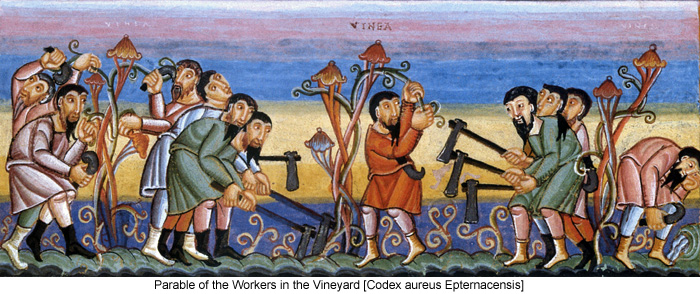
Parable_of_the_Workers_in_the_VineyardCommentary. 1 “The kingdom of heaven is like a landowner who went out at dawn to hire laborers for his vineyard. 2 After agreeing with them for the usual daily wage, he sent them into his vineyard. 3 Going out about nine o‘clock, he saw others standing idle in the marketplace, 4 and he said to them, ‘You too go into my vineyard, and I will give you what is just.’ 5 So they went off. (And) he went out again around noon, and around three o‘clock, and did likewise. 6 Going out about five o‘clock, he found others standing around, and said to them, ‘Why do you stand here idle all day?’ 7 They answered, ‘Because no one has hired us.’ He said to them, ‘You too go into my vineyard.’ Continue reading →

Colliding Worlds and Grace

Gospel_MatthewLong (Matthew, Westminster Bible Companion) writes concerning the rich man story, which also applies to our text: “… we must realize that, when the young man encounters Jesus, two very different worlds collide: this world, with all its prevailing customs and values, and the radical new way of life called for in the kingdom of heaven.” [p. 220]

This radical life comes at a price. Peter understands that and so he asks, “what about us who have already given up everything,” Jesus points to the life within the kingdom and then concludes that the called-for reversal will also be evident in the order of blessing on entering the kingdom: “But many who are first will be last, and the last will be first.” (Mt 19:30) Continue reading →

Assumptions about blessings

Gospel_MatthewMatthew 20:1–16  1 “The kingdom of heaven is like a landowner who went out at dawn to hire laborers for his vineyard. 2 After agreeing with them for the usual daily wage, he sent them into his vineyard….

Context. In the Matthean narrative we are firmly ensconced in the midst of Jesus’ instructions, not of the crowds, but of the disciples, preparing them for not only his death and resurrection, but also for their mission to world. In other words Jesus is preparing them to be disciples – and preparing them to serve the new People of God being formed. Continue reading →

Born again? Born from above?

Nicodemus and JesusJohn 3:3 Jesus answered and said to him[Nicodemus], “Amen, amen, I say to you, no one can see the kingdom of God without being born anōthen”.

Born anōthen. The expression gennēthē anōthen can be translated as “born again” or “born from above.” Some bibles opt for the “again” (TLW), some opt for “again” with a footnote to explain there is an alternative (RSV, NIV, TEV, NASB, ESV, KJV). Others opt for “from above” without explanation (NAB, NJB) or with explanation as to the alternative (NSRV, CEV). Continue reading →

Lifted up to Eternal Life

Nicodemus and JesusPicking up the dialogue between Nicodemus and Jesus in John 3, we hear

11 Amen, amen, I say to you, we speak of what we know and we testify to what we have seen, but you people do not accept our testimony. 12 If I tell you about earthly things and you do not believe, how will you believe if I tell you about heavenly things? 13 No one has gone up to heaven except the one who has come down from heaven, the Son of Man. 14 And just as Moses lifted up the serpent in the desert, so must the Son of Man be lifted up, 15 so that everyone who believes in him may have eternal life.” Continue reading →