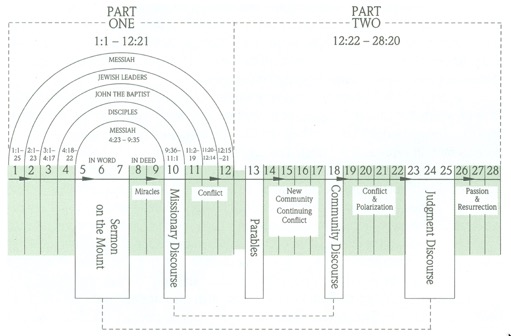
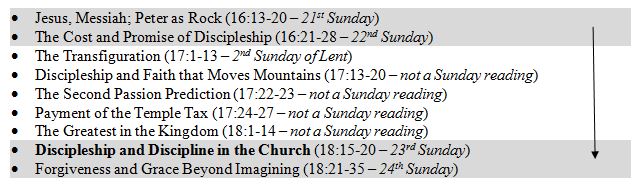
This coming Sunday is the 23rd Sunday in Ordinary Time. The passage takes into consideration that the person has not listened to you or you and the gathered witnesses. What’s next? “If he refuses to listen to them, tell the church. If he refuses to listen even to the church, then treat him as you would a Gentile or a tax collector.” (Mt 18:17)
We now come to the last resort, which the earlier approaches have been designed to avoid. To “tell the church” must presumably require a public statement when the community is gathered (rather than a whispering campaign). Such publicity must be avoided where possible, but may prove to be inevitable if the problem is to be solved. The object of the gathering is not to pronounce judgment but to strengthen the pastoral appeal, in the hope that the offender may yet “listen” (akouo). The offender, faced by the disapproval of the whole local disciple community, ought surely to recognize that this was not just a personal grievance on the part of the initiator. Anyone who is not willing to accept such united testimony may then properly be regarded as no longer a fit member of the community. “You” (singular, referring to the individual who raised the issue, not, at least explicitly, to the community as a whole) should then treat them as “a Gentile and a tax-collector.”
Gentile and tax collector: The two words (ethnikos and telones) have mixed usage in Matthew. Sometimes it refers to a way not to act, sometimes to a group of people who will enter heaven before the apostles, and in other ways. Perhaps it might be best to say that the Gentiles and tax collectors were people who were not Christians or at least they were “outside the fellowship,” or, from our context, their sins had made them “non-brothers”, but they are also people for whom the church had a special concern to bring them gospel so that they might repent and become part of the fellowship again.
Remember that the one seemingly charged with all this action is “you” (singular), presumably, the one who first raised the concern. You become the one to bring it to the church/community.
The commission given to Peter in 16:19 is repeated almost verbatim. “Amen, I say to you, whatever you bind on earth shall be bound in heaven, and whatever you loose on earth shall be loosed in heaven.” Matthew 18:18. One notable difference is that the verbs are now plural, addressed to the disciples as a group, and the introductory “Amen I say to you” gives it added weight. Here, as in 16:19, the object of the “binding” is expressed in the neuter, not the masculine: it is things, issues, actions that are tied or untied, not people—though of course, as v. 17b has made clear, the decision made in principle will have practical implications for the person involved. The individual who was at first concerned over the offender’s action has, in v. 17, found it necessary to appeal to the gathered community, and the community has endorsed that individual’s assessment that this was “sin.”
In so doing the community has exercised the same authority to declare God’s will which was given to Peter earlier, and that authority is now spelled out in exactly the same way as in that earlier saying; Peter ’s “power of the keys.” Different denominations understand this differently. Roman Catholics discuss it in terms of “ordinary” and “extraordinary” teaching authority. Orthodox Catholics see it in terms of their ecclesiology (study of being church) in which the Patriarchs operate in union with Ecumenical Councils. The Reformed churches (looking to Calvin) see it in terms of polity and democratization of authority arising from the “priesthood of all believers.” Independent Bible congregations see it only in Scripture and the local elders. In whatever way it is understood, it must be remembered that it is rooted in prayer.
Again, (amen,) I say to you, if two of you agree on earth about anything for which they are to pray, it shall be granted to them by my heavenly Father. For where two or three are gathered together in my name, there am I in the midst of them.” (Matthew 18:19-20)
In v. 19 prayer was expressed as a direct transaction between the two on earth and God in heaven. But now a third party is introduced into the scene. The wording makes sense only as a forward look to the presence of the risen Christ among his earthly followers. Its thrust is thus similar to that of 28:20, but whereas there the presence of Jesus “with you” is expressed in relation to the new post-Easter situation, here it is, remarkably, already in the present. The perspective is thus that of Matthew’s church rather than of the disciple group during Jesus’ ministry. The saying is linked to v. 19 with a “for,” which indicates that this is the basis for expecting united prayer to be answered: it is not just the prayer of the two who agree, but also that of Jesus who is “among them” because they have come together “in his name,” that is as his disciples representing him (cf. on v. 5, and cf. 10:40–42). While Jesus is on earth his disciples are his brothers and sisters (12:49–50) but even when he is no longer on earth he remains spiritually present as the focus of their unity.
Image credit: Sermon on the Mount (1877) by Carl Heinrich Bloch, Museum of National History at Frederiksborg Castle, Public Domain