
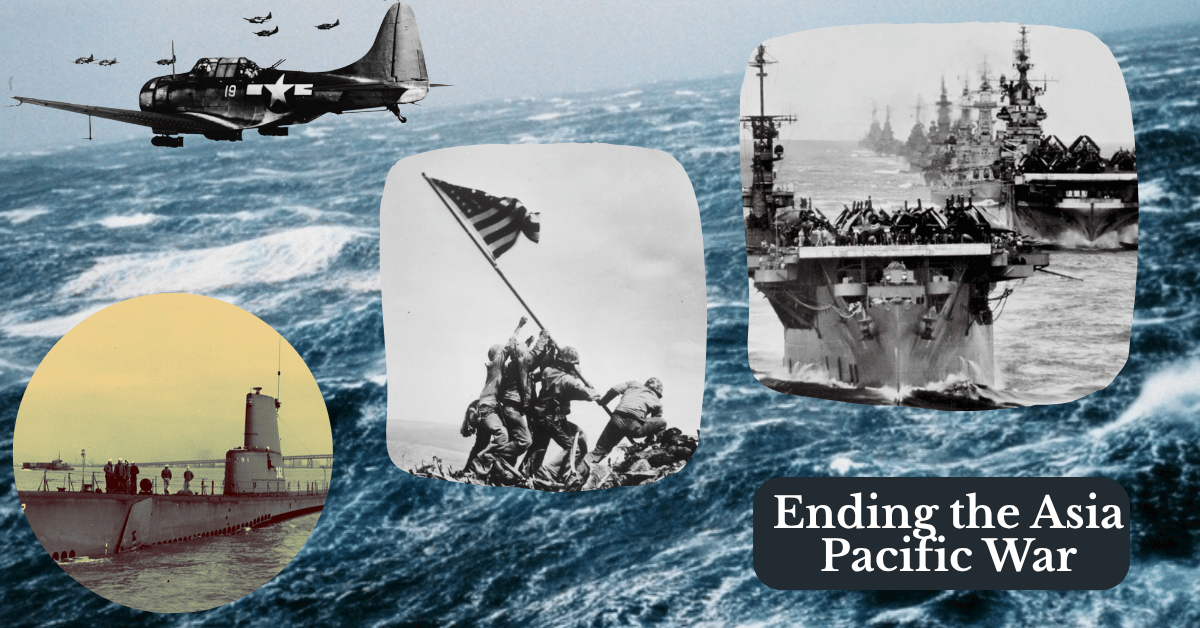
84 years ago today, the naval forces of Imperial Japan and the United States engaged in the epic confrontation known as the Battle of Midway. In my earlier Asia-Pacific War series I did not cover the Battle of Midway, only mentioning it in passing. Today seems like a good day to offer some insights about the battle and its enduring legacy.
Some historians call the Battle of Midway the turning point of the war. Later historians take a more nuanced view and note that Midway was unquestionably one of history’s decisive naval battles. Midway shifted the strategic initiative to the United States but Japan remained a formidable military power. The end of the war was in no way inevitable, but perhaps the tide was beginning to turn. At least Japan’s tactical onslaught had been stopped…for the moment. The Battle of Midway was a critical event seven months into the war.
Pearl Harbor
“Yesterday, December 7, 1941 a date which will live in infamy, the United States of America was suddenly and deliberately attacked by naval and air forces of the Empire of Japan.” Such were the words of President Franklin D. Roosevelt before a joint session of Congress as he asked for a declaration of war against the nation of Japan. Roosevelt is referring to the attack on Pearl Harbor which resulted in 2,403 lives lost and 1,178 wounded. Twenty-one naval ships were sunk upright in shallow water or severely damaged, including the battleships USS Arizona and USS Oklahoma. 188 airplanes were destroyed and another 159 damaged. By any measure it was an audacious and successful attack whose goal was to “knock out” the U.S. Pacific Fleet as Japan unleashed her armed forces against nations in the western Pacific. Later, Admiral Nimitz, Commander of the U.S. Pacific Fleet remarked it was lucky we did not meet the Japanese fleet in the open ocean. He believed the results would have been much the same, but all the ships would have sunk in deep waters and the loss of life would have been much greater. The Japanese fleet was that dominant and prepared.
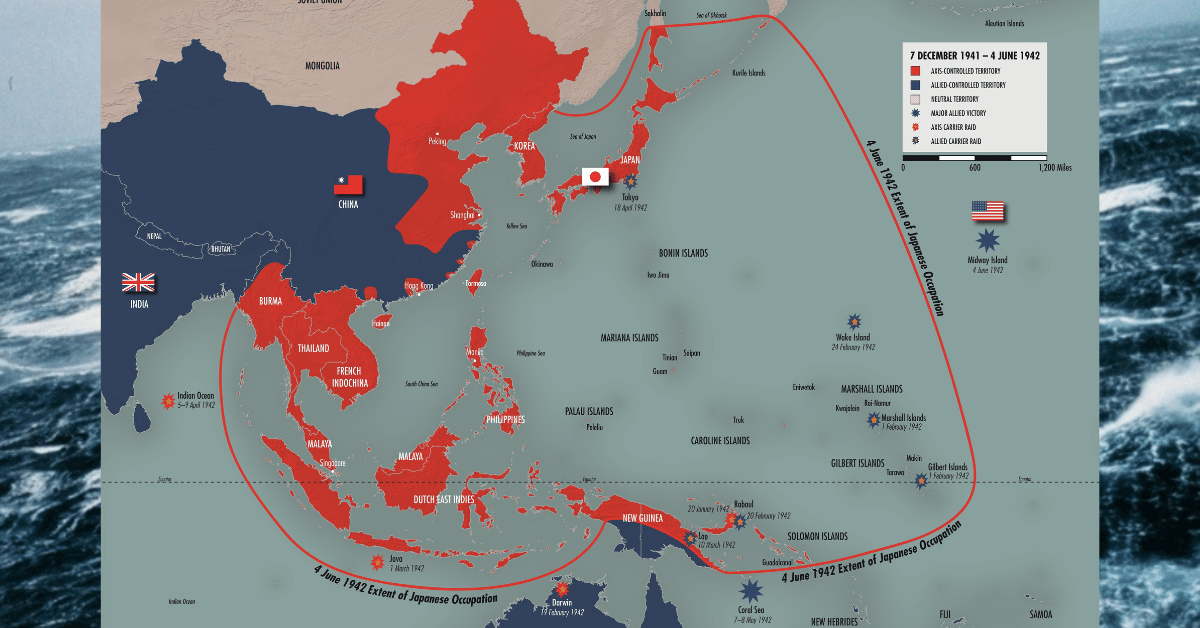
Pearl Harbor and the airfield of Oahu were but a small part of a larger plan. Simultaneously, Japanese forces launched coordinated offensives across Asia and the Pacific, rapidly overrunning Hong Kong, much of the Philippines, Malaya, and the Dutch East Indies. In February 1942, the supposedly impregnable British stronghold of Singapore fell, resulting in one of the largest surrenders in British military history. Japanese forces also captured key territories including Guam, Wake Island, Burma, and numerous islands throughout the western Pacific, securing access to vital resources such as oil, rubber, and minerals. By the spring of 1942, Japan had established a vast defensive perimeter stretching from the Aleutians in the north to New Guinea and the Solomon Islands in the south, and from Burma in the west to the Central Pacific. Japan stood at the height of its military power, having conquered an empire of roughly 200 million people and secured most of its initial strategic objectives. The U.S. and allies were on the defensive, struggling to contain the rapid Japanese advance.
Striking back as best we can
Nevertheless, the U.S. undertook a number of offensive actions that served both military and psychological purposes. Although none threatened Japan’s strategic position directly, they demonstrated that the U.S. Navy retained some offensive capability and helped build experience for later operations. The first significant American offensive actions were a series of carrier raids. American carriers struck Japanese-held islands in the Marshall and Gilbert Islands in February 1942. Task forces built around the carriers USS Enterprise (CV-6) and USS Yorktown (CV-5) attacked airfields, shipping, and installations at Kwajalein, Wotje, Jaluit, and other Japanese bases. Additional raids followed against Wake Island and Marcus Island. While the physical damage was limited, these operations forced Japan to divert resources to defend its perimeter and gave U.S. carrier crews valuable combat experience.
In April 1942 sixteen Army Air Forces B-25 bombers, launched from the carrier USS Hornet (CV-8) struck Tokyo and several other Japanese cities. It is remembered as the Doolittle Raid named after the US Army Air Corp Lieutenant Colonel who led the raid. The raid caused relatively minor physical damage, but its psychological impact was enormous. It boosted American morale after months of defeats and shocked Japanese leaders by demonstrating that the Home Islands were vulnerable to attack. The raid also contributed to Japanese decisions to engage the U.S. fleet in a decisive battle that would allow Japan to eliminate the remaining American aircraft carriers. It needed another bold plan from Admiral Yamamoto.
In May 1942, the United States fought its first major carrier battle in the Battle of the Coral Sea. Japan sought to invade and take over Port Moresby, the capital of Papua New Guinea and located just across the Coral Sea from Australia. This would allow the Japanese to threaten the vitally important sea lanes between Australia and the United States. The American carrier forces aggressively engaged the Japanese fleet. It was not the decisive victory that Japan sought. It was, at best, a draw.
The battle resulted in the sinking of the carrier Shōhō and the damaging of the fleet carrier Shōkaku, two of the six aircraft carriers involved in the attack on Pearl Harbor. However, stopping the Port Moresby invasion came at a cost. The USS Lexington (CV-2) was sunk and USS Yorktown (CV-5) was seriously damaged and left the Southwest Pacific to return to Pearl Harbor for repairs, arriving on May 27th. The full scope of repair was estimated to take months, but the repairs needed to return Yorktown to flight operations were completed in just 72 hours. The Yorktown departed Pearl Harbor on May 30, 1942, to take part in the Battle of Midway.
Plans and Plots
The battle plan for attacking Pearl Harbor was relatively straight forward. But the course of the war revealed Japan was given to creating overly complex plans – and the plan for capturing Midway Island was one of those plans. There was a strike group of four carriers, an invasion force, a task force of battleships and cruisers, and a group that was dispatched to the Aleutian Islands (whether as a diversion or a complimentary strike is left to the historians, but in any case, too far away to lend assistance to Midway operations). The plan was to capture Midway and then wait for the U.S. carriers to sally forth to recapture the island, located at the end of the Hawaiian island chain. That would be the decisive battle Japan hoped for. With their carrier fleet destroyed, surely the U.S. would sue for peace in the Pacific.
There are two classic movies made about the Battle of Midway (1979 and 2019 – the latter being far more accurate than the earlier version). The plots of both movies are about the same: the U.S. are underdogs on the defensive, but we have code breakers reading Japanese naval messages, so we know the Japanese Navy plans to invade Midway, and though outnumbered we surprise attack them and win the day. June 4, 1942 became the turning point of the war. As mentioned, if you want to watch a movie, try the 2019 version. Woody Harrelson does a good job in the role of Admiral Nimitz. If you want to “nerd out” on real history, the gold standard is the book “Shattered Sword” by Jonathan Parshall and Tony Tilly. Many of the stories that were part of popular memory were revised or challenged by historians like Parshall and Tilly who gained access to translations of Japanese records, operational logs (especially the air operations log), postwar analyses by Japanese historians, and especially the Senshi Sōsho, compiled by the Japanese Center for Military History at the National Institute for Defense Studies. The series spans 102 volumes.
The results of these later historians would not change the overall plot of the Midway movies, but would certainly eliminate the myths and misunderstandings.
Battle Intelligence
One of the myths about Midway is that we were reading their naval messages. Prior to Midway, the intelligence units in Australian (FRUMEL) and Pearl Harbor (HYPO) had made some progress on Japanese Naval Code JN-25B and were able, together with traffic analysis, to make some progress on reading messages in part, but not wholly. Several days before Midway they changed to JN-25C. Because the Japanese distributed the new codebooks slowly, messages were often sent in both the old and new codes during the transition, allied intelligence were able to get “an inkling” that a large operation was in the works.
A simple way to explain the intelligence breakthrough before the Battle of Midway is that the Americans did not fully “break” the Japanese naval code in the way movies often suggest. They could read some portions of Japanese messages and understood parts of the code system, but much of the information came from careful observation of communications patterns rather than from reading every message in plain language.
Equally important was what is often called traffic analysis. Even when messages could not be fully read, intelligence officers could learn a great deal by studying who was sending messages, how often they were sent, where they originated, and which units appeared to be communicating with one another. It is similar to noticing that a usually quiet office suddenly has dozens of phone calls between certain departments. You may not know what is being said, but you can tell that something important is being planned. By combining partial codebreaking, traffic analysis, and other intelligence sources, HYPO concluded that a major operation against Midway was imminent and roughly when it would occur. It is an interesting note that HYPO’s “boss” in Washington DC did not agree.
What the movies did get correctly was that station HYPO in Hawaii, noticed that Japanese messages repeatedly referred to a location designated “AF.” They strongly suspected that AF meant Midway Atoll, but they needed proof to convince Washington and Nimitz. To confirm their theory, they arranged for Midway to send an unencrypted radio message stating that its freshwater distillation plant had broken down and that the island was short of water. Shortly afterward, Japanese communications reported that “AF” was experiencing a water shortage. This confirmed that AF was indeed Midway.
The real intelligence achievement was not a dramatic moment when the entire Japanese naval code was cracked open. Rather, it was a patient process of assembling many small clues from partially deciphered messages, from communication patterns, and from educated deduction. By early June 1942, Admiral Chester W. Nimitz knew enough to place his carriers northeast of Midway and wait in ambush for the approaching Japanese fleet. That advance warning was one of the most important factors in the American victory at the Battle of Midway.
But to be clear, Nimitz did not know how many Japanese carriers would be there. His decision to engage the Japanese around Midway was a calculated risk. But in the end U.S. naval forces ambushed the Japanese fleet northwest of Midway Atoll and sank four frontline Japanese aircraft carriers: Akagi, Kaga, Sōryū, and Hiryū. This meant the loss of hundreds of aircraft and many of Japan’s most experienced naval aviators. The United States lost the carrier USS Yorktown (CV-5) and the destroyer USS Hammann (DD-412), but preserved its remaining carrier force. Midway did not end the war, but it halted Japanese expansion in the Pacific, shifted the strategic initiative to the United States, and inflicted losses that Japan could never fully replace, setting the stage for the Allied offensive that began later that year at Guadalcanal Campaign.
The Battle of Midway Revisited
This post will not replay or even attempt to outline the sequence of events that lead to this first major allied victory in the Pacific, but on this day 84 years later, it is perhaps good to revisit some of the narratives that have dominated popular understanding of this battle.
Hopeless Underdog? As noted above, later historians working with newly available sources were able to address some of the legends and conclusions about the battle, for example, the “Hopeless Underdog” narrative. Early American histories (such as Walter Lord’s Incredible Victory) painted the battle as a classic David-versus-Goliath encounter, suggesting the U.S. was hopelessly outnumbered by the entire Imperial Japanese Navy. In reality, while the Japanese had a larger total fleet, the vast majority of their battleships and support ships were hundreds of miles away and never saw combat thanks to Japan’s overly complex battle planning. At the actual point of contact on June 4, 1942, the U.S. and Japanese carrier forces were remarkably evenly matched in terms of naval assets. That being said the Japanese had more combat experience given 5 years of war in China and the battles to this point against the Allies.
The Five Minute Miracle. Perhaps the most enduring narrative is the “Five-Minute Miracle.” The primary source of the narrative is the 1951 book Midway: The Battle That Doomed Japan by Mitsuo Fuchida and Masatake Okumiya. First published in English by the U.S. Naval Institute (1955), Fuchida’s account heavily shaped Western historical understanding of the battle until Shattered Sword.
In his book, Fuchida, who was aboard the Japanese flagship Akagi during the battle, claimed that at 10:20 a.m. on June 4, 1942, the Japanese aircraft carriers were just five minutes away from launching a massive counter-strike against the American fleet. According to his narrative, the American dive-bombers arrived at the absolute last possible second to achieve a miraculous victory. This specific narrative was later popularized in mainstream Western histories, such as: Incredible Victory (1967) by Walter Lord and Miracle at Midway (1982) by Gordon Prange. Parshall and Tully completely disproved Fuchida’s timeline using actual Japanese operational logs, carrier doctrine, and survivor testimonies.
Shattered Sword revealed that the flight decks were clear. The Japanese strike force was actually in significant disarray. The Japanese strike planes were not lined up on the flight decks ready to launch in five minutes; they were still down in the hangar decks being rearmed. In addition, the Japanese carriers were actively launching and recovering Combat Air Patrol (CAP) Zero fighters to defend against continuous American attacks, making it structurally impossible to spot a massive counter-strike force on the flight decks at that time. They were not even close to having their bombers ready, spotted, and armed to attack the U.S. fleet.
Fuchida’s fabrications were not believed to be random errors. Instead, they were driven by a complex mix of personal ambition, a desire to protect his friends, and an effort to salvage the reputation of the Imperial Japanese Navy aviators. After the war the narrative proved to be a commercial success, securing his reputation as a key, and for a long time, unchallenged, historical figure. He was a consultant on the 1979 movie version.
The Flight to Nowhere. This refers to a disastrous, highly controversial navigational error/decision on the morning of June 4, 1942, when the USS Hornet’s entire strike group, except for one squadron, flew in the completely wrong direction, missed the Japanese fleet entirely, and most planes ran out of fuel over the open ocean although some landed on Midway. Early reconnaissance flights had located the main Japanese carrier force to the southwest of the American task force (at a bearing of roughly 240 degrees). However, Hornet’s Captain Marc Mitscher and Air Group Commander Stanhope C. Ring ordered Hornet Air Group 8 to fly on a due-west heading of 265 degrees. The Task Force Commander, Admiral Jack Fletcher, had ordered all strike groups to head 240 degrees. Historians believe Mitscher directed the new course and took this gamble because he suspected there was a second, unspotted group of Japanese carriers operating further to the north and west. It must be remembered that intelligence did not know if four, five, or six carries were part of the Japanese order of battle. Some historians wonder if Mitscher, the naval aviator, believed he simply knew better than Fletcher, a traditional surface officer.
As the Air Group flew west into the empty ocean, the commander of Hornet’s Torpedo Squadron 8 (VT-8), Lieutenant Commander John C. Waldron came to believe the course was wrong. He argued with Commander Ring over the radio, and in the end disobeyed a direct order, broke away turning his squadron southwest toward the real target. As a result, Torpedo Squadron 8 attacked the Japanese fleet alone.
Torpedo Squadron 8. Without a doubt, the aviators of Torpedo Squadron 8 from the USS Hornet heroically attacked knowing their method of approach would be subject to anti-aircraft fire and attack from Japanese Zero fighters. All 15 of their obsolete Douglas TBD Devastator torpedo bombers were shot down with only a single pilot, Ens. George Gay, surviving this flight. That part is historically accurate. But what is not is that their attack drew all the Japanese CAP down to sea level, thereby clearing the skies and allowing U.S. dive bombers to strike unopposed. This heroic timeline doesn’t hold up to tactical reality. Torpedo Squadron 8’s attack occurred about an hour before the decisive dive-bombing strike. By the time the dive bombers arrived, the Zeros had regained altitude and were actually in the middle of engaging American torpedo planes from the Enterprise and Yorktown.
After Action Report. While not a myth born from combat, one of the most significant historical fabrications involved Captain Marc Mitscher (Captain of the USS Hornet) writing a falsified after-action report (AAR). Contrary to naval procedure, Air Group Commander Stanhope C. Ring did not file an AAR, or it was destroyed. The only AAR was from Capt. Mitscher. He reported that the Air Group flew 240 degrees and found nothing apart from Waldron’s fated squadron. Was this to cover up his massive tactical blunder? Was it to protect the legacy of John Waldron, who had disobeyed a direct order in combat?
Waldron was a hero and America needed heroes. He received the Navy Cross posthumously for his extraordinary heroism and leadership during the Battle of Midway. The USS Waldron (DD-699), a Sumner-class destroyer, was named in his honor and commissioned in 1944, serving through World War II, the Korean War, and the Vietnam War. As well, a naval airfield in Corpus Christi Naval Airstation was named after him.
Cdr. Ring was shielded in official reports, as the Navy had no desire for a public scandal. But he was an exemplary officer and went on to a distinguished naval career. He retired in 1955 as a Vice Admiral (3 stars) and passed away in 1963. For decades, Ring never publicly defended himself or explained his actions at Midway. However, 36 years after his death his daughter discovered a 22-page handwritten letter inside his old sea chest. Written in 1946, the letter was Ring’s private attempt to set the record straight. In it, he admitted that his decision to not follow the fleet’s directive was a major error, writing that his estimate of the situation “proved faulty.” He did not direct any blame at Capt. Mitscher.
Capt. Mitscher, later Admiral, was perhaps the finest aircraft carrier skipper of the war and was the tactical commander of Task Force 58, the massive, “Fast Carrier Task Force.” Under his leadership, the force spearheaded the Pacific offensive, securing historic victories in major engagements including the Battle of the Philippine Sea, Leyte Gulf, and the invasions of Iwo Jima and Okinawa. The intense stress and exhaustion of four years of continuous wartime command took a heavy toll on his health. On February 3, 1947, at the age of 60, Admiral Mitscher suffered a fatal heart attack while on active duty in Norfolk, Virginia, having risen to become a 4-star admiral.
Admiral Yamamoto as a “Naval Genius” Both American and Japanese historians initially celebrated Admiral Isoroku Yamamoto (the architect of the Pearl Harbor attack) as a brilliant military genius. History revealed that Yamamoto’s Midway operation strategy was actually deeply flawed. His plan was overly complex, and had no room for delay or unforeseen events such as 3 American aircraft carriers waiting for them. In a war game session using Yamamoto’s battle plan, one junior officer (playing the opposition, that is the America battle group) started the scenario with American carriers located NE of Midway almost exactly the American-designated “Point Luck.” The result of the session proved to be prescient and predicted the loss of three Japanese carriers because the invasion force, the battle groups, and Aleutian forces were too far away to offer any support – all due to the complexity of the plan. Yamamoto’s complex plan overly dispersed Japanese forces, mandated radio silence, and crucially misunderstood American capabilities or willingness to mount an offensive effort. Pearl Harbor was “genius”; Midway was not.
The Battle of Midway – the turning point?
Midway was unquestionably one of history’s decisive naval battles. Yet postwar narratives sometimes implied that Japan’s defeat became inevitable on June 4, 1942 because of the loss of four aircraft carriers. Historians have long debated whether the true turning point of the Pacific War was the Battle of Midway or the Guadalcanal Campaign. The answer depends on what one means by “turning point.”
If a turning point is the moment when the strategic initiative begins to shift, then Midway has the stronger claim. Before Midway, Japan had won virtually every major campaign it undertook. After Midway, Japan could no longer conduct large-scale offensive operations with the same confidence or strength. The loss of four fleet carriers and many experienced aviators permanently weakened the striking power of the Imperial Japanese Navy. Most importantly, the Japanese plan to destroy the American carrier force failed, while the United States retained enough naval strength to remain in the fight. Midway stopped Japanese expansion and prevented Japan from dictating the pace of the war.
If a turning point is defined as the moment when Japan irretrievably lost the ability to win the war, then Guadalcanal offers an even stronger argument. The six-month struggle consumed irreplaceable Japanese pilots, sailors, soldiers, transports, and supplies. Japan entered the campaign hoping to regain the initiative and secure its defensive perimeter. Instead, it suffered a series of attritional defeats on land, at sea, and in the air. By the time Japanese forces evacuated Guadalcanal in February 1943, they had lost the offensive capability necessary to challenge the growing industrial and military power of the United States. From that point forward, Japan was largely reacting to Allied moves rather than shaping events itself.
Midway prevented Japan from winning; Guadalcanal demonstrated that Japan could not recover and that the Allies could sustain a major offensive campaign. Had the United States failed at Guadalcanal, the consequences could have been severe despite the victory at Midway. Guadalcanal tested whether the strategic advantage gained at Midway could be converted into sustained offensive success. When Japan lost Guadalcanal, it lost not only territory and forces but also the realistic prospect of regaining the initiative. In that sense, Midway was the battle that stopped Japan’s advance, while Guadalcanal was the campaign that confirmed the war’s ultimate direction.
I think that it is better said that together they form the turning point of the Pacific War.
Discover more from friarmusings
Subscribe to get the latest posts sent to your email.

