
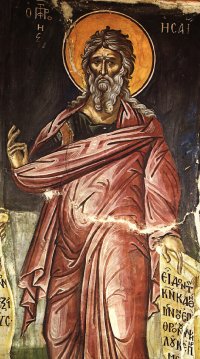
 The anger of the LORD blazes against his people, he stretches out his hand to strike them; The mountains quake, their corpses shall be like refuse in the streets. For all this, his anger is not turned back, his hand is still outstretched. (Isaiah 5:25)
Yikes! Dead bodies in the streets? That’s a lot of anger. In the passage above Isaiah is warning Israel that God’s judgment is coming. In fact, the entire chapter is one long indictment against the people of Israel. They’ve become corrupt and arrogant, and God has had enough. Invading armies are coming and the result will be death and ultimately exile.
God’s anger understandably makes us uncomfortable. In fact, God’s anger is one of the main reasons people state for not liking the God of the Bible. But if we take a closer look at scripture about God’s anger, we will find a more complex and nuanced picture than we might assume.
 Part of my experience includes 3+ years as a lay missionary in Kenya. It was an amazing and eye-opening experience. One of the pivotal experiences was seeing one’s home country through the eyes of another people. I remember one discussion with a chief of the Kikuyu people (one of the 50+ tribes of Kenya) who asked me if it was true that in the United States 51% of the people voted for something that was they way it would be. I responded that was accurate in our democracy. He sadly shook his head and noted that no Kikuyu chief would ever want 49% of the people to be unhappy. He would direct the people and leaders to continue to talk until at least 75% of the people agreed – the others would then understand that it was their communal duty to support such a decision. There are lots of other stories of people seeing us from afar and having some interesting insights.
 There are 75 million Americans who voted for Mr. Biden. There are 71 million Americans who voted for President Trump. There is a divide, there are passionate people. There is an election that had been lost; an election won. And in the midst of all this I am reading “The Immortal Irishman” by Timothy Egan. The books details the life and times of Thomas Francis Meagher, from his rise as an Irish nationalist and leader of the Young Irelanders in the Rebellion of 1848 (in the wake of the Great Hunger ((Irish: an Gorta Mór ; outside of Ireland known as the potato famine), his conviction
 Did you know that gratitude has been scientifically studied? In just the last 10 years, there have been hundreds of studies that have documented the social, physical, and psychological benefits of gratitude. The graphic and the following text all point to some of the benefits of practicing gratitude:
  Today has an
  Part of the blessing being a parish priest is that you are invited into some of the most intimate moments of a family’s life. There is perhaps none more intimate and intense than the moments when illness passes through uncertain diagnosis, to one which blurs into the final days of a life. It is part of a life of ministry to be into a family whose loved one’s days are numbered. It is a privilege to journey with the family are they prepare for the loss that surely and steadily this way comes. In those times, Hope can seem more tentative, more distant; perhaps hovering on the edge of disappointment.
  friarmusings