
 After having graduated from the US Naval Academy – the first cauldron of forming leaders for the Navy and Marine Corp – and after finishing nuclear power training and submarine school, I reported as a bright shiny Ensign to my first submarine! I was ready to be a deep-diving, backing down full at crush depth, denizen of the deep – “Run Silent, Run Deep” and “Hunt for Red October” all rolled into one.
Turns out the submarine’s supply office had just been medically disqualified from serving on submarines, I was the next officer to walk aboard, and so the Captain assigned me as Supply Officer (and Food Service Office) for a submarine that was in a 30-day intensive dry dock refit in which they removed and replaced the galley. Yikes. How did I do? Well… that’s another story.
 St. Francis of Assisi is the patron saint of Italy, merchants, stowaways, ecology, but most famously, of animals. If one searches the internet, you can easily find all kinds of pious, ecologically insightful, and often amazingly-modern sounding quotes from St. Francis. And they are inevitably without a citation from one of Francis’ writings or at least a later Franciscan source writing about Francis. As I noted in the beginning of this series, Francis has always been reinvented and marketed as needed. Perhaps the one book most responsible for casting Francis as the lover of animals and nature is a collection of stories – many miraculous and all very saintly – that first appeared in 1390 in Tuscany: the Fioretti (The Little Flowers). It should be noted that this is about 160 years after Francis’ death.
 Today’s
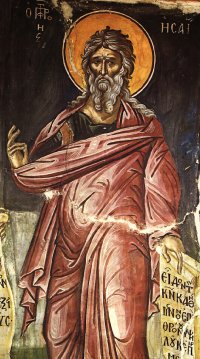 Isaiah, one of the greatest of the prophets, appeared at a critical moment in Israel’s history. To say that his ministry was part of one of the most complicated periods, is an understatement. During his time, the promised land had already split asunder. The people were no longer ruled under Jerusalem and the throne of David. Most of the tribes of Jacob formed the Northern Kingdom (referred to as Israel in this period) with the remaining tribes still loyal to Jerusalem and the throne of David – referred to as Judah.
 One of the most famous and insightful sentences in Christian history comes from the first page of Saint Augustine’s Confessions. As the book unfolds, Augustine describes his extensive experiences with unfulfilled desire. And so as if to give his conclusion beforehand, in the very first paragraph of the book he writes, “Thou has made us for Thyself, and our hearts are restless until they find their rest in Thee.” An insatiable craving, a psychic abyss, unsatisfied desire and desires, and the deep longing for a faraway land — all these point to and find fulfillment in God alone, despite our many failed experiments with all sorts of substitutes.
 Risk is one of those things we don’t think about, are adverse to in different measures. It is unavoidable. We would rather not have any, and yet are surrounded by it, and sometimes we are so focused on it that we can think of little else. It has always been one of the things I wonder about. Its one of the things financial advisors try to discern about your investment posture: risk avoidance or acceptance. It’s something people wonder about submariners. Its one of the things economists specialize in. It is part of life and is unavoidable – so sometimes it is easier to ignore. But I like to read about it from time to time.

 This coming Sunday, the 4th Sunday of Easter, is known as “Good Shepherd Sunday,” because of the gospel that is proclaimed:

