
 Saint Marguerite Marie Alacoque was a French Roman Catholic Visitation nun and mystic, who promoted devotion to the Sacred Heart of Jesus in its modern form. Today is her feast day
In 1905, at the dedication of our current church, our parish was renamed “Sacred Heart” and consecrated to the Sacred Heart of Jesus. The Sacred Heart of Jesus is a devotional with long and historic provenance within Christianity, and in modern times has been established as a Solemnity for the universal Church.
The Solemnity of the Most Sacred Heart of Jesus is a celebration that falls 19 days after Pentecost, on a Friday. The liturgical feast was first celebrated in Rennes, France. The liturgy was approved by the local bishop at the behest of St. John Eudes, who celebrated the Mass at the major seminary in Rennes on August 31, 1670. You’ll notice that the first celebration was not situated in the days following Pentecost. St. John Eudes composed a Mass and a set of prayers for outside the Mass (referred to as an “Office”) that were quickly adopted in other places in France. Continue reading
 On Sunday, October 19th, Pope Francis declared John Henry Newman, Mother Giuseppina Vannini, Mother Mariam Thresia Mankidiyan, Sister Dulce Lopes Pontes, and Marguerite Bays Catholic saints. In the west I suspect John Henry Newman is the best known, but here is the briefest of resumes of all five Saints. Of the new saints, one is the first woman born in Brazil; another is from Kerala, India. Five were priests or members of a religious order; one was a Swiss lay woman.
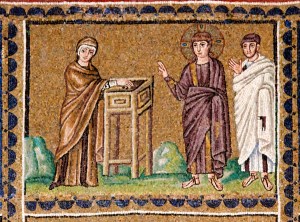 This coming Sunday marks our journey in Ordinary Time, the
 In the first reading, we hear the end of the story of Naaman, a Syrian general, who has just been cured of his leprosy. But we don’t get to hear the start of the story. It turns out that when Naaman comes to Israel he encounters the prophet Elisha. Naaman has come bearing all manner of riches and gifts, but Elisha wants none of it. He simply instructs Naaman to wash seven times in the Jordan. Pretty simple and ordinary, yes?
 There is the natural part of us that tends to speak in generalities or platitudes when we attempt to address God or our relationship to God. Unsurprisingly, after all, the core of it all is a mystery. Believers have struggled for centuries to express the ineffable, the mystery of the divine. Yet we still have hopes: “I want to have God first in my life.” So, what does that look like? Ineffable as God is, what does “first in my life” mean in concrete terms? If you don’t have an idea of what it looks like, how will you know when you have arrived? “But do you ever really arrive?” As they say, if you don’t have a destination then any road will get you there.
 I am not normally given to posting op-ed pieces from online sources. But there was an op-ed piece that caught my attention, more specifically, this:
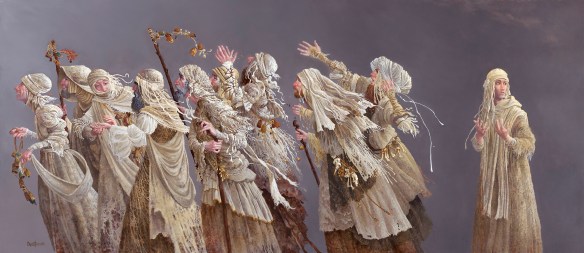 This coming Sunday marks our journey in Ordinary Time, the
 During WWII there was a platoon of Army Rangers deployed well behind enemy lines on a critical mission during the European campaign. A single sniper bullet had killed one of the platoon members. The mission had to continue, but they just could not leave their friend as a stranger in a strange land, buried in an unmarked grave that they might never again find. They remembered a small Catholic church in the area. So, under the cover of the moonless night, they approached the church and rectory, and knocked on the door. After a while a single light came on in the house. Eventually, the door cautiously opened, and the parish priest even more cautiously greeted them.
 In a 13th century text called the Il Foretti (The Little Flowers), a story is told about St. Francis in which a brother friar came to him and asked, “Why after you? Why is the whole world coming after you, wanting to see you, to hear you, to follow you?” Some 800 years after the life of St. Francis, this question remains. What is it about this unpretentious figure from the early 13th century that continues to exert such a perennial fascination for Catholics and non-Catholics, believers and agnostics alike? What is it that has made Francis the subject of more books than any other saint? Why has he inspired artists, led ecologists, peace activists, and advocates for the poor to claim him as a patron? Why has he inspired countless tens of thousands of men and women to follow his Rule of Life in religious and secular communities?
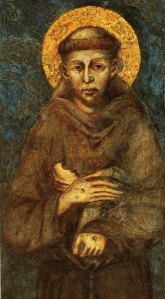 Today is the Feast of St. Francis of Assisi – buona festa!! to Franciscans and those of a Franciscan heart.

