
 31 Again he left the district of Tyre and went by way of Sidon to the Sea of Galilee, into the district of the Decapolis. 32 And people brought to him a deaf man who had a speech impediment and begged him to lay his hand on him. 33 He took him off by himself away from the crowd. He put his finger into the man’s ears and, spitting, touched his tongue; 34 then he looked up to heaven and groaned, and said to him, “Ephphatha!” (that is, “Be opened!”) 35 And (immediately) the man’s ears were opened, his speech impediment was removed, and he spoke plainly. 36 He ordered them not to tell anyone. But the more he ordered them not to, the more they proclaimed it. 37 They were exceedingly astonished and they said, “He has done all things well. He makes the deaf hear and (the) mute speak.” Continue reading
Ephphatha: story
Reply
 The first reading today is from the Book of Deuteronomy, an account of the last words of the prophet Moses to the people at the end of their 40-year trek in the wilderness – from slavery in Egypt to the freedom of the promise land. His words are to the people who long ago made the decision to stay, to fight, to endure the years of struggle, the ones who remained.
  St. Augustine of Hippo begins his great work “Confessions” with a question: “How shall I call upon my God and my Lord, when by the very act of calling upon him I would be calling himself into myself? Is there any place within me into which my God might come? How can God who made the heaven and earth come into me? Is there any room in me for you, Lord, my God?” (I:2)
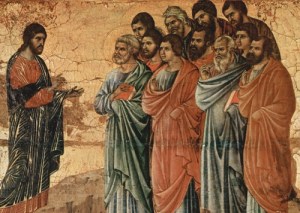 Today’s gospel is the last part of the “Bread of Life Discourse” from the Gospel of John. The disciples who have heard Jesus’ preaching, experienced his healing power, seen him command the stormy seas, witnessed the miracles, and hope him to be the promised Messiah – in today’s account we discover that, for some, Jesus’ claim that he is the “bread come down from heaven is a breaking point. “This saying is hard; who can accept it?…As a result of this, many of his disciples returned to their former way of life and no longer accompanied him.” For some it was all a bridge too far, the last straw, and with no reason to stay, they left. For some, there was motivation, desire, a reason to remain. I think we have all been there at some point in our lives. What is the difference between those who stay and those who go?
 friarmusings