
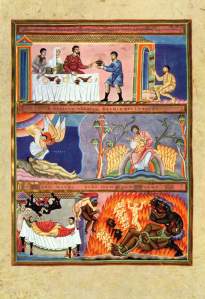
 “…between us and you a great chasm is established to prevent anyone from crossing who might wish to go from our side to yours or from your side to ours.…” Such are words spoken about Lazarus and the rich man, traditionally known as Dives. The words describe their fates in the afterlife: Lazarus comforted by Abraham while Dives languishes in a hellish afterlife.
But here is the thing – the chasm really wasn’t new; it was fixed a long time ago and made wider every time the rich man came and went to his safe, secure and plush home and ignored Lazarus. Don’t get me wrong, this parable indeed talks about the eternal consequences of the life we lead, but it is also about our lives now. And maybe, just maybe, St. Luke has been talking to us about the chasms, the great divides we have slowly built into our lives – and our failure to see them in the here and now. Continue reading
 In Jesus’ time, large agricultural operations such as the one described in our gospel parable were rarely run by the owner or the family, such things were left to the steward to oversee. The steward had the full faith and backing of the owner to operate the business. The steward would sell the oil and wheat production for cash, trade, or in exchange for promissory notes. The bartering that preceded the execution of the promissory note was classic commodity bargaining: I will give you so many measure of oil now, and at this future date you will repay with a higher measure of oil. There were two thing buried in the difference between the higher amount and the original amount: profit for the owner and commission for the steward. That was the way things worked.
 Last week’s
 This coming Sunday marks our journey in Ordinary Time, the
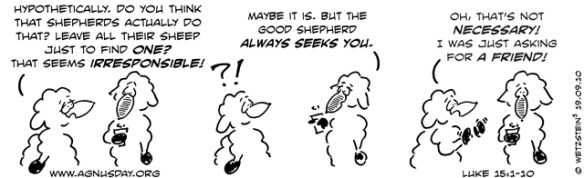 The Parable of the Lost Sheep – you’ve heard it countless times before and have taken in just as many homilies. I suspect the “take away” from the parable and the homily was focused on the shepherd – as it should be. I will simply say that indeed Jesus is the Good Shepherd and is relentless in search for and finding us. No matter how far we have strayed or what we have done, Jesus will find us and ever offer to take us up on his shoulders and bring us home. Always. That my friends, is as good a Good News as you can get. People of God, can I get an “Amen!”
 Who are the holy ones of Christianity? Or more pointedly asked, “Who do you consider the holy ones?” In the beginning it was the Apostles, the people who had actually met and lived with Jesus. They saw the miracles, heard the teaching, witnessed the healings, saw the Resurrected Savior, and went to the ends of the earth preaching and baptizing. Surely, they were the holy ones – especially called by Jesus himself!
 This coming Sunday marks our journey in Ordinary Time, the
 In this day and age, we receive all manner of evites: to meetings, parties, events and more. Upon receiving the evite are we excited? Were we just hoping for a day or evening off? Does this seem more obligation than interesting? Do we have to rearrange schedules? Are hoping something more exciting comes along? We have choices – delete, never open, don’t answer, answer with regrets, or accept. And then come all the consequences of all those choices we make, intended or no. Does all this seem like a phenomenon of the internet age? Not really. It is as old as time and part of the gospel.
 I remember the first time I had to speak to the parish, as pastor, and make a “pitch” for money. It was the 2012 Annual Pastoral Appeal. I think I remarked something akin to: “When I realized I had to make an appeal for money, I knew I had a choice. I could poke my eye out with a flaming stick, or I could make the pitch. It’s not a clear-cut choice.” I really do not like to talk about money or ask for it.

