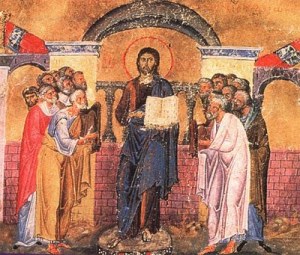
 A Final Thought – from Alan Culpepper, “The Gospel of Luke”
“This scene is more significant than its brevity might suggest. Its position at the beginning of Jesus’ ministry, its emphasis on the Spirit and Scripture, and its depiction of themes that will dominate the rest of the Gospel all point to its paradigmatic character. Readers of the Gospel now understand that all Jesus does in the coming chapters occurs by the power of the Spirit. Jesus teaches, preaches, heals, and casts out demons. He moves among the poor, the outcast, the sick, and the blind. His actions fulfill the Scriptures, especially the Prophets, but even those who awaited the fulfillment of the Scriptures took offense at Jesus and eventually put him to death. This scene suggests that the basis for their hostility toward Jesus was a difference in the way they read the Scriptures. The people of Jesus’ hometown read the Scriptures as promises of God’s exclusive covenant with them, a covenant that involved promises of deliverance from their oppressors. Jesus came announcing deliverance, but it was not a national deliverance but God’s promise of liberation for all the poor and oppressed regardless of nationality, gender, or race. When the radical inclusiveness of Jesus’ announcement became clear to those gathered in the synagogue in Nazareth, their commitment to their own community boundaries took precedence over their joy that God had sent a prophet among them. In the end, because they were not open to the prospect of others’ sharing in the bounty of God’s deliverance, they themselves were unable to receive it.”
“Not only is this scene paradigmatic of Jesus’ life and ministry, but it is also a reminder that God’s grace is never subject to the limitations and boundaries of any nation, church, group, or race. Those who would exclude others thereby exclude themselves. Human beings may be instruments of God’s grace for others, but we are never free to set limits on who may receive that grace. Throughout history, the gospel has always been more radically inclusive than any group, denomination, or church, so we continually struggle for a breadth of love and acceptance that more nearly approximates the breadth of God’s love. The paradox of the gospel, therefore, is that the unlimited grace that it offers so scandalizes us that we are unable to receive it. Jesus could not do more for his hometown because they were not open to him. How much more might God be able to do with us if we were ready to transcend the boundaries of community and limits of love that we ourselves have erected?” [Culpepper, 108-9]
Sources:
Commentaries
- Culpepper, R. Alan. “The Gospel of Luke.” New Interpreter’s Bible. Ed. Leander E. Keck. Vol. 9. Nashville: Abingdon Press, 1994–2004) 102–109
- Geldenhuys, Norval. Commentary on the Gospel of Luke: The English Text with Introduction, Exposition and Notes. Grand Rapids, MI: Wm. B. Eerdmans Publishing Co., 1952. 164-170
- Green, Joel B. The Gospel of Luke. Grand Rapids, MI: Wm. B. Eerdmans Publishing Co., 1997. Print. The New International Commentary on the New Testament. 204-219
- Luke Timothy Johnson, The Gospel of Luke, vol. 3 of the Sacra Pagina series, ed. Daniel J. Harrington (Collegville, MN: 1991)
- Jerome Kodell, “Luke” in The Collegeville Bible Commentary, eds. Dianne Bergant and Robert J. Karris, (Collegeville, Minn.: Liturgical Press, 1989). 936 – 980.
- Brian Stoffregen, “Brian P. Stoffregen Exegetical Notes” at crossmarks.com
Dictionaries
- Gerhard Kittel, Gerhard Friedrich and Geoffrey William Bromiley, Theological Dictionary of the New Testament (Grand Rapids, Mich.: W.B. Eerdmans, 1995)
Scripture Scripture quotes from New American Bible by Confraternity of Christian Doctrine, Inc., Washington, DC. © 1991, 1986, 1970

 1 While the crowd was pressing in on Jesus and listening to the word of God, he was standing by the Lake of Gennesaret. 2 He saw two boats there alongside the lake; the fishermen had disembarked and were washing their nets. 3 Getting into one of the boats, the one belonging to Simon, he asked him to put out a short distance from the shore. Then he sat down and taught the crowds from the boat. 4 After he had finished speaking, he said to Simon, “Put out into deep water and lower your nets for a catch.” 5 Simon said in reply, “Master, we have worked hard all night and have caught nothing, but at your command I will lower the nets.” 6 When they had done this, they caught a great number of fish and their nets were tearing. 7 They signaled to their partners in the other boat to come to help them. They came and filled both boats so that they were in danger of sinking. 8 When Simon Peter saw this, he fell at the knees of Jesus and said, “Depart from me, Lord, for I am a sinful man.” 9 For astonishment at the catch of fish they had made seized him and all those with him, 10 and likewise James and John, the sons of Zebedee, who were partners of Simon. Jesus said to Simon, “Do not be afraid; from now on you will be catching men.” 11 When they brought their boats to the shore, they left everything and followed him. Continue reading
  A couple of years ago, one of the parish staff members, Jennifer Williams, wrote a wonderful piece for this column. Here are some excerpts: “Catholics, in general, are reluctant to talk about their faith in the presence of others. Why? It is easy to talk about church issues and controversies or moral values but not about our relationship with Christ or about how we recognize God’s action in our lives. It seems socially ungracious to ‘talk religion’ around the water cooler or on the golf course or at the swimming pool.”
  It is not all that unusual that people will tell me that they find themselves waking up on Sunday morning somewhat less-than-excited about coming to Mass. “Father, it is so the-same-thing week after week, I find my mind wanders, I don’t get much out it, too many times I receive Communion and just keep walking out the door” I will almost always ask them, “When are thinking about coming to church, who do you look forward to seeing” – and I ask that God, Jesus or the priest not be their answer. Almost always the reply is “no one” or “I really don’t know anyone at the parish – I just park, come in, receive Eucharist, and go home.”
  I like trivia games. Nothing too esoteric or arcane, but still a bit challenging. A friend of mine knows music. Not my specialty. Because of life on a submarine, time in Kenya, and formation time as a friar and priest, I have large gaps in my musical knowledge and exposure. I do alright in history, swimming, and (likely no surprise here) the Bible.
  friarmusings