
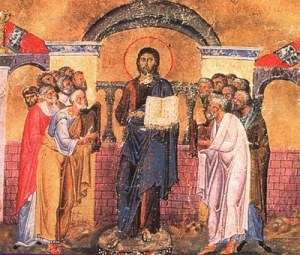
 Context. One thing that is evident when you look at this Gospel reading (Luke 4:21-30) is that the narrative really begins at v.14. As mentioned last week, it is as though the story was cut in half (last week vv.14-21) and we never got to know the reaction of the people in the synagogue. Fortunately, the story continues as Luke 4:21-30 is the Gospel reading for this Sunday (4th Ordinary, C). Many Lucan scholars hold that the two halves together are key and make clear the four major points in Luke’s account:
- the announcement of Jesus ministry as the fulfillment of God’s salvation-time,
- a statement about the content of Jesus’ ministry based on the quotation from Isaiah,
- the foreshadowing of Jesus’ final suffering and rejection,
- the foreshadowing of the movement of the gospel from Jew to Gentile. (found in Stoffregen)
 It is not all that unusual that people will tell me that they find themselves waking up on Sunday morning somewhat less-than-excited about coming to Mass. “Father, it is so the-same-thing week after week, I find my mind wanders, I don’t get much out it, too many times I receive Communion and just keep walking out the door” I will almost always ask them, “When are thinking about coming to church, who do you look forward to seeing” – and I ask that God, Jesus or the priest not be their answer. Almost always the reply is “no one” or “I really don’t know anyone at the parish – I just park, come in, receive Eucharist, and go home.”
 I like trivia games. Nothing too esoteric or arcane, but still a bit challenging. A friend of mine knows music. Not my specialty. Because of life on a submarine, time in Kenya, and formation time as a friar and priest, I have large gaps in my musical knowledge and exposure. I do alright in history, swimming, and (likely no surprise here) the Bible.

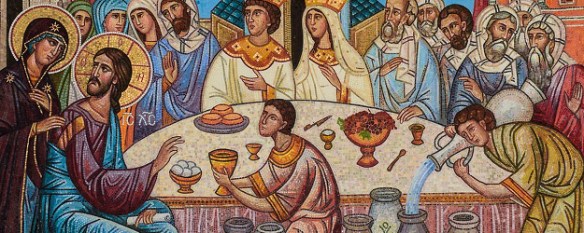 “They have no wine.” It is a simple line spoken by Mary to her son, Jesus. Spoken among the music, the dancing, the celebration, the servants working hard to hide their panic, and wedding guest having no idea that this celebration teeters on the edge of disaster. A simple line spoken in the midst of an account that St. John the gospel writer has filled with so much theological richness.

