The Power of Christ the King

christthekingiconImagine four persons in a room. The first is a powerful dictator who rules a country. He commands armies, directs the lives of millions, and his wishes become law and are enforced. He possesses a brutal power. Next to him sits a gifted athlete at the pinnacle of his physical prowess. This is one whose speed, strength, and endurance have few equals. His is a graceful power for which he is much admired and envied. The third person is a rock star whose music and charisma electrify sold out arenas. Her words can become the anthem for a generation. Her power is a soulfulness of the muse. The fourth person in the room is a newborn, a baby, lying in its crib, unable to clearly ask for what it needs. Continue reading →

Crucifying the King: The Penitent Thief

"Christ and the Thief" by Nikolai Ge.Luke 23:35-43. 33 When they came to the place called the Skull, they crucified him and the criminals there, one on his right, the other on his left. 34 (Then Jesus said, “Father, forgive them, they know not what they do.”) They divided his garments by casting lots. [The above is not part of the Sunday reading, but is generally considered within the narrative. ] 35 The people stood by and watched; the rulers, meanwhile, sneered at him and said, “He saved others, let him save himself if he is the chosen one, the Messiah of God.” 36 Even the soldiers jeered at him. As they approached to offer him wine 37 they called out, “If you are King of the Jews, save yourself.” 38 Above him there was an inscription that read, “This is the King of the Jews.”  39 Now one of the criminals hanging there reviled Jesus, saying, “Are you not the Messiah? Save yourself and us.” 40 The other, however, rebuking him, said in reply, “Have you no fear of God, for you are subject to the same condemnation? 41 And indeed, we have been condemned justly, for the sentence we received corresponds to our crimes, but this man has done nothing criminal.” 42 Then he said, “Jesus, remember me when you come into your kingdom.” 43 He replied to him, “Amen, I say to you, today you will be with me in Paradise.”

The “Penitent Thief” While one of the criminals, already crucified, began to revile “Jesus, saying, “Are you not the Messiah? Save yourself and us.” The word “revile” is eblasphēmei, literally “blaspheme.” It is then we hear the words from the one we know as “the penitent thief.”  Luke does not describe the criminal is such terms. His crime is never described and his penitence is conveyed only by his acknowledgement of his guilt and Jesus’ innocence, and his request that Jesus remember him. Continue reading →

Crucifying the King of the Jews

Copia desde la Crucifixion dibujada hacia 1540...Luke 23:35-43. 33 When they came to the place called the Skull, they crucified him and the criminals there, one on his right, the other on his left. 34 (Then Jesus said, “Father, forgive them, they know not what they do.”) They divided his garments by casting lots. [The above is not part of the Sunday reading, but is generally considered within the narrative.] 35 The people stood by and watched; the rulers, meanwhile, sneered at him and said, “He saved others, let him save himself if he is the chosen one, the Messiah of God.” 36 Even the soldiers jeered at him. As they approached to offer him wine 37 they called out, “If you are King of the Jews, save yourself.” 38 Above him there was an inscription that read, “This is the King of the Jews.”  39 Now one of the criminals hanging there reviled Jesus, saying, “Are you not the Messiah? Save yourself and us.” 40 The other, however, rebuking him, said in reply, “Have you no fear of God, for you are subject to the same condemnation? 41 And indeed, we have been condemned justly, for the sentence we received corresponds to our crimes, but this man has done nothing criminal.” 42 Then he said, “Jesus, remember me when you come into your kingdom.” 43 He replied to him, “Amen, I say to you, today you will be with me in Paradise.”

Those Who Mocked. The people stood by and watched; the rulers, meanwhile, sneered at him and said, “He saved others, let him save himself if he is the chosen one, the Messiah of God.” Luke pictures the majority of the people (laos) don’t mock Jesus (contrary to Mark’s description); they are simply watching. Executions were popular functions and doubtless many attended this one. But it was the rulers, not the people, who mocked (cf. Ps. 22:6–8). The leaders sneer (v. 35; lit. “look down their noses” or “thumbed their noses”) and the soldiers mock (v. 36) and one criminal blasphemes (v. 39). They all say the same thing: “Save yourself” – essentially the same temptations of the devil in Luke 4 – avoid the pain and suffering of the cross. Culpepper notes that “The irony here is that Luke underscores both Jesus’ real identity and the true meaning of his death. Jesus was hailed as the Savior at his birth (2:11); as the Son of Man, he had come to seek and save the lost (19:10). But just as he had taught that those who lost their lives for his sake would save them (9:24), so now he must lost his life so that they might be saved. Continue reading →

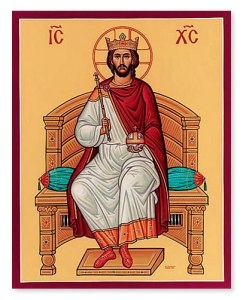
Crucifying the King: “Father forgive them…”

jesus_crucifiedLuke 23:35-43. 33 When they came to the place called the Skull, they crucified him and the criminals there, one on his right, the other on his left. 34 (Then Jesus said, “Father, forgive them, they know not what they do.”) They divided his garments by casting lots. [The above is not part of the Sunday reading, but is generally considered within the narrative.] 35 The people stood by and watched; the rulers, meanwhile, sneered at him and said, “He saved others, let him save himself if he is the chosen one, the Messiah of God.” 36 Even the soldiers jeered at him. As they approached to offer him wine 37 they called out, “If you are King of the Jews, save yourself.” 38 Above him there was an inscription that read, “This is the King of the Jews.”  39 Now one of the criminals hanging there reviled Jesus, saying, “Are you not the Messiah? Save yourself and us.” 40 The other, however, rebuking him, said in reply, “Have you no fear of God, for you are subject to the same condemnation? 41 And indeed, we have been condemned justly, for the sentence we received corresponds to our crimes, but this man has done nothing criminal.” 42 Then he said, “Jesus, remember me when you come into your kingdom.” 43 He replied to him, “Amen, I say to you, today you will be with me in Paradise.”

Commentary. In verses just prior to our gospel reading, Jesus addresses the women as representative of the nation: “daughters of Jerusalem” (Is 37:22; Mic 1:8; Zeph 3:14; Zech 9:9). Jesus notes that they weep for the wrong thing: “weep for yourselves and for your children.” This is because Jesus’ rejection means judgment for the nation (Luke 13:34; 19:41-44; 21:20-21). The tragedy, Jesus says, is not his death but the nation’s failure to choose deliverance, life and forgiveness. Continue reading →

Crucifying the King: Context

English: Stained glass window at the Melkite C...

Luke 23:35-43. 33 When they came to the place called the Skull, they crucified him and the criminals there, one on his right, the other on his left. 34 (Then Jesus said, “Father, forgive them, they know not what they do.”) They divided his garments by casting lots. [The above is not part of the Sunday reading, but is generally considered within the narrative.] 35 The people stood by and watched; the rulers, meanwhile, sneered at him and said, “He saved others, let him save himself if he is the chosen one, the Messiah of God.” 36 Even the soldiers jeered at him. As they approached to offer him wine 37 they called out, “If you are King of the Jews, save yourself.” 38 Above him there was an inscription that read, “This is the King of the Jews.”  39 Now one of the criminals hanging there reviled Jesus, saying, “Are you not the Messiah? Save yourself and us.” 40 The other, however, rebuking him, said in reply, “Have you no fear of God, for you are subject to the same condemnation? 41 And indeed, we have been condemned justly, for the sentence we received corresponds to our crimes, but this man has done nothing criminal.” 42 Then he said, “Jesus, remember me when you come into your kingdom.” 43 He replied to him, “Amen, I say to you, today you will be with me in Paradise.”

Context. Here on the last Sunday of Ordinary Time the Church celebrates Christ the King Sunday. The title is given several places in Scripture:  king of ages (1 Timothy 1:17), King of Israel (John 1:49), King of the Jews (Mt. 27:11), King of kings (1 Tim 6:15; Rev. 19:16), King of the nations (Book of Revelation 15:3) and ruler of the kings of the Earth (Rev. 1:5). The solemnity has been celebrated on the Roman calendar since 1925 and was instituted as a culmination of the liturgical year and a reminder that in His suffering and death, Christ ascended to his throne. Continue reading →

Preparing to prepare

be-preparedI think all of us have had the experience of walking into a store just after Labor Day and seeing the displays of merchandise for Halloween. And you say to yourself, “Really?” Needless to say, the Thanksgiving and Christmas displays and advertisements already are up. I saw a television ad the other night that wanted me to know that I could have white or orange Christmas tree lights, multicolored ones, and all the above with an optional remote control. “Really!?!” I guess I should get with it. Maybe it is good to do our own advertising for Advent! Continue reading →
About the end: divine plan

jesus-apostles-endtimesTime and The Divine Plan – A Theology of History. “Teacher, when will this happen? And what sign will there be when all these things are about to happen?” The broad scope of the question in v.7 is significant, since a judgment of Jerusalem that wipes out the temple suggests a time of great catastrophe and a turning point in the nation’s history and identity. Such an event can only signal that God’s plan for the nation is underway. Though Luke’s form of this question is more focused on the temple than the questions in Matthew 24:3 and Mark 13:4, its implications clearly cover the same span. Continue reading →

About the end: signs

jesus-apostles-endtimes7 Then they asked him, “Teacher, when will this happen? And what sign will there be when all these things are about to happen?” 8 He answered, “See that you not be deceived, for many will come in my name, saying, ‘I am he,’ and ‘The time has come.’ Do not follow them! 9 When you hear of wars and insurrections, do not be terrified; for such things must happen first, but it will not immediately be the end.” 10 Then he said to them, “Nation will rise against nation, and kingdom against kingdom. 11 There will be powerful earthquakes, famines, and plagues from place to place; and awesome sights and mighty signs will come from the sky.

When and by what Sign? In v.7 an unnamed interlocutor(s) asked Jesus, “Teacher, when will this happen? And what sign will there be when all these things are about to happen?” Given the introduction in v.5 where the disciples are mentioned, one assumes the disciples are the audience. But one should note that nowhere else in Luke do the disciples call Jesus “teacher.”  This is the eleventh time Jesus is so addressed and in none of the previous ten are the disciples the one addressing Jesus. Luke reserves the moniker “Teacher” for the Pharisees, lawyers, the crowd, the rich, Sadducees, and scribes.  Given the larger context of Luke, it is more likely that while the disciples are present, Jesus is responding to those present in the Temple complex. Continue reading →

About the end: Temple

jesus-apostles-endtimes5 While some people were speaking about how the temple was adorned with costly stones and votive offerings, he said, 6 “All that you see here—the days will come when there will not be left a stone upon another stone that will not be thrown down.”

The architectural entity known as the Jerusalem Temple was a complex institution. It played a central religious and cultic role in Israelite life, as well as functioning on a political level. It was a symbol of the national state of which Jerusalem was the capital during the pre-exilic period, then of the semiautonomous community of Judeans after the exile, and finally of the Jews who continued to live in Jerusalem and the surrounding territory, with sporadic periods of autonomy, in the centuries before its final destruction. Continue reading →