
 Peace and Division. 51 Do you think that I have come to establish peace on the earth? No, I tell you, but rather division. 52 From now on a household of five will be divided, three against two and two against three; 53 a father will be divided against his son and a son against his father, a mother against her daughter and a daughter against her mother, a mother-in-law against her daughter-in-law and a daughter-in-law against her mother-in-law.”
To the question whether Jesus came to bring peace most of us would unhesitatingly reply ‘Yes’. But Jesus’ “No, I tell you” is emphatic (ouchi). There is, of course, a sense in which he does bring peace, that deep peace with God which leads to true peace among people. But in another sense his message is divisive – such is the effect of prophetic speech. In this Jesus gives a fulfillment in the prophecy of Simeon (Luke 2:35). But one must note that the division is really caused – not by the prophetic speech – but by the decisions one makes because of that speech. This has already been seen when people are called to decide if Jesus is of God or of Satan (Luke 11:14-20). Those who see Jesus must decide rightly lest “the light in you not become darkness” (11:35). Continue reading
 “By faith…” Abraham went out from a land not his own to a place he and Sarah were to inherit. And in that long journey they continued to move forward, against all odds and sense, but always in faith. That journey was not only of faith, but also of service. Three weeks ago our first reading was an example of how Abraham and Sarah welcomed three travelers with hospitality – and this but adds to the accounts of Abraham’s service – to his family and clan, to Lot and his family, to the King of Salem, and so many others. The story of Abraham’s life is a story told in the outlines of faith and in the outlines of service as discipleship.
  One of the interesting things about “blogging” is what happens off-line. WordPress has a feature for “comments” and it is a controllable feature. You can allow all comments and then remove inappropriate ones as you see fit. But then that means you have to monitor; sometimes manners and charity are not hallmarks of text and comments left behind. It takes time. Not willing to dedicate time to the supervising task? The blog administrator can not allow any comments at all. That takes no additional time to oversee. There is at least one “middle way.” You can allow comments but require that all comments be approved before they are posted on one’s blog. That takes some time, but you have the luxury of getting to such things when you have time.
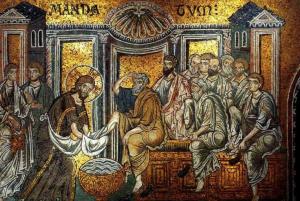
  The disciples of Jesus are to be ready to open to the Master “immediately when he comes.” The answer to Peter’s question (v. 41) directs the discourse toward the Christian leaders especially. The overriding image of authority in this text is one of service. Something that Jesus applies in a special way to the Twelve as leaders of a restored Israel. Where the servants are to stand in readiness for the return of the master, the stewards are responsible for their own work as well as that of the community as a whole. The care of what has been entrusted foreshadows the parable of the sums of money (19:11–27). The sayings on the distribution of responsibilities or gifts in the concluding verse of the section are clearly pertinent for those in authority, but they have a wider application for all on whom spiritual and temporal gifts have been bestowed.
  friarmusings