What was theirs to do

The church’s liturgical calendar marks today as commemorating “St. Paul Miki and Companions.” Paul Miki, a native Japanese convert to Catholicism and a member of the Society of Jesus, was among twenty-six religious and lay missionaries who were sentenced to death by the Emperor of Japan. Miki and two Jesuits were martyred on February 5, 1597, but they were not the only ones martyred that day. There were twenty-three others, all of whom were Franciscans – some members of the First Order (Franciscan friars) and others members of the Third Order (Secular Franciscans). Several of the Franciscans were later canonized as saints: Peter Baptist, Martin of the Ascension, Francis Blanco, Philip of Jesus, Gonsalvo Garzia, and Francis of St. Michael.

“St. Paul Miki and Companions.”  Too often we never ask about or remember the “companions.”  In this commemoration, the seventeen lay people who gave their lives for Christ and their trust in Him.

So, yes the Jesuits and Franciscans celebrate their brethren, but even more importantly let us give thanks for the lay women and men whose work on behalf of others – schools, and hospitals, and activities in support of the poor and hungry.  All were active doing what was theirs to do.

So…what are you giving up for Lent?

lent-2-heartlargeIsn’t that always the question? As if that is the reason for the season. Growing up, everything I remember about Lent circled around the acts of self-denial – what food, entertainment, or habit one would give up and how hard it was to deny oneself of that thing. It was not always made clear that the denial was meant to help one think about God and Christ’s sacrifice.

Of course it’s understandable that the deeper meaning of Lent can be missed. Even elsewhere in this bulletin we mention the religious traditions rituals and “Lenten obligations,” which are easier to promote, understand, and implement than spirituality and faith. We Catholics understand rules. It is far easier to tell kids (and ourselves) to obey rules than to explain to them why we should desire to act rightly. We can end up following the rules simply because… well because that is what we do, that is how we think of religion. In Lent, too often we are denying ourselves for the sake of denial. We give up chocolate or Facebook thinking that act of denial is the purpose of Lent. And we end up missing the point. Continue reading →

Snowflakes, Fractals, and What is Ours to Do

charity_headerA fractal is a mathematical set that often appears in self-similar patterns, in other words, they may appear the same at every scale from the grand to the microscopic. Where can you find them? They occur in nature, e.g., in clouds, crystals, certain types of broccoli (perhaps to the dismay of President George W.H. Bush, aka 41), lightning bolts, blood vessels, DNA, oak trees, and its leaves, and all other matter of things. Consider the snowflake. No matter how far one zooms into a snowflake, one finds a repeating pattern. It is like finding a snowflake within a snowflake, within a snowflake, in a never-ending pattern down to the microscopic level. Really quite fascinating. Continue reading →

Following Francis: The Disposal of Worldly Goods

Francis and Lady Poverty

Many people have a very romantic idea of Franciscan life and the vow of poverty. What I can tell you is that the meaning and the manner of living poverty has vexed Franciscans since the beginning with very little about it being terribly romantic. Most of the descriptions and stories of the life of early poverty were written years after St. Francis’ death, when the manner of living the vow – in conjunction with the vow obedience – was a divisive issue among the brothers. In one of the more notable descriptions from the Sacrum Commercium, an anonymous text from a latter period, the author tries to give his or her insight into St Francis: “While they were hastening to the heights with easy steps, behold Lady Poverty, standing on the top of the mountain. Seeing them climb with such strength, almost flying, she was quite astonished. ‘It is a long time since I saw and watched people so free of all burdens.’ And so Lady Poverty greeted them with rich blessings. ‘Tell me brothers, what is the reason for your coming here and why do you come so quickly from the valley of sorrows to the mountain of light?’ They answered: ‘We wish to become servants of the Lord of hosts because He is the King of glory. So, kneeling at your feet, we humbly beg you to agree to live with us and be our way to the King of glory, as you were the way when the dawn from on high came to visit those who sit in darkness and in the shadow of death.'” Continue reading →

Following Francis: The Itinerant Life of the Brothers

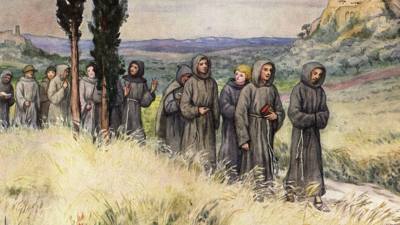
As we noted in last week’s article, Francis expected his brothers to learn by imitation – and to understand that as Francis sought to imitate Christ, so too should the brothers. But in reality, the first generation of Assisi-area brothers simply did what Francis did: daily prayer, work at a local leprosarium, go to local churches to participate in Eucharist, eat, pray again, witness to the local Umbrian people near Assisi, and live a life in community.  You have to remember this was all new. Prior to this “Franciscan moment” the spiritual journey of medieval people consisted of being a monk or cloistered nun behind the walls of the monastery, being a priest and living close to the sacraments and the Scriptures, or being a lay person and hoping the other groups were praying for you. And then along comes this different, new, intriguing way of being spiritual in the world. And it was not set down in writing; it did not come with instructions. But sometimes is borrowed from the past.

Continue reading →

Following Francis: The Exhortation to the Brothers

The small band of brothers living at Rivo Torto and later at the Porziuncula, were drawing others to their way of following Christ in the world.  And if they expected to find a uniform dress code, posted rules, a great deal of organization, a formation program, or even someone to sit them down and explain what was expected – they were in for a surprise. Francis assumed that his followers would learn by imitation. Giving them rules or structures to follow was not merely difficult for him, it went against the grain of the meaning of minority – to be the lesser brother. The new arrivals simply did what Francis did: daily prayer, work at a local leprosarium, go to local churches to participate in Eucharist, eat, pray again, witness to the local Umbrian people near Assisi, and live a life in community.  The brothers had to watch Francis closely and do their best to understand. Continue reading →