Agnus Day’s on 3rd Advent

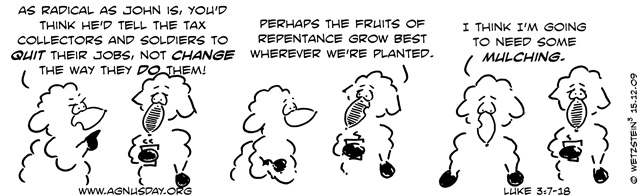
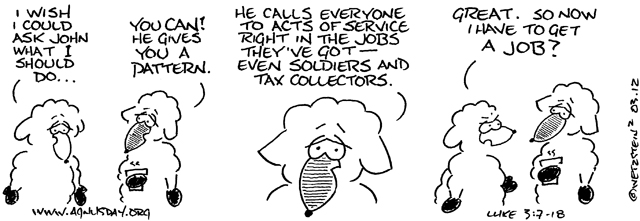
Today is the 3rd Sunday in Advent in Year C of the Lectionary cycle. Following upon John the Baptist’s stern warning of the coming day of judgement, people cry out “Teacher, what should be do?” (Luke 3:12). There are lots of commentaries on this passage, but here on Guadete Sunday, let me offer a bit of “joy” from the folks at Agnus Day and their perspective.

The Theology of History

In Christian biblical studies, “the theology of history” refers to the understanding of history as shaped by God’s purpose and action. Unlike secular views of history, which may see events as random or solely influenced by human actions and natural processes, the theology of history views events within the context of God’s overarching plan, especially as it is revealed in Scripture. This perspective assumes that history unfolds according to God’s will and that each event has theological significance as part of a divine narrative. The key aspects of the theology of history in Christian thought are: Continue reading

The Promises of God

There is a lot going on this week: the nation remembers Pearl Harbor, the church remembers St. Ambrose and St. Lucy, the Solemnity of the Immaculate Conception and the Season of Advent continues. And then there is the whole of “Christmas things.” We all are getting busy about many things and our list of things to do just gets a little longer.

Since the beginning of Advent this year we have heard from the Prophet Isaiah. The verses have all been brimming with Hope. Today is a bit of an exception. I would note that in all times, especially so in troubling times, there are some among us who lead with Hope. Some among us have retreated into different kinds of shells, keeping the world at bay, keeping Hope at a distance. Some just flat out do not listen. The passage from the Prophet Isaiah, is from a section in which the prophet is exasperated by the people’s failure to respond:

Continue reading

Questions about the Messiah

15 Now the people were filled with expectation, and all were asking in their hearts whether John might be the Messiah.16 John answered them all, saying, “I am baptizing you with water, but one mightier than I is coming. I am not worthy to loosen the thongs of his sandals. (Luke 3:15–16a) After inquiring how they might prepare themselves for coming judgment, now, they ask whether John is the Messiah. Green [180] notes: “Recognizing in John’s mission the first hints of eschatological consolation (Isaiah 40; cf. Luke 3:4–6), they wonder if he is God’s agent of salvation. For them, the meaning of “Messiah” is manifestly fluid at this point; hope is present but ill defined. They do not know if John and the anticipated messianic figure fit the same profile, and this allows John to begin the process of outlining what to expect of the Messiah. At the same time, he is able to identify his own relationship to the coming one. According to the narrator, John’s answer is to all the people; everyone receives the invitation to accept his baptism and receive the baptism ‘with the Holy Spirit and fire.’” Continue reading

Guadalupe and Linguistics

Our Lady of Guadalupe.

Today it is common to find villages, towns, cities, and even districts in Mexico, Central and South America named “Guadalupe.”  But in the year 1531 there was no such place in Mexico. So, I have always wondered why the appearance of the Blessed Virgin Mary is referred to as “Our Lady of Guadalupe.” It is an interesting story of linguistic misunderstanding.

Guadalupe is the name of an area, a city, a river, and a Marian shrine in Spain. The word itself comes from a mixture of  Arabic and Latin roots. Remember that Spain was occupied in part and whole by an Islamic regime from 720 CE until 1492 CE, hence many words have Arabic origin. The Arabic wadi (seasonal river bed) became the Spanish “quadi” having the same meaning. “Quadi” seems to have been combined with the Latin lupus (wolf) to come up with Guadalupe.

Continue reading

Then what should we do?

10 And the crowds asked him, “What then should we do?” 11 He said to them in reply, “Whoever has two cloaks should share with the person who has none. And whoever has food should do likewise.” 12 Even tax collectors came to be baptized and they said to him, “Teacher, what should we do?” 13 He answered them, “Stop collecting more than what is prescribed.” 14 Soldiers also asked him, “And what is it that we should do?” He told them, “Do not practice extortion, do not falsely accuse anyone, and be satisfied with your wages.”

The basic question is asked three times: what should we do? The questions come from the crowd, tax collectors and soldiers – and later in Luke’s writings by a lawyer (10:25), a ruler (18:18), a Jerusalem audience in Acts 2:37, a jailer (Acts 16:30), and a zealous Jew, Saul (Acts 22:10). The fundamental response will be “What behavior is appropriate to those who claim to have repented?” Continue reading

Remembering

The people are exiled in Babylon, their capital city and Temple destroyed. The prophet Isaiah has offered them assurance that they are not abandoned by God. In yesterday’s first reading the message was: your trials are not without purpose – it is a time for you to remember the choices that brought these troubles into your lives but also to remember that God is both just and compassionate. The prophet assures them that their hardship will end; they will be restored.

Continue reading

John’s Instructions

7 He said to the crowds who came out to be baptized by him, “You brood of vipers! Who warned you to flee from the coming wrath? 8 Produce good fruits as evidence of your repentance; and do not begin to say to yourselves, ‘We have Abraham as our father,’ for I tell you, God can raise up children to Abraham from these stones. 9 Even now the ax lies at the root of the trees. Therefore every tree that does not produce good fruit will be cut down and thrown into the fire.” (Luke 3:7–9) Continue reading

Such is Our God

“Comfort, give comfort to my people, says your God. Speak tenderly to Jerusalem, and proclaim to her that her service is at an end, her guilt is expiated…” (Isaiah 40:1-2)

The Prophet Isaiah is speaking to the Jewish people exiled to Babylon. His message is one of profound hope and consolation, reminding them – and us – of God’s infinite mercy. After a period of suffering and exile, God assures His people that their trials are not without purpose. He is both just and compassionate, bringing an end to their hardship and preparing a way for restoration.

Continue reading

John’s Baptism

…the crowds who came out to be baptized by him.” (Luke 3:7)

At this point in the narrative there are no baptismal actions, but there is an emphasis on the interpretation of the ritual action itself. As Joel Green [173] notes: “ baptism is seen as an initiatory rite of passage as people (1) come away from their normal lives to participate in John’s ministry through baptism, (2) undergo a repentance-baptism signifying their (re)new(ed) allegiance to God’s purpose, and (3) return to their normal lives having accepted the challenge to reflect in their lives ways of living appropriate to true children of Abraham. John’s proclamation ensures that his baptism is understood as an assault on the status quo, that to participate in his baptism is to embrace behaviors rooted in a radical realignment with God’s purpose.” Continue reading