
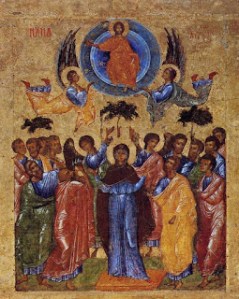
 The Ascension of the Lord is a great celebration of the Church. It commemorates the bodily ascension of Jesus into heaven. According to St. Luke it occurred 40 days after the Resurrection (Acts 1:3). It is a feast of great antiquity with liturgies and art of the 4th century already addressing it as a norm of the Church. In the Eastern Church this feast is known in Greek as Analepsis, the “taking up,” and also as the Episozomene, the “salvation from on high,” indicating that by ascending into his glory Christ completed the work of our redemption.
Especially in Western Europe, the Feast of the Ascension, falling on Thursday, traditionally has been a public holiday, allowing the faithful to participate in the holy day of obligation. In modern times, there are no mid-week public holidays in most places, and so, celebration of the feast diminished. There are many Christian traditions that do not celebrate the Ascension. In the early 1990s the Vatican gave permission for the local bishop to move the observance of the Feast of the Ascension from the traditional Thursday to the following Sunday, the Sunday before Pentecost. The permission to move was given so that the faithful might maintain contact with the importance of the feast. Continue reading
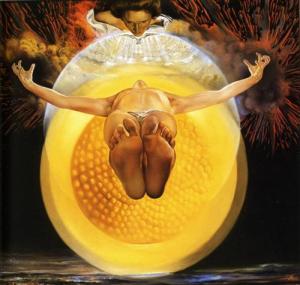 Salvador Dali’s painting “Ascension” is certainly one of the most provocative paintings depicting the Ascension of Our Lord Jesus. The symbolic elements are many, the speculations even more, and the agreement on meaning is still up for grabs. But I sometimes tend to focus on some of the more realistic elements cast among the surrealistic things. While the art experts discuss the finer points of Dali — his life, faith, and his work, I am fascinated by perspective, as well as the hands and feet. The former as though clutching at something; the latter soiled and showing the wear and tear of life on earth.
  When they saw him, they worshiped, but they doubted… (Mt 20:17)
 All power…all nations… all that I have commanded you…with you always – One should be struck by the repetition of the word “all” in this passage:
 Matthew 28:16-20 16 The eleven disciples went to Galilee, to the mountain to which Jesus had ordered them. 17 When they saw him, they worshiped, but they doubted. 18 Then Jesus approached and said to them, “All power in heaven and on earth has been given to me. 19 Go, therefore, and make disciples of all nations, baptizing them in the name of the Father, and of the Son, and of the holy Spirit, 20 teaching them to observe all that I have commanded you. And behold, I am with you always, until the end of the age.”
  When I was in seminary, our homiletics professor had lots of advice and pointers for the Sunday homily – I am about to ignore one of the pieces of advice. The professor was pretty adamant about not explaining theology. And I mostly agree with his point – it can make a homily really dry and fill it with language that needs its own explanation. The professor’s final point was that you are likely to give an inaccurate or heretical version of the theology in any case.
  friarmusings