Amen

This coming Sunday is the celebration of the Solemnity of Our Lord Jesus Christ, King of the Universe. In yesterday’s post we considered those executed alongside him – the two thieves. Today we conclude our study and consider “Amen, I say to you.” This is the sixth time Luke has used this phrase and the only one addressed to one person.  It is also the last of the emphatic “today” pronouncements. Like the poor, the crippled, the blind, and the lame in Jesus’ parable of the great banquet (14:21), the thief would feast with Jesus that day in paradise. Like Lazarus who died at the rich man’s fate (16:19-31), the thief would experience the blessing of God’s mercy. Continue reading

Standing against the Messiah

This coming Sunday is the celebration of the Solemnity of Our Lord Jesus Christ, King of the Universe. In yesterday’s post we considered Jesus’ famous words: “Father, forgive them, they know not what they do.” Today we explore those people and leaders who formed “an unholy alliance” against Jesus: those who mocked him and those who condemned him. Continue reading

Father, forgive them

This coming Sunday is the celebration of the Solemnity of Our Lord Jesus Christ, King of the Universe. In yesterday’s post we explored Luke’s sparse description of crucifixion and pointed to the scriptural evidence regarding the location of the execution. In today’s post, we consider Jesus’ famous words: “Father, forgive them, they know not what they do.” Continue reading

Crucifixion

This coming Sunday is the celebration of the Solemnity of Our Lord Jesus Christ, King of the Universe. In yesterday’s post we covered some background on the solemnity, the titular use of “king” as applied to Jesus and an exploration of Luke’s use of the phrase “the kingdom of God.” Today, we take a look at Luke’s sparse description of the crucifixion and its location. Continue reading

Christ the King – background

Here on the last Sunday of Ordinary Time the Church celebrates Christ the King Sunday. The title is given several places in Scripture:  king of ages (1 Timothy 1:17), King of Israel (John 1:49), King of the Jews (Mt. 27:11), King of kings (1 Tim 6:15; Rev. 19:16), King of the nations (Book of Revelation 15:3) and ruler of the kings of the Earth (Rev. 1:5). The solemnity has been celebrated on the Roman calendar since 1925 and was instituted as a culmination of the liturgical year and a reminder that in His suffering and death, Christ ascended to his throne. Continue reading

The King

I suspect if I asked most people, “Who is the King?” the answer might well come back “Elvis.” There is just part of us that lives in a pop-culture world. Besides, we Americans aren’t too keen on kings. After all, we fought a Revolutionary War to rid ourselves of English monarchs. Of course, we remain fascinated by them. Just look at the television ratings for royal weddings. Continue reading

The Power of Christ the King

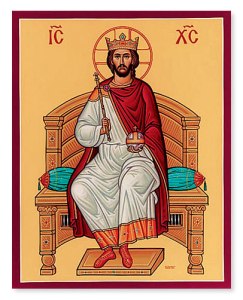
christthekingiconImagine four persons in a room. The first is a powerful dictator who rules a country. He commands armies, directs the lives of millions, and his wishes become law and are enforced. He possesses a brutal power. Next to him sits a gifted athlete at the pinnacle of his physical prowess. This is one whose speed, strength, and endurance have few equals. His is a graceful power for which he is much admired and envied. The third person is a rock star whose music and charisma electrify sold out arenas. Her words can become the anthem for a generation. Her power is a soulfulness of the muse. The fourth person in the room is a newborn, a baby, lying in its crib, unable to clearly ask for what it needs. Continue reading

Christ the King

This coming Sunday is the celebration of the Solemnity of the Our Lord Jesus Christ, King of the Universe – commonly known as Christ the King Sunday. While the formal declaration of the feast only dates to 1925, it origin of the consideration of Christ as King dates back to the patriotic period of the Church appearing in the writings of Cyril of Jerusalem, but is also found in the Gospel of Matthew 28 which Cyril saw as part of his foundation of thought. The celebration, originally placed in October, has an eschatological dimension pointing to the end of time when the kingdom of Jesus will be established in all its fullness to the ends of the earth. It leads into Advent. Attention to the nature of the Advent reading reveals anticipation of the second coming of Jesus. A detailed commentary can be found in Matthew 25:31-46. Continue reading