
Although most everyone calls today Palm Sunday, today is properly called Palm Sunday of the Lord’s Passion. In the opening Gospel we recall the wonderful account of Jesus entering Jerusalem. We get to get to celebrate, wave palms, and greet the Messiah. It is a moment of joy.
It is all rather short lived. Not only in history, but in our liturgy, too. As soon as our entrance procession is over, the readings take on a decidedly different tone. There was a time when I thought that reading the Passion was jumping the gun a bit. I mean, won’t Good Friday arrive in its own good time? Can’t we let the week unfold, walking the journey with Jesus as he spends the week? Can’t we wait to hear about the Last Supper, the betrayal, Gethsemane, the trials, Pontius Pilate, scouring, the crucifixion, and Jesus dead, laid in a tomb? What is the rush? Continue reading
 Introduction to The Lucan Passion Narrative: The passion narratives provide the climax for each of the four gospels, catching up themes that weave their way through the evangelists’ entire portrayal of Jesus life and bringing them to a dramatic completion. In deft strokes the evangelists tell us of the final hours of Jesus’ life – his last meal with his disciples; his arrest in Gethsemane; his interrogation by the religious leaders; the trial before Pilate; and finally the heart clutching scenes of Jesus’ crucifixion, death and burial.
 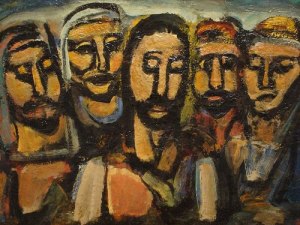 I find that Luke’s treatment of Judas offers an important message. There are some major differences between Luke’s account of Judas and what the other Gospels say about him — and in our day and age, it might be good to hear about Judas — at least Luke’s presentation of Judas.
 Every year on the Sunday before Easter – the sixth Sunday of Lent – the church celebrates “Palm Sunday.” Most general calendars list the day as “Palm Sunday,” but if you look closely at a liturgical calendar you will see that it is actually called “Palm Sunday of the Lord’s Passion.” The name is appropriate as it celebrates Jesus’ triumphal entry into Jerusalem but also commemorates the beginning of Holy Week and Jesus’ final journey to the cross.
 16 The soldiers led him away inside the palace, that is, the praetorium, and assembled the whole cohort. 17 They clothed him in purple and, weaving a crown of thorns, placed it on him. 18 They began to salute him with, “Hail, King of the Jews!” 19 and kept striking his head with a reed and spitting upon him. They knelt before him in homage. 20 And when they had mocked him, they stripped him of the purple cloak, dressed him in his own clothes, and led him out to crucify him. 21 They pressed into service a passer-by, Simon, a Cyrenian, who was coming in from the country, the father of Alexander and Rufus, to carry his cross.
  32 Then they came to a place named Gethsemane, and he said to his disciples, “Sit here while I pray.” 33 He took with him Peter, James, and John, and began to be troubled and distressed. 34 Then he said to them, “My soul is sorrowful even to death. Remain here and keep watch.” 35 He advanced a little and fell to the ground and prayed that if it were possible the hour might pass by him; 36 he said, “Abba, Father, all things are possible to you. Take this cup away from me, but not what I will but what you will.” 37 When he returned he found them asleep. He said to Peter, “Simon, are you asleep? Could you not keep watch for one hour? 38 Watch and pray that you may not undergo the test. The spirit is willing but the flesh is weak.” 39 Withdrawing again, he prayed, saying the same thing. 40 Then he returned once more and found them asleep, for they could not keep their eyes open and did not know what to answer him. 41 He returned a third time and said to them, “Are you still sleeping and taking your rest? It is enough. The hour has come. Behold, the Son of Man is to be handed over to sinners. 42 Get up, let us go. See, my betrayer is at hand.”
 Introduction to The Lucan Passion Narrative: The passion narratives provide the climax for each of the four gospels, catching up themes that weave their way through the evangelists’ entire portrayal of Jesus life and bringing them to a dramatic completion. In deft strokes the evangelists tell us of the final hours of Jesus’ life – his last meal with his disciples; his arrest in Gethsemane; his interrogation by the religious leaders; the trial before Pilate; and finally the heart clutching scenes of Jesus’ crucifixion, death and burial.
  friarmusings