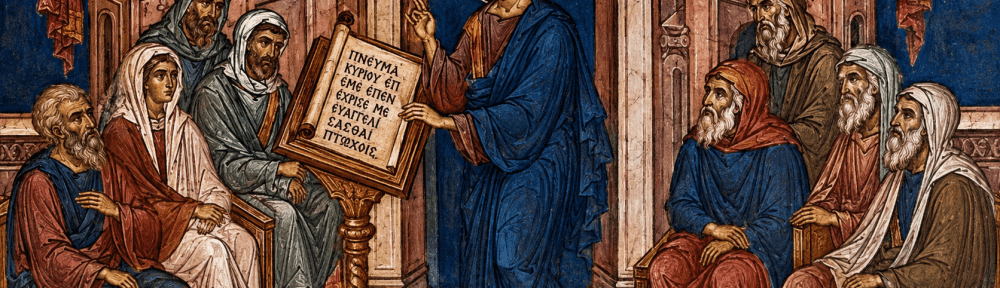
Today’s gospel is the familiar story of Jesus in his home town synagogue in Nazareth. He proclaims, “The Spirit of the Lord is upon me, because he has anointed me to bring glad tidings to the poor….Today this Scripture passage is fulfilled in your hearing.” (Luke 4:18, 21) At the beginning of today’s Gospel, everyone in the synagogue is impressed with Jesus. By the end, they’re trying to kill him. Why? There are likely reasons,e.g., misplaced familiarity with the “home town boy” – “Isn’t this the son of Joseph?” (v.22) What is the old adage about familiarity breeding contempt? Perhaps there is a corollary: familiarity leads us to think we know just enough and so we stop listening.
Jesus knows that the people want him to “Do here in your native place the things that we heard were done in Capernaum.” (v.23) It is the OT equivalent of the modern slang, “show us a little love.” One might guess they are feeling a little entitled. This is very similar to last week’s parable of the workers in the vineyard who had been at it all day, come the end of the day and they felt entitled to more. I wonder if they too stopped listening to the vineyard owner’s explanation?
But what about us? This is not likely the first time hearing this gospel or a homily about it. Are you still trying to peel back the layers of the story to discover how this story impacts you at this time in your life which is no doubt very different from the first time you encountered this episode.
The people in the synagogue heard scripture selectively. The people are provoked when Jesus quotes their own history back to them. They know Elijah, Elisha, the widow and Naaman. Their problem is not a lack of familiarity with Scripture. It’s a selective memory. Israel’s Scriptures contain both election and God’s concern for the nations. Nazareth likes the first and doesn’t want to hear the implications of the second.
We are equally capable of building a Christianity from our favorite verses. We can emphasize justice and forget mercy or emphasize mercy and forget justice. We can insist upon personal morality while ignoring our responsibility for one another. We can become passionate about changing society while avoiding our own need for conversion.
It is not just this story. Countless times we have heard the Beatitudes, the stories of the Good Samaritan and the Prodigal Son. We know the words of Eucharistic institution. We know when to stand, sit and kneel. The danger isn’t necessarily unbelief. It can be overfamiliarity especially when we stop expecting the Word to surprise us. Sometimes knowing the Bible story is precisely what prevents us from hearing the Bible story. Familiarity can create the illusion our understanding is complete.
Jesus senses that he has touched something the listeners don’t want touched: God’s saving mercy for the “others”. The widow was a foreigner. Naaman was a Syrian and not merely a Syrian, but a commander in the enemy army. It is at this point that their admiration turns toward fury. It is just like the first workers in the vineyard parable: God’s generosity becomes offensive when God is generous to someone we don’t think deserves it.
We all have portions of Scripture we love because they reinforce what we already believe. The more revealing question is which parts do I wish Jesus hadn’t said? We readily hear Scripture when it supports our instincts about morality, politics, economics, social questions or whatever issue happens to matter deeply to us. The real test comes when Scripture challenges a position we already hold. We are very good at hearing the Word of God when it tells somebody else to change. The harder question is whether I will allow the Word of God to disagree with me.
The people of Nazareth thought they knew God. They thought they knew Jesus. They even knew the Scripture stories Jesus was telling them. What they weren’t prepared for was allowing those stories to change them.
So perhaps when the Word of God unsettles us, irritates us, or challenges something we have long assumed, our first response shouldn’t be, “That can’t be what Jesus means.” Perhaps it should be: “Lord, what are you trying to change in me?”
Image credit: Created in Dalle-3 | Aug 28, 2026 | prompt: create an image of Jesus in the Nazareth synagogue as described in Luke 4 – keep in an icon style with vibrant colors. Have Jesus centered with listeners on either side, seated. Include an open scroll or book | CC-BY-NC
Discover more from friarmusings
Subscribe to get the latest posts sent to your email.

