
When the Word Disagrees with Me

Today’s gospel is the familiar story of Jesus in his home town synagogue in Nazareth. He proclaims, “The Spirit of the Lord is upon me, because he has anointed me to bring glad tidings to the poor….Today this Scripture passage is fulfilled in your hearing.” (Luke 4:18, 21) At the beginning of today’s Gospel, everyone in the synagogue is impressed with Jesus. By the end, they’re trying to kill him. Why? There are likely reasons,e.g., misplaced familiarity with the “home town boy” – “Isn’t this the son of Joseph?” (v.22) What is the old adage about familiarity breeding contempt? Perhaps there is a corollary: familiarity leads us to think we know just enough and so we stop listening.

Jesus knows that the people want him to “Do here in your native place the things that we heard were done in Capernaum.” (v.23) It is the OT equivalent of the modern slang, “show us a little love.” One might guess they are feeling a little entitled. This is very similar to last week’s parable of the workers in the vineyard who had been at it all day, come the end of the day and they felt entitled to more. I wonder if they too stopped listening to the vineyard owner’s explanation?

But what about us? This is not likely the first time hearing this gospel or a homily about it. Are you still trying to peel back the layers of the story to discover how this story impacts you at this time in your life which is no doubt very different from the first time you encountered this episode.

The people in the synagogue heard scripture selectively. The people are provoked when Jesus quotes their own history back to them. They know Elijah, Elisha, the widow and Naaman. Their problem is not a lack of familiarity with Scripture. It’s a selective memory. Israel’s Scriptures contain both election and God’s concern for the nations. Nazareth likes the first and doesn’t want to hear the implications of the second.

We are equally capable of building a Christianity from our favorite verses. We can emphasize justice and forget mercy or emphasize mercy and forget justice. We can insist upon personal morality while ignoring our responsibility for one another. We can become passionate about changing society while avoiding our own need for conversion.

It is not just this story. Countless times we have heard the Beatitudes, the stories of the Good Samaritan and the Prodigal Son. We know the words of Eucharistic institution. We know when to stand, sit and kneel. The danger isn’t necessarily unbelief. It can be overfamiliarity especially when we stop expecting the Word to surprise us. Sometimes knowing the Bible story is precisely what prevents us from hearing the Bible story. Familiarity can create the illusion our understanding is complete.

Jesus senses that he has touched something the listeners don’t want touched: God’s saving mercy for the “others”. The widow was a foreigner. Naaman was a Syrian and not merely a Syrian, but a commander in the enemy army. It is at this point that their admiration turns toward fury. It is just like the first workers in the vineyard parable: God’s generosity becomes offensive when God is generous to someone we don’t think deserves it.

We all have portions of Scripture we love because they reinforce what we already believe. The more revealing question is which parts do I wish Jesus hadn’t said? We readily hear Scripture when it supports our instincts about morality, politics, economics, social questions or whatever issue happens to matter deeply to us. The real test comes when Scripture challenges a position we already hold. We are very good at hearing the Word of God when it tells somebody else to change. The harder question is whether I will allow the Word of God to disagree with me.

The people of Nazareth thought they knew God. They thought they knew Jesus. They even knew the Scripture stories Jesus was telling them. What they weren’t prepared for was allowing those stories to change them.

So perhaps when the Word of God unsettles us, irritates us, or challenges something we have long assumed, our first response shouldn’t be, “That can’t be what Jesus means.” Perhaps it should be: “Lord, what are you trying to change in me?”


Image credit: Created in Dalle-3 | Aug 28, 2026 | prompt: create an image of Jesus in the Nazareth synagogue as described in Luke 4 – keep in an icon style with vibrant colors. Have Jesus centered with listeners on either side, seated. Include an open scroll or book | CC-BY-NC
Instruction for the Community

This coming Sunday is the 23rd Sunday in Ordinary Time. The previous two Sundays have focused on the gospel narrative that is set at the site of Peter’s great confession of faith: Caesarea Philippi.  This is also the place where Jesus’ first passion prediction occurs which leads to Peter’s exclamation: “God forbid, Lord! No such thing shall ever happen to you” (16:22) – in effect denying the revealed nature and role of the messiah. Jesus corrects Peter in v.24: “Get behind me, Satan! You are an obstacle to me. You are thinking not as God does, but as human beings do.” Despite his confession of faith and the blessing in response to it, Peter initially rejects the possibility that Jesus’ messiahship could involve suffering.  This leads to Jesus’ instruction to the disciples about the true nature of the cross and the willingness to carry it in accordance with the will of God.

At this point in Matthew’s narrative the scene changes: “After six days Jesus took Peter, James, and John his brother, and led them up a high mountain by themselves. And he was transfigured before them” (17:1-2).  But even after the revelation of the glory of God in the experience of the Transfiguration, the disciples are still plagued by their “little faith” and their inability to perform great signs and wonders (17:16, 19) – almost a counterpoint to the glory just witnessed.  Yet in using the symbol of a mustard seed, Jesus still witnesses that through faith, he is present to the disciples.

The relentless movement towards Jerusalem continues as the disciples gather in Galilee (17:22).  This is a community gathered from the “faithless and perverse generation” (v.17).  Jesus’ witness of the second passion prediction serves to announce the focal point and bases upon which this new community gathers.  Nonetheless the gathered disciples are sorrowful because they as yet do not understand.  The disciples have a way to go, but slowly they are becoming church.

This perhaps the subtle but often overlooked element of Matthew’s narrative. Throughout the arc of the storyline Jesus has been addressing the gathering community. “But who do you say that I am?” is addressed not the singular “you” of Simon Peter, but the plural “you” of all the disciples – Peter is simply the one who steps forward to give voice to the response of the community.

Chapter 18 is considered by most scholars as containing the 4th of the 5 discourses, often labeling this section as “Instructions to the Community.”  The fourth major collection of Jesus’ teaching is concerned with relationships among Jesus’ followers, who are clearly seen as a distinct community (as 16:18 has led us to expect). Within such a community there is opportunity both to harm and to care for others, and the health and effectiveness of the group will depend on the attitudes to one another which are fostered. Matthew has brought much of the stories together in this compact form with a view to the needs of the developing church. It is not so much a ‘Manual of Discipline,’ with regulations parallel to those of the so-named document from Qumran, rather it is a guide to relationships within the community. It is only in vv.15–17 that specific procedures are set out, and those are not so much ‘disciplinary’ as pastoral.


Image credit: Sermon on the Mount (1877) by Carl Heinrich Bloch, Museum of National History at Frederiksborg Castle, Public Domain

Liturgical Choices and Narrative Continuity

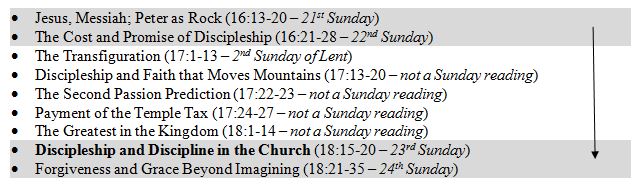
This coming Sunday is the 23rd Sunday in Ordinary Time, Lectionary Cycle A. Choosing readings for liturgy while taking into account the ebb and flow of liturgical seasons is an incredible undertaking that requires study and the blessing of Wisdom. The choices made sometimes leave unusual gaps in the narrative intended by the sacred author. The move from the 22nd to the 23rd Sunday is such a move. Consider the following flow:

23rd-Sunday-snip

We move across 1½ chapter of the text which contains important narratives that pertain to the deepening revelation of the person of Jesus to his disciples – recalling and confirming Peter’s confession – and making clear the connection of Jesus as Son of God and as the Suffering Servant who would be the means of reconciling God and God’s people. All the while pointing ahead to the Resurrection.


Image credit: Sermon on the Mount (1877) by Carl Heinrich Bloch, Museum of National History at Frederiksborg Castle, Public Domain