 37 For as it was in the days of Noah, so it will be at the coming of the Son of Man. 38 In (those) days before the flood, they were eating and drinking, marrying and giving in marriage, up to the day that Noah entered the ark. 39 They did not know until the flood came and carried them all away. So will it be (also) at the coming of the Son of Man. 40 Two men will be out in the field; one will be taken, and one will be left. 41 Two women will be grinding at the mill; one will be taken, and one will be left. 42 Therefore, stay awake! For you do not know on which day your Lord will come. 43 Be sure of this: if the master of the house had known the hour of night when the thief was coming, he would have stayed awake and not let his house be broken into. 44 So too, you also must be prepared, for at an hour you do not expect, the Son of Man will come.
Commentary. Our gospel combines several pictures to describe the arrival of the Son of Man (v. 37). The Noah parable (vv. 37–39) contrasts Noah and the other people of his generation. The flood came upon them suddenly and had dire consequences for many. The pictures of the two men in the field (v. 40) and the two women grinding meal (v. 41) emphasize the suddenness of the coming and the separation that it will bring. Since the exact hour of the coming is unknown, the only appropriate attitude is constant watchfulness (v. 42). This attitude is encouraged further by the story of the homeowner (v. 43). If a homeowner knows when a thief is coming, he exercises watchfulness at that time. But since the time of the Son of Man’s coming remains unknown, the watchfulness must be constant (v. 44).
Matthew (and Luke) use this material that is common to them – but not in the Gospel of Mark – in a way that is very different from the “little apocalypse” of Mark 13 (you should take a quick read of that short chapter to gain a sense of Mark’s vision and purpose). It is clear that Mark emphasizes a wickedness upon the earth that only a final eschatological cleansing can rectify. Matthew (and Luke) refer to the days of Noah “When the LORD saw how great was man’s wickedness on earth, and how no desire that his heart conceived was ever anything but evil, he regretted that he had made man on the earth, and his heart was grieved. So the LORD said: ‘I will wipe out from the earth the men whom I have created, and not only the men, but also the beasts and the creeping things and the birds of the air, for I am sorry that I made them’” (Gen 6:5-7). And yet the gospel writers do not compare this generation to Noah’s. Compare the two gospel accounts:

This text has been preceded by: “But of that day and hour no one knows, neither the angels of heaven, nor the Son, but the Father alone” (Mt 23:36). The emphasis is that life goes on as normal. The emphasis is that the disciples will not know the day – no one knows – but that does not remove the need to stay awake.
The Matthean text, written well after Paul’s Letter to the Thessalonians, does not contain a “rapture” eschatological understanding. The “taken” (vv.40,41) is, as in Noah, a gathering of the saved community. Those on the Ark did not escape the tribulation, as always, they are witnesses and thus their mission continues. Matthew’s pastoral concerns are the same. The new tribulations of Matthew’s time (and ours) are not something from which to escape, rather the tribulations are a time in which the faithful/saved are revealed – as well as the lost. It is revelatory of what “already is.”
If the time is unknown… It will catch people unprepared. The analogy with the days of Noah suggests that judgment is to be a major feature (though it is not the whole picture) of the coming of the Son of man. But the main point is the unpreparedness of Noah’s contemporaries. Whereas Noah and his family were ready, everyone else carried on oblivious to the threat of judgment, and so, while Noah was saved, they were swept away. The implication is that it is possible to prepare for the parousia, not by calculating its date, but by a life of constant readiness and response to God’s warnings and introductions. There will apparently be only two categories, the prepared (and therefore saved) and the unprepared (and therefore lost).
Some are taken – some are not… This radical division is reinforced by two cameos of ordinary life suddenly disrupted. Both men are involved in the same work in the field, both women in the same grinding at the mill. It is not a difference in work or situation which causes the separation, but a difference in readiness. (Cf. 13:30 for the idea of a coexistence of the ‘saved’ and the ‘lost’ until the final judgment.) Taken is the same verb used e.g. in 1:20; 17:1; 18:16; 20:17; the word for “taken” (paralambanomai) doesn’t mean “to go up” or “to meet”, but “to go along with”. It is used in the Transfiguration story: “Jesus took with him Peter and James and John his brother.” It is used in the section on church discipline. If someone has sinned against you, you are to go to him and tell him his fault. If he does not listen, take one or two others along with you.
If indeed discipleship is a primary focus of the narrative, it is perhaps useful to speculate what the people are doing when this “taking” or “leaving” occurs? They are at the place of employment. They are busy at work. I would guess that the man working in the field is “left”, because he couldn’t leave his important work. The woman working in the mill is “left”, because she couldn’t leave her important work. Work is important. One needs to provide food and shelter for self and family, but there is something more important than your work: the Son of Man. God might show up at your work place without an appointment. What would you tell him? “Great, let’s meet. I’ve got work to do right now, but have your people call my people and we can do lunch.” Of course, “his people” have been calling all along.
I would suggest, in the Matthean verse, the word “taken” (paralambanomai) points to the salvation of rather than the destruction of the one ‘taken’. No indication is given of where they are ‘taken’ to; the point is simply the sharp division which the parousia will entail.
Notes
Matthew 24:37 it will be like it was in Noah’s day. Humans living in the days preceding Jesus’ return will be as unaware of it as Noah’s contemporaries were of the flood (Gen 6:5ff; Isa 54:9; cf. 2 Pet 2:5; 3:6). The timing of God’s judgment in both instances is totally unanticipated. The analogy with the days of Noah suggests that judgment is to be a feature of the coming of the Son of man. But the main point is the unpreparedness of Noah’s contemporaries. Whereas Noah and his family were ready, everyone else carried on oblivious to the threat of judgment, and so, while Noah was saved, they were swept away. The implication is that it is possible to prepare for the parousia, not by calculating its date, but by a life of constant readiness and response to God’s warnings and teaching. There will apparently be only two categories, the prepared (and therefore saved) and the unprepared (and therefore lost).
Matthew 24:37 coming: parousía The general meaning of parousía is “presence,” specifically “active presence” (e.g., of representatives or troops, in person; cf. 2 Cor. 10:10). In Hellenistic writings it referred to the visit of rulers or high officials. The word has no exact parallels in Hebrew, but similar terms (“to be present” and “to come”) are plentiful and point to the coming of the end of time (Lam. 4:18), end of evil (Prov. 1:27), or of the day of redemption (Is. 63:4) or recompense (Dt. 32:35). Above all, God comes draws near to his people. (e.g., Gen. 16:13–14; 28:18; 2 Sam. 24:25). The entry of the ark is God’s coming (1 Sam. 4:6–7). But God is not tied to places; he may come in dreams (Gen. 20:3), theophanies (18:1ff.), clouds and storms, visions, the quiet breath (1 Kgs. 19:12–13), and in his Word or Spirit (Num. 22:9; 24:2). The OT refers to God’s coming as World King (Dt. 32:2ff). He is king forever and ever in Ex. 15:18. He will finally assume full kingship (Is. 2:2). His coming as world king will mean the creating of a new heaven and earth (Is. 66:15) and universal peace and joy (Is. 2:2ff.; 65:21ff.; 66:10ff.). The concept also refers to the coming of the Messiah whose main task is to establish peace (Zech. 9:9–10). This coming has a universal sweep and is historical, but with eschatological aspects (Dan. 7:13). In the Psalms the stress is on God’s coming, not that of the Messiah. The place of the parousía concept in the NT is that Jesus has come already, but so strong is the hope of his coming in glory that the word is not used for his first coming. There is not a twofold parousía.
Matthew 24:37 Son of Man: In Matthew, as in all the other Gospels, the title which Jesus uses to describe his own mission is usually ‘the Son of man’. Matthew’s recording of this title differs little from that by Mark and Luke. None of them use it themselves in narrative or comment, but all agree that Jesus made frequent use of it, and, most remarkably, that when the title ‘Christ’ was offered to him, he substituted ‘the Son of man’ (26:64).
This is not the place to give a full account of the voluminous and continuing debate about this title. Even the description of it as a ‘title’ is controversial, as the phrase ‘a son of man’ in Hebrew and Aramaic means simply a human being. When God addresses Ezekiel frequently as ‘Son of man’ (Ezek. 2:1, 3; 3:1; etc.) it is as ‘man’ in contrast with God, almost meaning ‘little man’! (Cf. also Pss. 8:4; 80:17.) In later Aramaic a similar phrase came to be used sometimes, rather like the English ‘one’, to refer to oneself or (occasionally) someone else, in contexts where modesty or prudence made a direct statement undesirable. But the phrase ‘the Son of man’ seems to demand a more specific content than that, especially when it is seen that Jesus uses the phrase predominantly in discussing the nature of his specific mission, not the lot of men in general.
But there is no clear evidence that the phrase ‘the Son of man’ was used thus as a title in any Jewish literature before the time of Jesus. It is therefore likely that Jesus developed this strange usage himself, perhaps deliberately in order to avoid a familiar title (such as ‘Messiah’) which would already have carried its own meaning for Jesus’ hearers.
It is a strange usage: the Greek phrase ho hyios tou anthrōpou is as unnatural as the English, and the Aramaic phrase bar-nāšā’ would not normally be used, as Jesus always used it, with a definite article. It seems most likely that Jesus ‘coined’ the title on the basis of the vision of ‘one like a son of man’ in Daniel 7:13 (a passage to which he frequently referred in explaining his mission: see on 10:23; 16:27–28; 19:28; 24:30; 25:31; 26:64; 28:18); in Daniel this is no title, simply a description of a human figure (as opposed to an animal) in a vision, but Jesus’ definite article functions virtually as a demonstrative, ‘that Son of man’, i.e. the one described in Daniel 7:13–14, which Jesus clearly saw as a figure for his own mission.
But while the phrase was probably derived from reflection on Daniel 7:13f., Jesus’ use of it as a title for himself extends far beyond what that passage suggests. In addition to the future glory and triumph depicted in Daniel 7:13–14, Jesus uses the phrase particularly in predicting his own rejection, suffering and death, a theme which Daniel 7 alone would not have required. Further, he speaks of his ministry on earth, both in its humiliation (e.g. 8:20) and in its authority (e.g. 9:6; 12:8), under this title. It is, then, a wide-ranging term whose content is fixed not by any predetermined meaning as a title (for it had none), but by the breadth of Jesus’ own understanding of his unique mission. [France, 46-47]
Matthew 24:41 taken: paralambánō. the term is used for the reception of Christ by the world (Jn. 1:11) and for acceptance into the kingdom of Christ.
Sources
- Daniel J. Harrington, The Gospel of Matthew, vol. 1 of Sacra Pagina, ed. Daniel J. Harrington (Collegeville, MN: Liturgical Press, 1991) pp. 341-47
- Brian Stoffregen, “Brian P. Stoffregen Exegetical Notes” at www.crossmarks.com
- Kittel, G. W. Bromiley & G. Friedrich, eds. ,Theological dictionary of the New Testament (Grand Rapids, MI: Eerdmans, 1995): Delling, paralambánō, 4:5-15; Oepke, parousía, 5:858–71
- Scripture quotes from New American Bible by Confraternity of Christian Doctrine, Inc., Washington, DC.


 There have been lots of reports in the news about the choices people are making this Thanksgiving – and I am not referring to the turkey or the ham. Sadly, emotions are running so high regarding the recent elections, some families are choosing not to come together, not to invite certain family members. Others are a little more proactive, announcing there will be no political discussions allowed – and I hope that works, but I think it will still be there hanging in the air. Such is life. It is always about the choices we make. Continue reading
 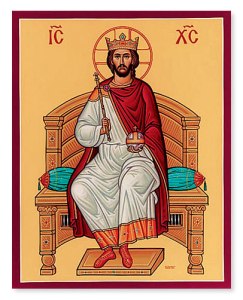 Kings are an interesting concept. When someone tries to impose their will upon us, one of our tried-and-true responses is, “Who died and made you king?” Maybe our American spirit has a bias against unbridled power in the hands of the one. Yet there is something within in us that wants a king when we want a king – you know – the times we feel uncertain, times are turbulent, and we are just a tad frightened.


