

 2 “There was a judge in a certain town who neither feared God nor respected any human being. 3 And a widow in that town used to come to him and say, ‘Render a just decision for me against my adversary.’ 4 For a long time the judge was unwilling, but eventually he thought, ‘While it is true that I neither fear God nor respect any human being, 5 because this widow keeps bothering me I shall deliver a just decision for her lest she finally come and strike me.’”
More literal translation: There was a certain judge in a certain town. Echo of previous passages – a certain rich man who experienced an abundant harvest or a certain rich man (fool) who lived in purple garments and fine linens but never gave heed to poor Lazarus. Continue reading
 In the first reading, we hear the end of the story of Naaman, a Syrian general, who has just been cured of his leprosy. But we don’t get to hear the start of the story. It turns out that when Naaman comes to Israel he encounters the prophet Elisha. Naaman has come bearing all manner of riches and gifts, but Elisha wants none of it. He simply instructs Naaman to wash seven times in the Jordan. Pretty simple and ordinary, yes?
  I am often given to repeating St. Bonaventure’s wise council: humility is the guardian and gateway to all the other virtues…and the first evidence of it is gratitude. We can all have moments in which we are profoundly grateful, but are we grateful people? The first is a description of a moment in time, deeply remembered; the second is an intrinsic condition of who you are as a person. It is at the root of your being, it is the lens through which you see the world, and it is the mode by which you engage the world. Even as I write that last sentence, I am thinking, “Gosh, I want to be that person!”
 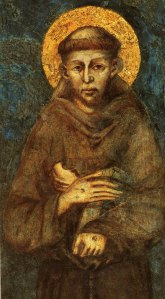 Happy Feast Day to all Franciscans and those Franciscan at heart!
