 Things That Scandalize
1 He said to his disciples, “Things that cause sin will inevitably occur, but woe to the person through whom they occur. 2 It would be better for him if a millstone were put around his neck and he be thrown into the sea than for him to cause one of these little ones to sin.
These two sayings are connected by the words skandala (v. 1) and skandalizo (v. 2). The original meaning of this word group skandal- was “trap;” or, more specifically a trap’s tripping mechanism. The word group is sued to translate the Hebrew próskomma, meaning both “trap” and “stumbling block” or, “cause of ruin.” In the latter sense, this transferred to the religious setting to mean “cause of sin.” But is “cause of sin” the best translation here? Paul says that “Christ crucified is a stumbling block (skándalon) to the Jews (1 Cor 1:23) and describes the cross as a stumbling block (skándalon) (Galatians 5:11). Consider three other modern gospel translations, all noted for faithful adherence to translation.
1“Occasions for stumbling are bound to come, but woe to anyone by whom they come! 2 It would be better for you if a millstone were hung around your neck and you were thrown into the sea than for you to cause one of these little ones to stumble.” (NRSV)
1“It is inevitable that stumbling blocks come, but woe to him through whom they come! 2 “It would be better for him if a millstone were hung around his neck and he were thrown into the sea, than that he would cause one of these little ones to stumble.” (NASB)
“Temptations to sin are sure to come, but woe to the one through whom they come! 2 It would be better for him if a millstone were hung around his neck and he were cast into the sea than that he should cause one of these little ones to sin.” (ESV)
Either “stumble” or “cause to sin” are valid translations. I would suggest “stumble” given the context of these verses following Jesus’ warnings (direct and via parable) against injustice, indifference, and a lack of hospitality towards those in need – “the little ones,” e.g., Lazarus (16:19-31), the prodigal son (15:11-32), and the poor, crippled, blind and lame (14:12-14). All of these demonstrated behaviors are hostile and in opposition to the Reign of God where the invitation is for all. To set up barriers that keep some outside the kingdom is to become a stumbling block of witness for all – especially those who would be found and restored to the community (cf. Luke 15:1-10, the parables of the lost and found).
With the graphic image of the millstone (see note below), Jesus says it would be better to drown than to become the barrier to another’s repentance and restoration. The watery death is a echo of the fate that befell the rich man (16:24-28) who suffered eternal, fiery torment.
Notes
Luke 17:1 Things that cause sin: skandala, a cause of offense or stumbling. The word group is sued to translate the Hebrew próskomma, meaning both “trap” and “stumbling block” or, “cause of ruin” either with idols in view or offenses against the law. As a ground of divine punishment skándalon can then denote an occasion of sinning or a temptation to sin. will inevitably occur: Matthew asserts that it is necessary that sin occurs. Luke notes only that sin is impossible to avoid. woe to the person: this is the 11th woe spoken by Jesus in Luke’s gospel, but the first directed towards the disciples.
Luke 17:2 were put around his neck: The Greek phrase, perikeitai peri ton trachêlon, does not refer to tying one end of a rope a person’s neck and the other end of the rope to a large mill grinding stone. Rather it literally means to insert the person’s head into the hole at the center of the stone – some of which were three to four feet in diameter. to cause … to sin: skandalízō. See note on 17:1. Skandalízō is from the same word group
Sources
Gerhard Kittel, Gerhard Friedrich and Geoffrey William Bromiley, Theological Dictionary of the New Testament (Grand Rapids, Mich.: W.B. Eerdmans, 1995, c1985).
- Stahlin, skándalon , 3:339-58
- Stauffer, epitimáō, 2:623-7
- Behm, metanoēsē , 4:948-80
Scripture – Scripture quotes from New American Bible by Confraternity of Christian Doctrine, Inc., Washington, DC. ©


 You have to feel for the disciples. In recent gospels Jesus has been asking some fairly extraordinary things of them – to give away their possessions, to forgive countless times, to take up his cross, and the list goes on. No wonder then, they ask for more faith. They don’t feel up to what is being asked of them, are anxious about the challenges ahead, and just can’t imagine accomplishing what is being asked of them.
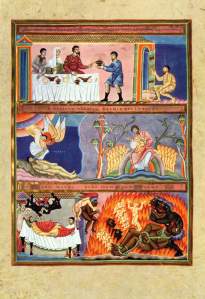 “…between us and you a great chasm is established to prevent anyone from crossing who might wish to go from our side to yours or from your side to ours.…” Such are words spoken about Lazarus and the rich man, traditionally known as Dives. The words describe their fates in the afterlife: Lazarus comforted by Abraham while Dives languishes in a hellish afterlife.
 It’s hard to sustain a regular life of prayer. Why? Why is it so difficult to pray regularly? Some reasons are obvious: over-busyness, tiredness, and too many demands on our time, constant distraction, spiritual laziness, worship services that bore us, and methods of prayer that leave us flat and inattentive.
