Forming the Church

This coming Sunday the Church celebrates the Solemnity of Saints Peter and Paul. Our reading is located in a section of Matthean narrative that portrays the formation of the church (13:53-17:27) in the midst of the continuing conflict with all levels of Jewish society that is leaning towards a growing rejection of Jesus as Messiah. This story forms the hinge of the section because after this Jesus will heighten his attention to the preparation of the disciples for their mission as a community once Jesus has died and resurrected from the dead.  It will be a community who perceives and professes his true identity.

Crossing Over: A new theme emerges

A theme that began with Jesus’ encounter with the Canaanite woman (15:21-28) continues with the geographical setting of the story: the region of Caesarea Philippi. Early in its history this location had been the setting of Canaanite worship to Ba’al and later a Greek temple to the god Pan (hence the name Paneas). Eventually it simply became a center of secular power under the Roman regency of Herod the Great and his son Phillip who renamed it after Tiberius Caesar and himself: Caesarea Philippi.  Is the mention of the location just a geographical touch of narrative – Luke, the “geographer” of the gospel writers, does not mention the name – so one wonders why Matthew includes it.  It is not clear, but perhaps Matthew wanted to emphasize that this significant scene took place in a setting with significant religious and secular meanings and associations.  By doing so, Matthew crosses over to confront the pantheon of gods and the power of Caesar, with the true King of Kings and Lord of Lords.

But at the same time, this scene does not really cross over into new “territory” as regards Jesus’ divine identity.  While this parallel scene in Mark is the first time Jesus’ divine identity is proclaimed by others and worship (homage) takes place, that is not true in Matthew.  Jesus’ true identity is not really new to the disciples who have heard Jesus refer to himself in christological terms, have understood it, and worshiped him as the Son of God (14:33).  The breakthrough is not christological. Matthew is crossing over to begin to explicate the ecclesiological (“being church”) dimensions of the profession and worship.  It is from here that there is a separation of the new community of believers in the Kingdom of Heaven from those who oppose and reject it.


Image Credit: Pietro Perugino, The Delivery of the Keys (c 1481–1482). Sistine Chapel, Vatican City | Public Domain

The Solemnity Gospel

13 When Jesus went into the region of Caesarea Philippi he asked his disciples, “Who do people say that the Son of Man is?”14 They replied, “Some say John the Baptist, others Elijah, still others Jeremiah or one of the prophets.”15 He said to them, “But who do you say that I am?”16 Simon Peter said in reply, “You are the Messiah, the Son of the living God.”17 Jesus said to him in reply, “Blessed are you, Simon son of Jonah. For flesh and blood has not revealed this to you, but my heavenly Father.18 And so I say to you, you are Peter, and upon this rock I will build my church, and the gates of the netherworld shall not prevail against it.19 I will give you the keys to the kingdom of heaven.  Whatever you bind on earth shall be bound in heaven; and whatever you loose on earth shall be loosed in heaven.”  (Matthew 16:13-19)

The three questions

This coming Sunday the Church celebrates the Solemnity of Saints Peter and Paul. The Gospel passage is taken from Matthew and is the scene in which Jesus gives Simon a new name, Peter, and says that He will give him the keys to the kingdom of heaven. It is a passage that well fits the  Matthean narrative devoted to the tripartite question: (a) who is Jesus, (b) what does it mean to be his disciples in the light of his identity, and (c) what choices will you make because of his call.  In the flow of the gospel our pericope is preceded by Peter walking upon the waters (Mt 14:22-33) and the encounter with the Canaanite woman (15:21-28) – and both episodes move Jesus to comment upon the faith of the disciple. These stories serve as the immediate context for our gospel about Peter’s confession and what it will mean for him in his on-going role of discipleship.

Continue reading

Saints Together

This coming Sunday is the Solemnity of Saints Peter and Paul. Most of the apostles and lots of saints have their own feast day, but how about the two most famous saints of the early church? There is February 22nd in which the Church celebrates the “Chair of Peter” the sign that Peter was the first among the apostles and the one designated to lead the early Church after Jesus’ Resurrection and Ascension. But there is no “Feast of St. Peter.”

St. Paul, although not one of the Twelve, was an Apostle commissioned by Jesus. There is the January 25th celebration of “The Conversion of St. Paul” which commemorates the Damascus Road episode described in Acts of the Apostles: 9:1-31, 22:1-22, and 26:9-24. It is the scene made famous by the “Conversion on the Way to Damascus” painting by Caravaggio. But there is no “Feast of St. Paul.”

The two leading saints of the early Church are celebrated together in the Feast of Saints Peter and Paul as they are the founders of the See of Rome, through their preaching, ministry and martyrdom there. This celebration is a liturgical feast in honor of the martyrdom in Rome of the apostles Saint Peter and Saint Paul and is observed on June 29th – without declaring that to be the day of their deaths. St. Augustine of Hippo (late 4th century) says in his Sermon 295: “One day is assigned for the celebration of the martyrdom of the two apostles. But those two were one. Although their martyrdom occurred on different days, they were one.” Thus it is clear that the celebration is of ancient origin.

Continue reading

The Passing of Pope Francis

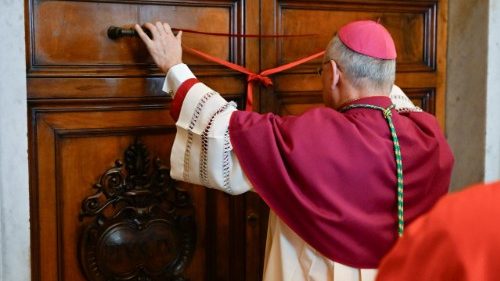
The rite confirming the death and the placement of Pope Francis’s body in the coffin took place on the evening of Monday 21 April in the ground-floor chapel of the Casa Santa Marta. The official declaration of death was read aloud. The act was validated by Cardinal Kevin Farrell, Camerlengo of the Holy Roman Church. The ceremony lasted just under an hour. Seals were also placed on the papal apartment on the third floor of the Apostolic Palace and on the apartment on the second floor of Casa Santa Marta, where the Pope had resided.

The Holy See Press Office announced on today that Pope Francis’ funeral Mass will take place on Saturday, April 26, 2025, at 10:00 AM in St. Peter’s Square. Cardinal Giovanni Battista Re, Dean of the College of Cardinals, will preside at the Mass, which will be concelebrated by Patriarchs, Cardinals, Archbishops, Bishops, and priests from across the globe. The Eucharistic celebration will conclude with the Ultima commendatio and the Valedictio, marking the beginning of the Novemdiales, or nine days of mourning and Masses for the repose of Pope Francis’ soul. The late Pope’s body will then be taken into St. Peter’s Basilica and then to the Basilica of St. Mary Major for entombment.


Image credit: Vatican News

We mourn his passing

This was the pontiff who took the name “Francis” in homage to Catholicism’s most iconic and beloved saint, the “little poor man” of Assisi; the pope who rejected the marble and gold of the Papal Apartments in favor of the Domus Santa Marta, a modest hotel on Vatican grounds; the pope who returned to the clerical residence where he’d stayed prior to his election to pack his own bag and to pay his own bill. His pontificate that followed was consistent to its start.

May his soul and all the souls of the faithful rest in peace.

Descent from the Cross

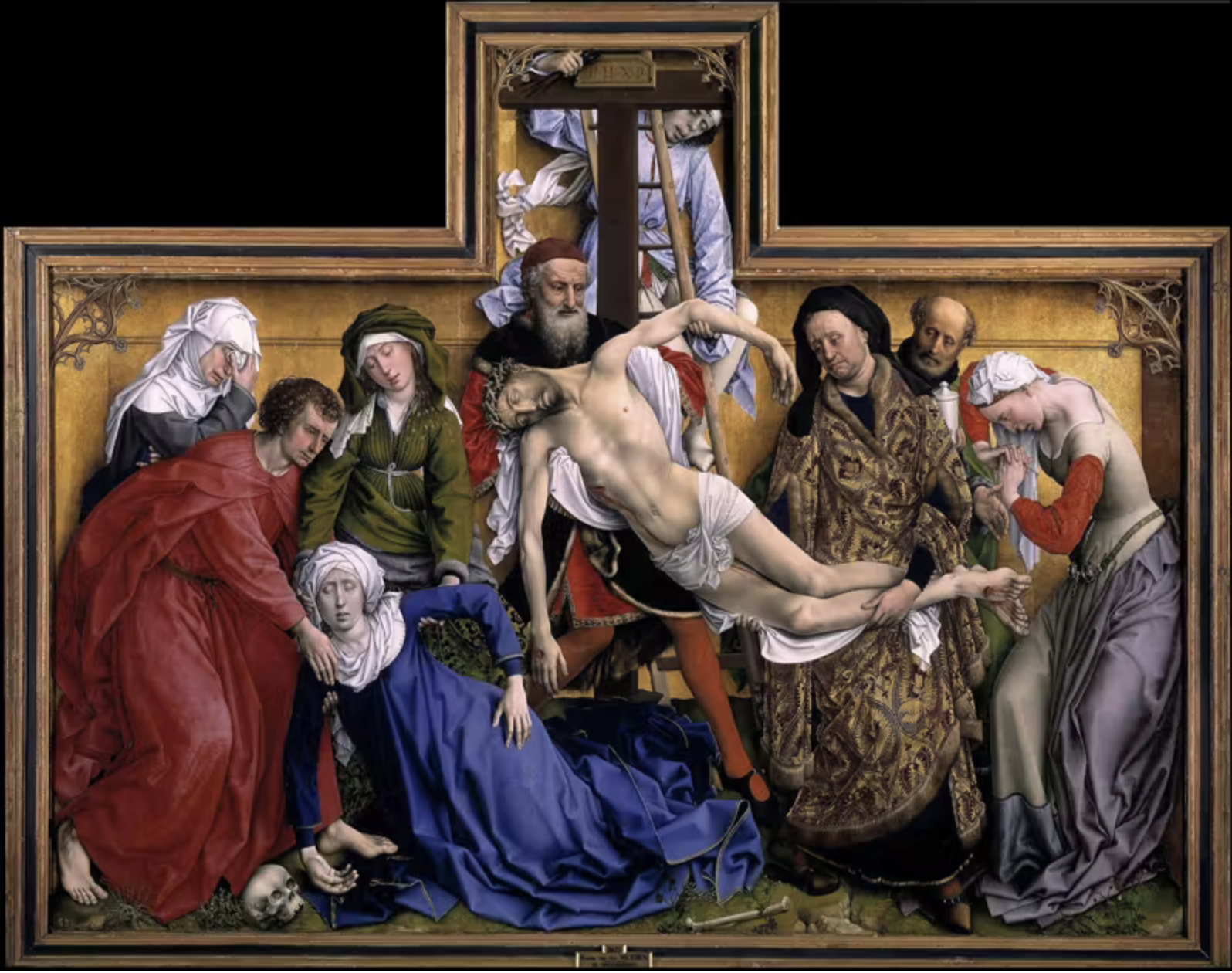
Museum of the Bible in Washington DC has a beautiful exhibition, Descent from the Cross. This exhibition explores how 21 artists across five centuries, multiple genres, and mixed media have visualized the scene in The Gospel of John, chapter 19, the moment Jesus is removed from the cross. This moment, traditionally called “Deposition” or “Descent from the Cross,” is not described in the Bible. There are no details explaining the process or who was present. Because of this, artists across the centuries have interpreted this emotional moment in unique and varying ways, each filling in the blanks with what they think might have happened. It has become a popular scene in art history, and thus a part of our shared visual language.

The earliest-known renderings of the scene appeared in the ninth century and soon became part of a cycle through the life of Christ and his passion, later known as the Stations of the Cross. But perhaps the most influential depiction was painted by Flemish master painter Rogier van der Weyden in 1435. The unique shape of the composition and the cramped “box” that the characters occupy create a theatrical look, like that of a stage play or a diorama. The sharp angles and rich details reflect the late Gothic, early Renaissance styles of northern Europe, and the crossbows seen in the corners honor the patron of this piece, the Leuven Guild of Archers.

Museum of the Bible

You can see the exhibit virtually at the Museum’s website by clicking the button below.


Image credit: Descent from the Cross | Rogier van der Weyden, ca. 1435 | Museo del Prado, Madrid | PD-US

Guadalupe and Linguistics

Our Lady of Guadalupe.

Today it is common to find villages, towns, cities, and even districts in Mexico, Central and South America named “Guadalupe.”  But in the year 1531 there was no such place in Mexico. So, I have always wondered why the appearance of the Blessed Virgin Mary is referred to as “Our Lady of Guadalupe.” It is an interesting story of linguistic misunderstanding.

Guadalupe is the name of an area, a city, a river, and a Marian shrine in Spain. The word itself comes from a mixture of  Arabic and Latin roots. Remember that Spain was occupied in part and whole by an Islamic regime from 720 CE until 1492 CE, hence many words have Arabic origin. The Arabic wadi (seasonal river bed) became the Spanish “quadi” having the same meaning. “Quadi” seems to have been combined with the Latin lupus (wolf) to come up with Guadalupe.

Continue reading

A History: The Immaculate Conception

The Immaculate Conception of the Venerable One...It’s important to understand what the doctrine of the Immaculate Conception is and what it is not. Some people think the term refers to Christ’s conception in Mary’s womb without the intervention of a human father; but that is the Virgin Birth. Others think the Immaculate Conception means Mary was conceived “by the power of the Holy Spirit,” in the way Jesus was, but that, too, is incorrect. The Immaculate Conception means that Mary, whose conception was brought about the normal way, was conceived without original sin or its stain—that’s what “immaculate” means: without stain. The essence of original sin consists in the deprivation of sanctifying grace, and its stain is a corrupt nature. Mary was preserved from these defects by God’s grace; from the first instant of her existence she was in the state of sanctifying grace and was free from the corrupt nature original sin brings. Continue reading

The Season of Advent

Advent is the liturgical season that precedes and prepares for Christmas. It is a season of hope and of longing, of joyful expectation and of peaceful preparation. Many symbols and traditions are associated with Advent, especially the Advent Wreath with its four colored candles (three purple and one pink), but also Advent calendars, special Advent music, food, processions, and other traditions that may vary from one culture or region to the next. Here are a few interesting things to know about Advent: Continue reading