This was the pontiff who took the name “Francis” in homage to Catholicism’s most iconic and beloved saint, the “little poor man” of Assisi; the pope who rejected the marble and gold of the Papal Apartments in favor of the Domus Santa Marta, a modest hotel on Vatican grounds; the pope who returned to the clerical residence where he’d stayed prior to his election to pack his own bag and to pay his own bill. His pontificate that followed was consistent to its start.
May his soul and all the souls of the faithful rest in peace.
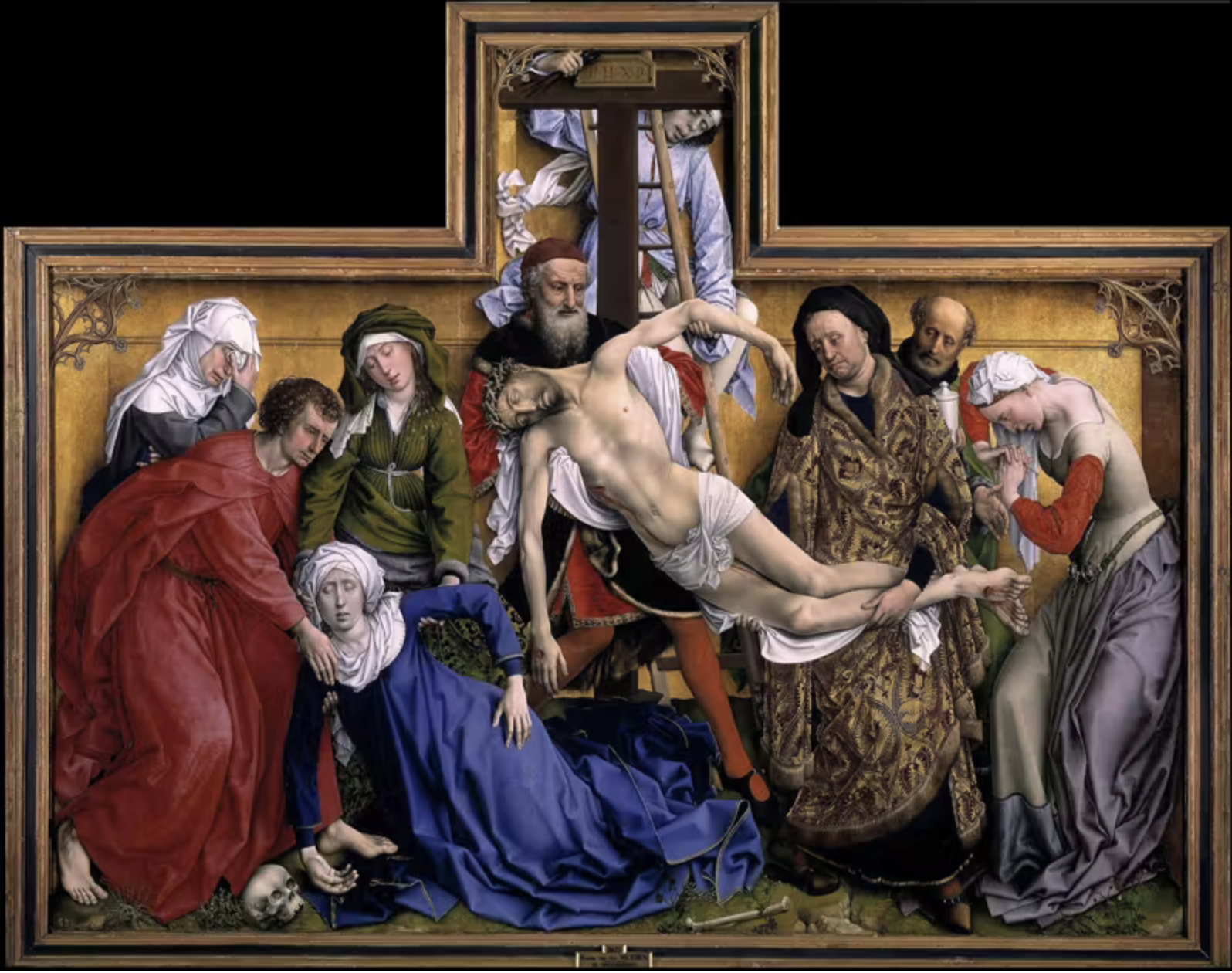
Museum of the Bible in Washington DC has a beautiful exhibition, Descent from the Cross. This exhibition explores how 21 artists across five centuries, multiple genres, and mixed media have visualized the scene in The Gospel of John, chapter 19, the moment Jesus is removed from the cross. This moment, traditionally called “Deposition” or “Descent from the Cross,” is not described in the Bible. There are no details explaining the process or who was present. Because of this, artists across the centuries have interpreted this emotional moment in unique and varying ways, each filling in the blanks with what they think might have happened. It has become a popular scene in art history, and thus a part of our shared visual language.
The earliest-known renderings of the scene appeared in the ninth century and soon became part of a cycle through the life of Christ and his passion, later known as the Stations of the Cross. But perhaps the most influential depiction was painted by Flemish master painter Rogier van der Weyden in 1435. The unique shape of the composition and the cramped “box” that the characters occupy create a theatrical look, like that of a stage play or a diorama. The sharp angles and rich details reflect the late Gothic, early Renaissance styles of northern Europe, and the crossbows seen in the corners honor the patron of this piece, the Leuven Guild of Archers.
Museum of the Bible
You can see the exhibit virtually at the Museum’s website by clicking the button below.
Today it is common to find villages, towns, cities, and even districts in Mexico, Central and South America named “Guadalupe.” But in the year 1531 there was no such place in Mexico. So, I have always wondered why the appearance of the Blessed Virgin Mary is referred to as “Our Lady of Guadalupe.” It is an interesting story of linguistic misunderstanding.
Guadalupe is the name of an area, a city, a river, and a Marian shrine in Spain. The word itself comes from a mixture of Arabic and Latin roots. Remember that Spain was occupied in part and whole by an Islamic regime from 720 CE until 1492 CE, hence many words have Arabic origin. The Arabic wadi (seasonal river bed) became the Spanish “quadi” having the same meaning. “Quadi” seems to have been combined with the Latin lupus (wolf) to come up with Guadalupe.
It’s important to understand what the doctrine of the Immaculate Conception is and what it is not. Some people think the term refers to Christ’s conception in Mary’s womb without the intervention of a human father; but that is the Virgin Birth. Others think the Immaculate Conception means Mary was conceived “by the power of the Holy Spirit,” in the way Jesus was, but that, too, is incorrect. The Immaculate Conception means that Mary, whose conception was brought about the normal way, was conceived without original sin or its stain—that’s what “immaculate” means: without stain. The essence of original sin consists in the deprivation of sanctifying grace, and its stain is a corrupt nature. Mary was preserved from these defects by God’s grace; from the first instant of her existence she was in the state of sanctifying grace and was free from the corrupt nature original sin brings. Continue reading →
Advent is the liturgical season that precedes and prepares for Christmas. It is a season of hope and of longing, of joyful expectation and of peaceful preparation. Many symbols and traditions are associated with Advent, especially the Advent Wreath with its four colored candles (three purple and one pink), but also Advent calendars, special Advent music, food, processions, and other traditions that may vary from one culture or region to the next. Here are a few interesting things to know about Advent: Continue reading →
Today is the Memorial of the Holy Guardian Angels. You can find the readings for the memorial celebration here. I thought it would be interesting, instructional and fun to use Catholic.Chat to see what the Catechism of the Catholic Church (CCC) provides about guardian angels. The CCC emphasized their role as protectors and guides for individuals. According to the teachings found in the Catechism, guardian angels are personal, spiritual beings assigned by God to watch over and assist each person throughout their life. Continue reading →
The expression “sensus fidelium” means the sense of the faithful. It played a large role in the dogmatic statement of the Immaculate Conception.
It’s important to understand what the doctrine of the Immaculate Conception is and what it is not. Some people think the term refers to Christ’s conception in Mary’s womb without the intervention of a human father; but that is the Virgin Birth. Others think the Immaculate Conception means Mary was conceived “by the power of the Holy Spirit,” in the way Jesus was, but that, too, is incorrect. The Immaculate Conception means that Mary, whose conception was brought about the normal way, was conceived without original sin or its stain—that’s what “immaculate” means: without stain. The essence of original sin consists in the deprivation of sanctifying grace, and its stain is a corrupt nature. Mary was preserved from these defects by God’s grace; from the first instant of her existence she was in the state of sanctifying grace and was free from the corrupt nature original sin brings. Continue reading →
There are posts that I publish which “upsets the apple cart” so to speak. For example, a post where I show that St. Francis did not write the “Peace Prayer of St. Francis” or dispute various quotes attributed to St. Francis but words he never said. This might be one of those posts. Continue reading →