Franciscans Fast for Families

Fast4FamiliesOn December 3rd, join with Franciscans and Franciscan-hearted people in solidarity fast. The fast is a response to our immigration system that, all too often, instills fear, excludes, and tears apart immigrant families. Reform is needed. As we wait in anticipation during Advent for the freedom and redemption begun in the Christ child, so too do our immigrant sisters, brothers, and families wait for freedom and redemption of broken immigration laws.

The fast is both a prayer and a collective, moral call summoning our elected officials to do what is right and just vis-à-vis our immigrant brothers and sisters. Continue reading

Franciscans in China

Ideograms for Rabban Bar Sauma

Servant of God – John of Montecorvino
Franciscan and first Bishop of Beijing

In today’s Twitter feed came the tweet that today is a day in which we Franciscans remember John of Montecorvino. To which most people – even most Franciscans – will say “who?” Brother John was the first Catholic missionary to China, centuries before the efforts of other Catholic religious orders. It is a compelling story.  If you would like to read an interesting and accessible account of the travel within the context of an art historian comparing 13th century Italian and Chinese art, read Lauren Arnold’s: Princely Gifts & Papal Treasures: The Franciscan Mission to China & Its Influence on the Art of the West, 1250-1350 – fascinating book.

Beginning with the pontificate of Innocent IV (1243–1254), the popes and Mongol khans began to communicate and exchange gifts in a diplomatic effort to see if there was a basis upon which to effectively bind and subdue their common enemy, the Muslim Empire.  The two most famous envoys were the Franciscans John of Plano Carpini and William of Rubruck. Their journeys, remarkable and daring, were not specifically missionary but were more as political emissaries. Carpini traveled in the years 1245–1247 while Rubruck’s mission was 1253–1255. Although Rubruck was sent by Louis XI of France to enlist the aid of the khan against Islam, Rubruck also attempted to convert the Mongols (also known as Tartars) by converting the Great Khan.  William’s Itinera is a masterful travel account  that also includes observations about the Saracens and Nestorian Christians found in the Mongol territories. On Pentecost 1255 William met with the Great Khan who received William but nothing more came of the meeting. Continue reading

Admonition Eighteen

Who among us wants to be considered condescending? Merriam-Webster defines “condescending” as showing or characterized by a patronizing or superior attitude toward others. I suspect no one is soon volunteering.  In the Franciscan tradition it is a good thing to be condescending or at least condescendere.  St. Bonaventure wrote about the condescendere of God in the Incarnation of Jesus who “stepped down” from his divinity, took on our humanity, took off his cloak and put on a servant’s apron and washed our feet.  It is from that “condescending” position we are called to reach up to our neighbors and serve them.  Such is the posture of compassion.

Admonition Eighteen: Compassion for a Neighbor

1 Blessed in the person who supports his neighbor in his weakness as he would want to be supported were he in a similar situation.

2 Blessed is the servant who returns every good to the Lord God because whoever holds onto something for himself hides the money of his Lord God within himself, and what things he has will be taken away from him.

The Stories That Will Be Told

Detail: left side

You know many of us here at this morning Mass can answer the question: “Where were you when you heard the news that President Kennedy had been shot.”  We are in the minority. Most folks here in the United States were not yet born on that fateful day 50 years ago.  But we tell the stories of our young war hero president, of his family, of Camelot, and all that made up the Kennedy legend.  And we tell the generations that follow.

Today we tell the story of the martyr St. Cecilia. We do not know much about here other than she lived in the 3rd century and died for the faith. We tell the generations that come after us what we know. We tell them she is the patron saint of musicians. Continue reading

Why the Incarnation?

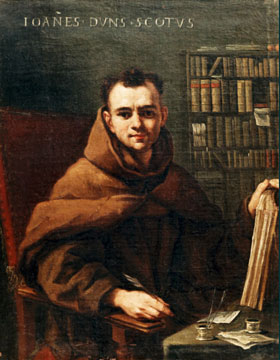
Duns Scotus1On November 8th the Church and the Franciscan world celebrates the feast of Blessed John Duns Scotus, a friar and medieval theologian/philosopher.  Not a household name, Scotus is best known for his philosophical writings, but it is his theological perspective that has left the most impact.  His theological writings on Mary form the basis for how we understand the Feast of the Immaculate Conception and his writings on the preeminence of Christ are the basis for the celebration of the Solemnity of Christ the King.

But it is also his reflection on the primacy of Christ that led to his asking about the Incarnation, or more specifically, why did the Word of God, the second Person of the Holy Trinity, become flesh.  “In the beginning was the Word, and the Word was with God, and the Word was God… and the Word became flesh and lived among us and we have seen his glory.”  (John 1:1,14)  Certainly those verses and others, e.g. Phil 2:5-7, clearly speak to Jesus taking on our humanity, becoming one with us.  But it doesn’t necessarily answer why. Continue reading

Finding the Lost…and then what?

Zacchaeus in the Sycamore Awaiting the Passage...


Zacchaeus was the chief tax collector and a wealthy man. In his day and age these were not things that would endear him to his fellow Jews. Zacchaeus worked for the occupying Roman government, extorted taxes and fees from his own countrymen, and became wealthy in the process.  He was not part of the Roman world. He was not part of the Jewish world. He is betwixt and between. He is lost


For the Son of Man has come to seek and to save what was lost.”  The story of Jesus and Zacchaeus is a story of the seeker encountering the lost. And in that encounter, what was lost is found.  A heart was changed. The one whose choices in life led to exclusion from his people and family seems to have made an abrupt about-face.  Choices were being unmade and consequences of choices were bring undone. Continue reading

“The” Faith

I am partial to the Gospel according to Luke. I think his writing is good at telling the story and leaving room for the hearer to work though the implications of it all.  Some of the most memorable parables – the Good Samaritan, the Prodigal Son, Lazarus and the Rich Man, and more are all unique to Luke’s gospel. Also, Luke is particular about his choice of words and phrases – the small nuances of language find their place in his telling of Jesus’ story.

Today we have one of those small curiosities of language: But when the Son of Man comes, will he find faith on earth? (Luke 18:8).  What the Greek actually says is not “find faith” but “find the faith.” It is the only place in all of Luke’s gospel he uses this phrase.  In fact it is the only place in all the New Testament. Maybe it’s nothing, but then again, as he often does, maybe Luke is trying to tell us something in this small parable of the persistent widow and the unjust judge. Continue reading

The Persisten Widow – the Judge

Unjust JudgeMore literal translation: There was a certain judge in a certain town. Echo of previous passages – a certain rich man who experienced an abundant harvest or a certain rich man (fool) who lived in purple garments and fine linens but never gave heed to poor Lazarus.  This judge is likely a local magistrate yet of notable status within the community. Despite his exterior bearing Jesus characterizes him as someone who neither feared God nor respected any human being (v.2).  Continue reading

Darkness, Candles, and Things Unsaid

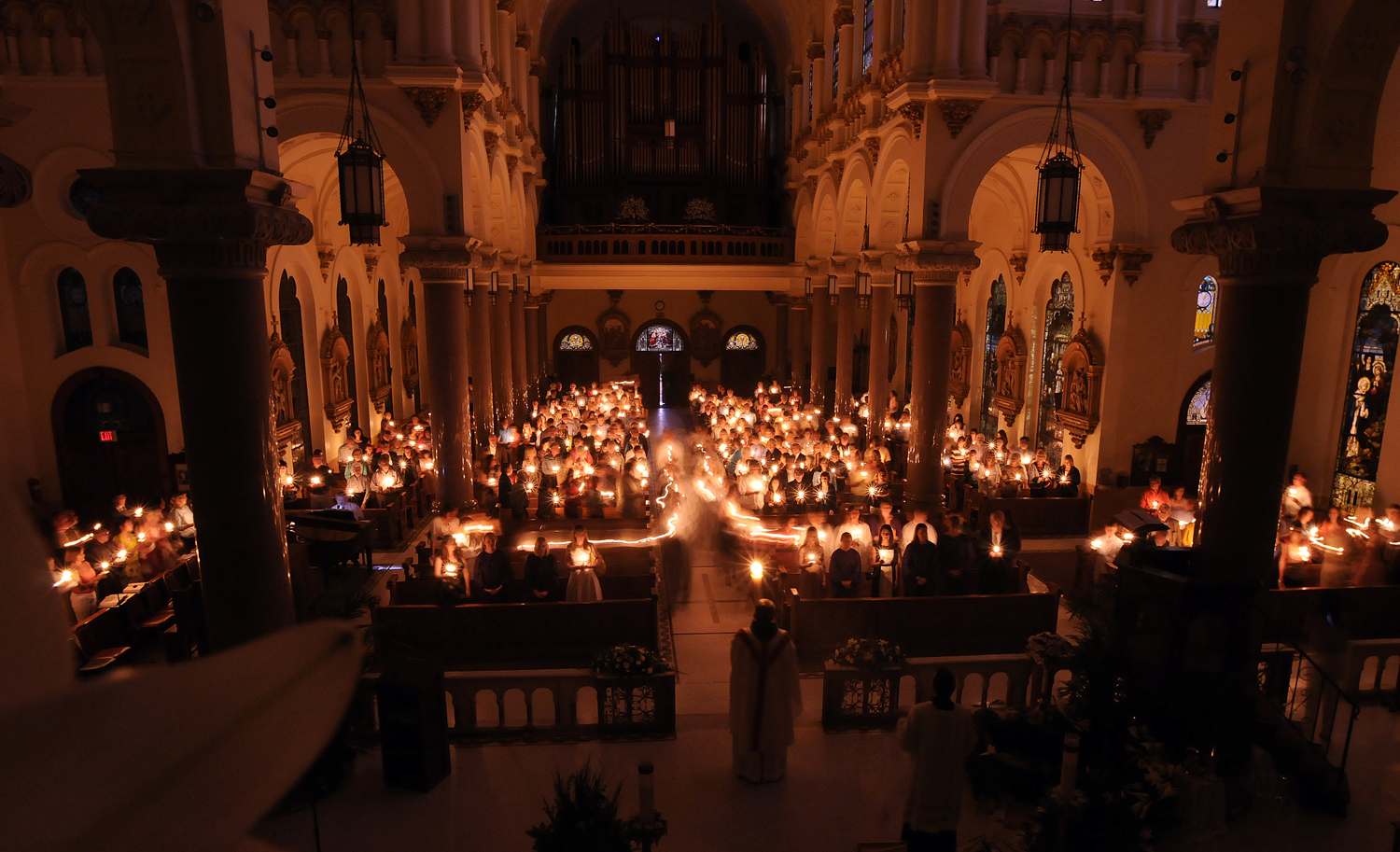
Easter Vigil at Sacred HeartI am always amazed at the sayings that are attributed to St. Francis of Assisi.  Today, I was asked if the following saying was from Francis: “All the darkness in the world cannot extinguish the light of a single candle.”  Nice, but at first blush it does not possess the language or sense of language for which Francis is known. The language is not even particularly medieval, but then maybe this is just a modernized version of the saint’s words.

If you search the internet, you will find this “quote” has pretty wide distribution and uniform attributed to St. Francis.  Most have no citation; but some do.  The only source given was “The Little Flowers of St. Francis.”  You can find the Little Flowers in volume 3 (pp. 566-658) of Francis of Assisi: Early Documents  –  Armstrong, Regis, J.A. Wayne Hellmann, and William Short, eds. (New York: New City Press, 1999–2004).

What you can’t find is the quote, or an account for which the quote could be a reduction. I could be wrong.  If someone has the specific citation (text and chapter) that would be an interesting thing to know.   I know I should just let these things go, but…. let the saint speak for himself … I’m just saying.

Boundaries, Faith, and Gratitude – Boundaries

all-kinds-doorsThey stood at a distance from him 13 and raised their voice, saying, “Jesus, Master! Have pity on us!” 14 And when he saw them, he said, “Go show yourselves to the priests.” As they were going they were cleansed. 15 And one of them, realizing he had been healed, returned, glorifying God in a loud voice; 16 and he fell at the feet of Jesus and thanked him. He was a Samaritan. 17 Jesus said in reply, “Ten were cleansed, were they not? Where are the other nine? 18 Has none but this foreigner returned to give thanks to God?”

The telling of this encounter seems straight forward: (a) Jesus encounters a group of lepers on the road to Jerusalem, (b) they ask for his mercy,  (c) they are cured, but (d) only one returns to thank Jesus and that one is a Samaritan. A simple miracle story, yes? A narrative about faith as the foundation of healing? Such simple summaries, even if true, miss several key aspects of the encounter and the chance to reflect further on our own life of faith in Jesus. Continue reading