
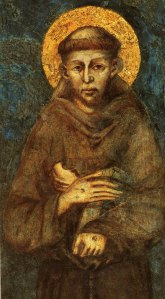
 As we noted in last week’s article, Francis expected his brothers to learn by imitation – and to understand that as Francis sought to imitate Christ, so too should the brothers. But in reality, the first generation of Assisi-area brothers simply did what Francis did: daily prayer, work at a local leprosarium, go to local churches to participate in Eucharist, eat, pray again, witness to the local Umbrian people near Assisi, and live a life in community. You have to remember this was all new. Prior to this “Franciscan moment” the spiritual journey of medieval people consisted of being a monk or cloistered nun behind the walls of the monastery, being a priest and living close to the sacraments and the Scriptures, or being a lay person and hoping the other groups were praying for you. And then along comes this different, new, intriguing way of being spiritual in the world. And it was not set down in writing; it did not come with instructions. But sometimes is borrowed from the past. Continue reading
Itinerancy
Reply
 The small band of brothers living at Rivo Torto and later at the Porziuncula, were drawing others to their way of following Christ in the world. And if they expected to find a uniform dress code, posted rules, a great deal of organization, a formation program, or even someone to sit them down and explain what was expected – they were in for a surprise. Francis assumed that his followers would learn by imitation. Giving them rules or structures to follow was not merely difficult for him, it went against the grain of the meaning of minority – to be the lesser brother. The new arrivals simply did what Francis did: daily prayer, work at a local leprosarium, go to local churches to participate in Eucharist, eat, pray again, witness to the local Umbrian people near Assisi, and live a life in community. The brothers had to watch Francis closely and do their best to understand.
  One aspect of Francis’ changing life that has attracted recent attention is the movement of Francis from solitary figure, living a quasi-hermetical life for four to five years, now beginning to live in a growing community of brothers – all of whom are looking to Francis for spiritual and communal leadership. There was something attractive about Francis, his way of following the gospel, and perhaps the recent “commissioning” by Pope Innocent III gave a certain cache of legitimacy to this way of being Christian in the world. Eventually many people came to join the Franciscan movement, which soon enough became a religio and eventually an ordo, but those demarcations are eight to ten years in the future ahead of the Spring of 1209.
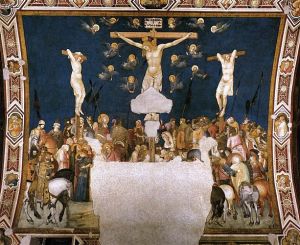 One of the famous pieces of Franciscan art can be found in the left transept of the Lower Church of San Francesco in Assisi. It is a fresco done by Pietro Lorenzetti and is one of 17 frescoes he created in the church. This fresco is located lower on the transept wall under Lorenzetti’s masterpiece, The Crucifixion. The fresco is known as Our Lady of the Sunsets.
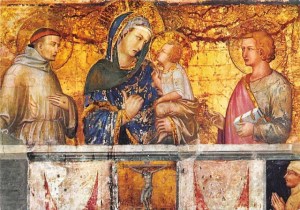 In the scene the Virgin Marry is holding the Child Jesus. The other two figures in the fresco are St. John the Evangelist (right) and St. Francis of Assisi (left), both of whom are looking at what is unfolding in the center of the scene. There Mary and Jesus are focused on each other, and Mary has a unique gesture, holding her thumb up pointing back to Saint Francis.
 I have written about calumny as sin, which it is indeed as noted in the Catechism of the Catholic Church. There are times I wonder if a “lack of curiosity” is very distant cousin. This would be a place for a “wink” emoji, but I will easily resist such temptations.
 Several days ago I posted about the
