

St. Clare of Assisi
In the last several articles we have described the brothers who gathered around Francis and committed themselves to his way of following Christ. Two of the earliest arrivals were Leo and Rufino. The first became Francis’ chaplain and confessor, as Leo was an ordained priest already. Rufino, a lifelong confidant and wisdom figure for Francis, was also the first cousin of an aristocratic woman of Assisi, the niece of Monaldo, lord of Coriano. Clare di Favarone di Offredicio was a woman from the very class of landed aristocrats that the young Francis had imitated and longed to join socially. Continue reading

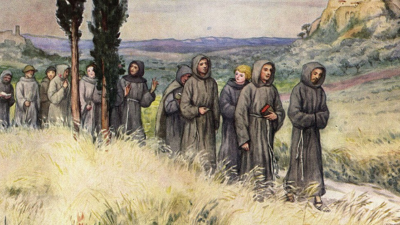
 The small band of brothers living at Rivo Torto and later at the Porziuncula, were drawing others to their way of following Christ in the world. And if they expected to find a uniform dress code, posted rules, a great deal of organization, a formation program, or even someone to sit them down and explain what was expected – they were in for a surprise. Francis assumed that his followers would learn by imitation. Giving them rules or structures to follow was not merely difficult for him, it went against the grain of the meaning of minority – to be the lesser brother. The new arrivals simply did what Francis did: daily prayer, work at a local leprosarium, go to local churches to participate in Eucharist, eat, pray again, witness to the local Umbrian people near Assisi, and live a life in community. The brothers had to watch Francis closely and do their best to understand.
 One aspect of Francis’ changing life that has attracted recent attention is the movement of Francis from solitary figure, living a quasi-hermetical life for four to five years, now beginning to live in a growing community of brothers – all of whom are looking to Francis for spiritual and communal leadership. There was something attractive about Francis, his way of following the gospel, and perhaps the recent “commissioning” by Pope Innocent III gave a certain cache of legitimacy to this way of being Christian in the world. Eventually many people came to join the Franciscan movement, which soon enough became a religio and eventually an ordo, but those demarcations are eight to ten years in the future ahead of the Spring of 1209.
 It is later in the autumn of 1206 that with his decision to “leave the world” Francis began to be aware of the powerful Divine Presence in his life through, his work among the lepers near Assisi, and his habit of taking refuge in churches for prayer and rebuilding the structures. At San Damiano he encountered the consoling presence of the Savior who had suffered and died for him. It was a presence he soon came to recognize in other church: “And the Lord granted me such faith in churches that I would pray simply and say: We adore you, Lord Jesus Christ, in all you churches throughout the world, and we bless you, because by your Holy Cross, you have redeemed the world.” (Testament 4-7). Francis was at the beginnings of an inner peace.

