
Bitcoin and Care for Creation

Bitcoin Circuit BoardMany Catholics are aware of Pope Francis’ encyclical Laudato Si (Praise Be to You) which carries the subtitle “on care for our common home.”  In this encyclical and in other documents the Pope critiques capitalism, not as an economic theory in itself, but in its divorce from the human condition and Creation. In Laudato Si’, Pope Francis wrote: “The economy accepts every advance in technology with a view to profit, without concern for its potentially negative impact on human beings. Finance overwhelms the real economy…Some circles maintain that current economics and technology will solve all environmental problems.” (#109). Continue reading →

A place at the Table

SaintGregorytheGreatToday is the memorial of St. Gregory the Great. The gospel reading, particular to the memorial is Luke 22:24-30 which recounts when “argument broke out among the Apostles about which of them should be regarded as the greatest.” It is an ironic selection for a man who never wanted the Chair of Peter as it disturbed his life of prayer in the monastery – and yet when called, he knew to his call and roll was to serve. Continue reading →

Prayer and memory

sermon-on-the-mountJesus said to his disciples: “In praying, do not babble like the pagans, who think that they will be heard because of their many words. Do not be like them. Your Father knows what you need before you ask him” (Mark 6:7-8) This is the verse that comes just before the Markan version of the Lord’s Prayer/Our Father. Depending o the translation one is viewing you will read references to “babbling” in prayer, vain repetitions, empty phrases, needless words – all referring to the pattern of prayer used by the pagans of Jesus’ time. Continue reading →
Inside the camp

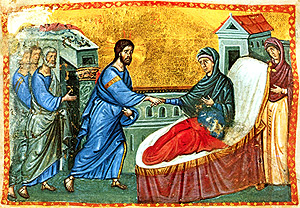
Today’s gospel is one that always needs 1st century context as we read, “After Jesus left the synagogue, he entered the house of Simon. Simon’s mother-in-law was afflicted with a severe fever, and they interceded with him about her. He stood over her, rebuked the fever, and it left her. She got up immediately and waited on them” (Luke 4:3-39)

Over the years, in more than one Bible Study, a participant has commented, “Really, healing the woman just so she can get up and serve a bunch of men.”

Continue reading →

Free from burden

How2ReadBibleIn yesterday’s homily, I noted that God’s Word is always related to human need. If a person is dying of cancer, the gospel is God’s strong word of resurrection. If a person is permeated with guilt, the gospel is God’s assurance of forgiveness. If people experience extreme suffering, God’s word is our refuge and strength.

If a person is under the power of the devil, to that one has come the proclamation of  liberty to captives, the recovery of sight to the blind, and letting the oppressed or possessed go free. In this day’s gospel, we are presented by what we understand as a classic exorcism, a quite dramatic expulsion of a demon from a person. The stuff of movies, Hollywood, but sadly also real life. But if this is just a narrative of particularly dramatic demonstration of the power of the Word, then how is it related to your human need? Your need on this day? Continue reading →

Human Need

JesusIconNazarethOn January 1st 1863 the Emancipation Proclamation was issued in the midst of the Civil War. Slaves who lived within the borders of the Confederacy remained in bondage. Most never heard about the proclamation until the last days of the conflict; some only heard well after the war’s end – the basis of Juneteenth Celebration when freedom from slavery was proclaimed to the people of Galveston months after Lee’s surrender at Appomattox Courthouse. Continue reading →

What is unclean

JesusHealstheDeafMuteThis coming Sunday, the 23rd Sunday of Ordinary Time in Year B, we will hear the Gospel of Mark 7:31-37 proclaimed. It is an encounter with “a deaf man who had a speech impediment.” This section of the Gospel of Mark is book-ended by two stories of a miraculous feeding of the crowds (6:34-44 and 8:1-10) – and so when Jesus heals the man, it seems a rather tame and minor miracles by comparison. Continue reading →
Changing language

linguisticsI appreciate the good turn of a phrase, expressions of speech local to a region of the country, knowing the etymological origin of words, and many other things about language and dialogue. And if one lives long enough, one becomes witness to the changes that are ever ongoing. Lexicographers document our changing use of words even as the take on the exact opposite meanings over time – for example, the word “peruse.” Linguists study the domains  of phonology, morphology, and syntax, often complemented by phonetics, semantics, and pragmatics. Grammarians study the structural constraints of  clauses, phrases and words to describe the the ways we use natural language to communication. They helps us recognize the importance of commas – after all there is a difference between “Let’s eat, Grandma” and “Let’s eat Grandma.” Commas save lives. Continue reading →

Francis of Assisi and Prayer

When people think of St. Francis of Assisi and prayer, what most likely comes to mind is “The Peace Prayer of St. Francis,” with the memorable line: “Make me an instrument of peace…” It is a moving and noteworthy prayer, certainly in the Franciscan tradition, perhaps inspired by St. Francis, but it dates to 1912 and was first published as a poem in the French spiritual magazine, La Clochette. Later, during World War I, it appeared on the back of a holy card bearing an image of St. Francis and the association of the two became cemented in our minds. Continue reading →