
 In the well known parable of today’s gospel, the landowner goes out to secure laborers for the harvest. At the end of the day, all laborers are paid the same regardless of the time of day at which their labor began. Some complain that they worked from sunrise, while the ones who only began day’s end are paid the same. This has been a week of teachings on wisdom and riches…. what is today’s lesson?
The Wisdom of Generosity
Reply
 In today’s
  Today’s
  There are a couple of “feeds” that come across my computer, email, mobile, etc. Some are more interesting than others. Some I read “religiously” others I will take a peek if the title is interesting. Some are topically interesting all by themselves. It is an eclectic sets of “feeds.” One came across this morning that my niece Julie would be interested in. She graduated from Georgia Tech in urban planning and did Master’s level work at UNC Chapel Hill. She has continued her career and works out west in urban traffic planning. So, because it is off interest to my niece and my own lifetime experience of interstates/freeways/etc., when “
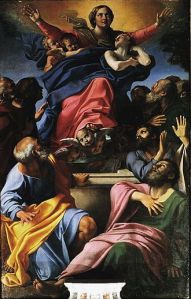 The Assumption was defined as dogma only in the 1950. In our Catholic Church ‘dogma” is defined as a truth revealed by God, which the magisterium of the Church declared as binding upon all Catholics. The term Dogma Catholicum was first used by Vincent of Lérins (450), referring to “what all, everywhere and always believed” – with the emphasis on katholica meaning universal. The term dogma derived from the Greek dogma (δόγμα) meaning literally “that which one thinks is true” and the verb dokein, “to seem good.”
 Each Sunday at Mass, we profess our faith. We proclaim what we believe via the Creed. A creed is a brief statement of faith used to list important truths, to clarify doctrinal points and to distinguish truth from error. The word creed comes from the Latin word credo, meaning, “I believe.” The Bible contains a number of creed-like passages. The Jews still recite a creed known as the Shema that comes from
 Christmas 2019. I think most pastors and their vicars, if asked, would remember back to the days when attendance at church overflowed the pews, into the aisles, and perhaps out the door. We Catholics, a largely silent and patient bunch, are given to sitting quietly awaiting the start of liturgy. Long ago silent reverence for “God’s house” was drilled into our consciousness and obedience. We would fidget, bu quietly. Remember the expression, “as quiet as a church mouse? They were the noise makers. But even we had our own special stirrings and sounds of life – especially on the solemnities and feast days.
 Today across the Church universal and especially among the Franciscan communities, we celebrate the Feast of St. Clare of Assisi. It is a very appropriate
  friarmusings