
 This weekend we celebrate the patronal feast of our parish – The Sacred Heart of Jesus. There is an earlier post on the history of the feast day in which St. Bonaventure in his writing, “With You is the Source of Life” (which is the reading for the Divine Office on the Solemnity of the Sacred Heart) described the heart as the fountain from which God’s love poured into our lives.
But what about our heart? In Scripture, the heart symbolizes the center or “core” of our being, from which prayer and moral actions originate. The heart is mentioned frequently by Jesus explain spiritual truths. Continue reading
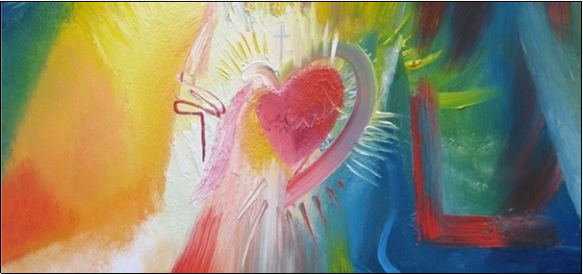 This week, we celebrate The Solemnity of the Sacred Heart of Jesus, our church’s namesake. The Sacred Heart of Jesus is a devotional with long and historic provenance within Christianity, and in modern times has been established as a Solemnity for the universal Church. The Solemnity was first celebrated in France. The liturgy was approved by the local bishop at the behest of St. John Eudes, who celebrated the Mass on August 31, 1670. The celebration was quickly adopted in other places in France. In 1856, Pope Pius IX established the Feast of the Sacred Heart as obligatory for the whole Church.
  In
In  Kerry Weber, an associate editor at America Magazine, a wife and mom, offered her thoughts on Hope. Her words are from a letter she and her husband wrote to her not-yet-born son on their hopes for his life in the Faith. As do all parents, they wait with expectation to see how this new life unfolds. They wrote:
 This morning I was preparing for the noon-Mass homily on
 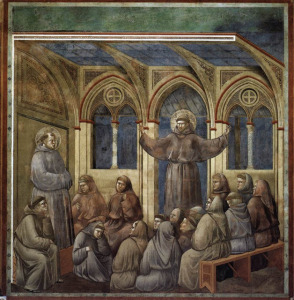 During these last days as the topic of racial justice was omnipresent around us, someone emailed to ask if Francis of Assisi had ever written on race relationships. The short answer is “no.” Francis of Assisi lived in the 13th century growing up in the Umbria region of Italy. His world was provincial and focused on the world in which diversity meant which town you were from and the “other” referred to the “Saracens,” against whom the Crusades were aimed in order to free the Holy Land from Islamic control.
 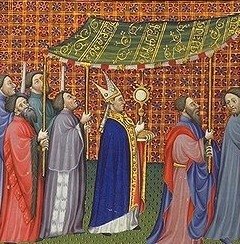 This weekend the Church celebrates the Solemnity of the Body and Blood of Christ, a feast perhaps better known by the Latin Corpus Christi. At its core, the solemnity is a celebration of the Tradition and belief in the Eucharist as the Real Presence of the Body and Blood of Jesus Christ. Many folks wonder why this celebration is not part of Holy Thursday, and it was, mixed in with other themes, e.g., institution of the priesthood. And, all this occurs in the shadow of Good Friday. The placement of the celebration was not one that necessarily lends itself to a joyful celebration.
  In
In 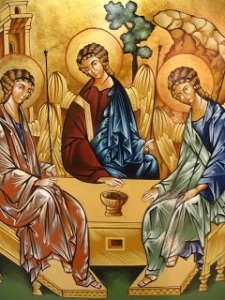 Years ago, while a Franciscan novice, my fellow friars and I attended a gathering of all the Franciscan novices, men and women, who lived in the Eastern United States. During our week-long gathering, each group was responsible for leading morning or evening prayer or animating the Eucharistic celebration. One morning, a group of Franciscan sisters was responsible for morning prayer. Just before we were to begin, the leader of prayer explained that we would not be using the traditional words associated with the sign of the Cross. Rather, we would say “In the Name of the Creator, the Redeemer, and the Sanctifier.” She explained this was a way to remove the gender bias from the opening of prayer and to make all feel welcomed.
  friarmusings