 24 When the crowd saw that neither Jesus nor his disciples were there, they themselves got into boats and came to Capernaum looking for Jesus. 25 And when they found him across the sea they said to him, “Rabbi, when did you get here?” 26 Jesus answered them and said, “Amen, amen, I say to you, you are looking for me not because you saw signs but because you ate the loaves and were filled. 27 Do not work for food that perishes but for the food that endures for eternal life, which the Son of Man will give you. For on him the Father, God, has set his seal.” 28 So they said to him, “What can we do to accomplish the works of God?” 29 Jesus answered and said to them, “This is the work of God, that you believe in the one he sent.” 30 So they said to him, “What sign can you do, that we may see and believe in you? What can you do? 31 Our ancestors ate manna in the desert, as it is written: ‘He gave them bread from heaven to eat.’” 32 So Jesus said to them, “Amen, amen, I say to you, it was not Moses who gave the bread from heaven; my Father gives you the true bread from heaven. 33 For the bread of God is that which comes down from heaven and gives life to the world.” 34 So they said to him, “Sir, give us this bread always.” 35 Jesus said to them, “I am the bread of life; whoever comes to me will never hunger, and whoever believes in me will never thirst. (John 6:24-35) Continue reading →

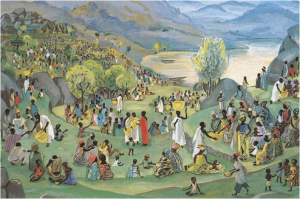 Continuing our look into the gospel for the 18th Sunday of Ordinary Time….
 Today’s gospel
 Continuing our look into the gospel for the
  “The Kingdom of heaven is like a mustard seed…The Kingdom of heaven is like yeast..” (Mt 13). There is much debate over the meaning of these
  This coming Sunday is the
  The Book of Esther is from the Old Testament and not a book that often appears in the lectionary cycle for Sunday readings. “The Book of Esther tells a story of the deliverance of the Jewish people. We are shown a Persian emperor, Ahasuerus (loosely based on Xerxes, 485–464 B.C.), who makes momentous decisions for trivial reasons, and his wicked minister, Haman, who takes advantage of the king’s compliance to pursue a personal vendetta against the Jews by having a royal decree issued ordering their destruction. The threat is averted by two Jews, Esther and Mordecai. Their influence and intervention allow the Jews to turn the tables on their enemies and rout their attackers. This deliverance is commemorated by the inauguration of the Jewish festival of Purim on the fourteenth and fifteenth of Adar (mid-February through mid-March). The book confronts the modern reader with important themes, the evils of genocide and racism.” (
