I have been leading Bible studies for a long time now. I think the first one was in 1984. When I think back, it seems to me, that each time we study St. Luke’s account called the “Road to Emmaus” the same basic questions arise. “How could these two people, clearly disciples, people who may have followed Jesus for maybe three years – having seen the miracles, the mighty works, heard the preaching, seen Lazarus raised from the dead, and heard Jesus proclaim that he would be put to death and then rise – how could they then hear the reports of the empty tomb and then walk away in a slow descent into despair? Don’t they get it? How could they not get it? Where is their faith? It doesn’t make sense.” Continue reading
Category Archives: Scripture
Emmaus: at table
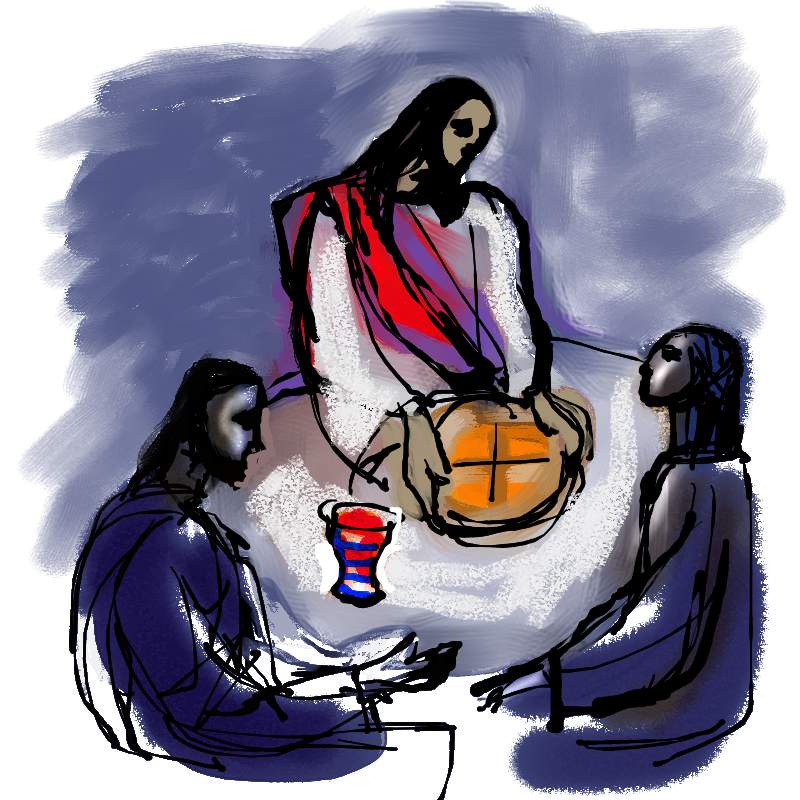
At The Table With Jesus The disciples are struck by what Jesus has said and ask him to stay with them even has he appears to be traveling on. Alan Culpepper (479) offers an interesting insight into the simple passage (v.28):
Jesus’ first action is probably significant both thematically and theologically. He “walked ahead as if he were going on.” On the surface it is a gesture of social deference and polish. It implies that Jesus was not really going further but that he would not impose on the disciples to offer him hospitality. In Near Eastern customs, the guest was obligated to turn down such an invitation until it was vigorously repeated (see Gen 19:2-3). Theologically, Jesus’ action demonstrates that he never forces himself upon others. Faith must always be a spontaneous, voluntary response to God’s grace. Thematically, the action is suggestive, because all the way through the Gospel Jesus has been going further. When the people at Nazareth rejected him, Jesus “passed through the midst of them and went on his way” (4:30). When the crowds wanted to prevent Jesus from leaving them, he responded, “I must proclaim the good news of the kingdom of God to the other cities also” (4:43). He preached in synagogues and withdrew to desert places to pray (4:44; 5:16). In Galilee he was constantly on the move, and from Luke 9:51 until 19:44 he is on the way to Jerusalem. The Lukan Jesus, therefore, was always going further, and in the book of Acts the gospel of Jesus will spread “to the ends of the earth.” Continue reading
Emmaus: on the way
Commentary. Luke sets the scene with markers of time (that very day), place (on the road between Jerusalem and Emmaus) and situation – two disciples who earlier had been with the disciples, heard the women’s testimony and apparently discounted their testimony has idle wistfulness. The community of believers has been fractured.
Unable to see. Elsewhere in the Gospel according to Luke “eyes” and “sight” have been correlated with comprehension, faith and salvation (cf. 1:78-79; 2:30; 6:39-42; 10:23; 11:34; 18:35-42; 10:42). For most the gospel referred to as the “Journey to Jerusalem” (9:51 – 18:14) the disciples have witnesses Jesus’ teaching, mighty deeds, and revelation of his heavenly Father. But in the earliest hours of the new world order after the Resurrection, the two disciples do not recognize Jesus. Their eyes are “prevented” from seeing, an expression for spiritual blindness. It ironic that the two travelers consider themselves the truly knowledgeable ones who are shocked that this fellow traveler has no idea of the very public events of the last three days. While they understand the details of the events from a human perspective, they are truly unaware of those event’s meaning. Continue reading
Emmaus: context
Luke 24:13-35 13 Now that very day two of them were going to a village seven miles from Jerusalem called Emmaus, 14 and they were conversing about all the things that had occurred. 15 And it happened that while they were conversing and debating, Jesus himself drew near and walked with them, 16 but their eyes were prevented from recognizing him. 17 He asked them, “What are you discussing as you walk along?” They stopped, looking downcast. 18 One of them, named Cleopas, said to him in reply, “Are you the only visitor to Jerusalem who does not know of the things that have taken place there in these days?” 19 And he replied to them, “What sort of things?” They said to him, “The things that happened to Jesus the Nazarene, who was a prophet mighty in deed and word before God and all the people, 20 how our chief priests and rulers both handed him over to a sentence of death and crucified him. 21 But we were hoping that he would be the one to redeem Israel; and besides all this, it is now the third day since this took place. 22 Some women from our group, however, have astounded us: they were at the tomb early in the morning 23 and did not find his body; they came back and reported that they had indeed seen a vision of angels who announced that he was alive. 24 Then some of those with us went to the tomb and found things just as the women had described, but him they did not see.” Continue reading
Spy Wednesday
Today is known as “Spy Wednesday”, a reference to the betrayal of Jesus by Judas Iscariot for thirty silver coins. This event is described in the three Synoptic Gospels: Matthew 26:14-16, Mark 14:10-12, Luke 22:3-6. We know that Judas’ betrayal was but part of a larger vortex of events that would lead to Jesus’ arrest, trails, scourging, crucifixion, and death. Only Matthew (Matthew 27:3-6 ) narrates Judas’ own death.
For all this, Judas’ name is synonymous with betrayal, and Dante, in Canto XXXIV of his “Inferno,” places him in the very lowest circle of Hell, being devoured eternally by a three-faced, bat-winged devil. Virtually every image we carry about Judas comes from Dante or a later artistic portrayal of the man – e.g., reddish hair color (Harvey Keitel in “The Last Temptation of Christ”) or his fiery disposition (“Jesus Christ Superstar”). Continue reading
The anointing
1 Six days before Passover Jesus came to Bethany, where Lazarus was, whom Jesus had raised from the dead.2 They gave a dinner for him there, and Martha served, while Lazarus was one of those reclining at table with him. 3 Mary took a liter of costly perfumed oil made from genuine aromatic nard and anointed the feet of Jesus and dried them with her hair; the house was filled with the fragrance of the oil. 4 Then Judas the Iscariot, one (of) his disciples, and the one who would betray him, said, 5 “Why was this oil not sold for three hundred days’ wages and given to the poor?” 6 He said this not because he cared about the poor but because he was a thief and held the money bag and used to steal the contributions. 7 So Jesus said, “Leave her alone. Let her keep this for the day of my burial. 8 You always have the poor with you, but you do not always have me.” 9 (The) large crowd of the Jews found out that he was there and came, not only because of Jesus, but also to see Lazarus, whom he had raised from the dead. 10 And the chief priests plotted to kill Lazarus too, 11 because many of the Jews were turning away and believing in Jesus because of him. Continue reading
Passion Sunday: condemned
Jesus Is Condemned (27:11-25) The Gospel reading for Palm Sunday of the Lord’s Passion is quite lengthy and so will not be included here. It can be found at the USCCB website: http://www.usccb.org/bible/readings/041314.cfm
This is the official trial of Jesus, and yet the description sounds less like a formal judicial hearing than an example of oriental bargaining. Pilate, as prefect of Judea, had the sole authority to acquit or to condemn, and to determine the sentence. There is a perfunctory attempt at a formal examination of the prisoner, but increasingly the dominant force is not the official role of the governor but the demands of the Jewish leaders, backed by ‘the people’. It is here that the focus of Matthew’s attention falls, so that Pilate’s role is as a cast extra on the movie set whose sole role is at best a catalyst which helps to define unequivocally the people’s stance towards the Messiah. Continue reading
Passion Sunday: trials, failures, and betrayals
The Jewish Trial Before the Sanhedrin (26:57-68) The Gospel reading for Palm Sunday of the Lord’s Passion is quite lengthy and so will not be included here. It can be found at the USCCB website.
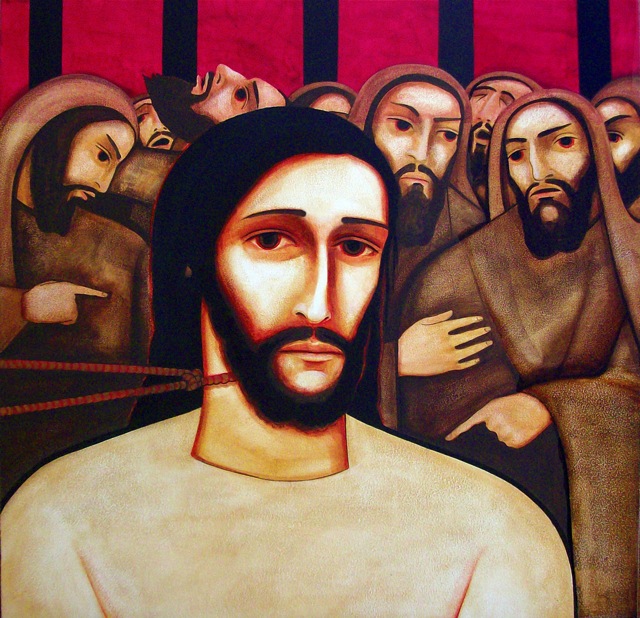
R.T France (2007, p.1016) writes, “This is the point at which Jesus’ death is sealed; all that follows involving the Roman prefect is only the formal implementation of a verdict already decided by the Jewish authorities.” This is a conflict that has been growing unabated since the beginning of Jesus’ public ministry and has reached the point where the religious authorities are simply looking for the basis upon which they can seal Jesus’ fate. But for the moment he is in their power and he Jesus has preciously little to say. The events unfold and Jesus appears as helpless before the hearing by Jewish religious leaders. It is not likely that this is a formal trial that occurs at Caiaphas’ house, but rather an ad hoc meeting of senior people to agree on, first, the need to have Jesus executed (this being a matter of Jewish law), and secondly, an appropriate tactic to induce the Roman governor to impose the death penalty (which would, of course, require a charge of which Roman law could take cognizance). The formal Jewish trial begins, as suggested by 27:1, later when the whole Sanhedrin has assembled. Whatever the official status of the gathering, the Evangelists leave us in no doubt that it was not an unprejudiced hearing, but was convened specifically to “put him to death.” Continue reading
Passion Sunday: the sheep scatter
Jesus Predicts Desertion and Promises Reunion (26:30b-35) The Gospel reading for Palm Sunday of the Lord’s Passion is quite lengthy and so will not be included here. It can be found at the USCCB website:
One of the curious “tests” that some scholars apply to a passage regarding “authenticity” (by which they really mean historicity) is “would it embarrass the early church?” If it would, then it must be so “authentic” and compelling that the sacred writer includes it even though it is embarrassing. Jesus’ prediction that all the disciples would abandon him in his hour does not reflect well on the future leaders of the nascent Christian movement.
The NSRV says “You will all become deserters [skandallisthēsesthe]…” – and though it more literally means to “fall away” “be caused to stumble” – there is something scandalous that will shake their faith to the very core. This the word that Matthew uses to describe the hometown folk, the Pharisees, and those who profess belief in Jesus but who stumble when the world or persecution arises on account of Jesus’ word (13:21). Continue reading
Passion Sunday: betrayer and betrayed
The Gospel reading for Palm Sunday of the Lord’s Passion is quite lengthy and so will not be included here. It can be found at the USCCB website:
Commentary. This very long narrative will be broken into small passages that may help the reader to focus and reflect on specific sections. The general outline listed in the previous post is provided for you to locate these smaller passages within the larger framework. The narrow framework is taken from Boring’s outline of the Matthean Passion narrative. Continue reading