Are we ready?

One of the late summer, early autumn rituals in Florida is hurricane preparedness. You might be thinking, “ah….isn’t that the middle of the peak of hurricane season?” Yes, it is. And to be clear there also has to be a projection of a hurricane possibly heading to your home area for any meaningful preparedness activities to be undertaken in earnest.. And then, even at that, the level of preparedness is related to the projected storm strength. “Only Cat 1? No problem, we’re good.” The fact that, especially in Gulf of Mexico waters, storms can rapidly increase to Cat 3 and 4 is acknowledged, “but that stuff hits Texas or Louisiana – maybe the Florida Panhandle, but that’s almost Alabama anyway.” Every year in late May the newspapers print a special insert on preparing for hurricane season; not sure how well it is read.  I am not sure we Floridians are the most prepared for hurricane season and we know it’s coming. We’ll chat about it, we’ll tell stories about particular hurricanes, “that was a big one; blew roofs clean off homes. The whole neighborhood had the blue tarp covers on roofs for months. Yup, that was a big one.” But as the seasons change, Floridian’s conversations shift from hurricanes to the changing colors of … auto license plates during the annual snowbird invasion, congesting roads but filling state tax coffers with the tourist tax. We’re prepared for that. Continue reading

From the backseat

I remember family road trips when I was a child.  All my cousins on my father’s side lived in Atlanta. My dad was the only one of the 7 siblings that did not live in Atlanta. Each year – sometimes over Thanksgiving, sometimes over Christmas – we would load up the car with kids, bags, and whatnot and off we went. There were games, snacks, and drinks for us all. There was a suitcase with my clothes. The car was serviced, the oil checked, and the gas tank filled. This was before the days of the interstate highways and so there was route planning that needed to be done. I contributed to none of that. My only job was to be on time having recently gone to the bathroom and subsequently thoroughly washed my hands. I wasn’t in charge or responsible for any task or duties. I was 8 years old. Continue reading

Francis and the Leper: Growing Pains

…and we continue with some historical context and background for our consideration of the accounts of St. Francis and the Leper.

By the spring of 1213, four years after the founding of the “order,” Francis’ reputation had risen to the attention of the Italian aristocracy – not just in Assisi but throughout central Italy.  The order was beginning to attract men from the higher social classes. Sons of merchants like Francis, sons of the landed wealthy, sons of ruling households, men with established careers in law, music and the arts, and also ordained priests. They joined the already formed group of men from middle and lower backgrounds and joined in on the muddling through what it meant to follow Christ in the manner of Francis. G.K. Chesterton’s later definition of the Catholic Church – “here comes everybody.” Broadly speaking, apart from their spiritual gifts, these were “company men.” How many friars joined the fraternity in those years?  It is impossible to say, but we do know this: in 1217 the annual meeting (called a “chapter”) made the decision to send out missions across the Alps into northern Europe, the Baltic states, and to the Crusader States in the eastern Mediterranean. Within Italy, six provinces were established; outside of Italy, five provinces were established: Spain, northern and southern France, Germany, and Syria. Some scholars have written that the number of brothers exceeded 700 men. Continue reading

50 years ago; for 50 years

Lots of social media posts, tweets, emails, and the like, today, are announcing the Walt Disney World outside of Orlando – today turns 50 years old. I grew up in Orlando and was in my second year of college when the doors opened to “where dreams come true” and of course Christmas vacation included a trip to the theme park. It was amazing, sparkly new, and a lot of fun. As you might imagine the Central Florida papers prepared articles for a walk down memory lane – some are engaging, some just rehashing old news, some written in a way that make me feel old… of course, I was in college 50 years ago…. so they aren’t wrong!

But there was an article in the Tampa Bay Times that I thought we really interesting. There are three employees who were there for opening day and these 50 years later still work at Walt Disney World:

WDW-3-employees

Walt Disney World employees from left, Chuck Milam, Earliene Anderson and Forrest Bahruth gather at the Magic Kingdom in August to celebrate their 50 years working at the park. [ JOHN RAOUX | AP ]

You can read the article here.  Congrats to them all!


Feature image: WDW News Today, October 1

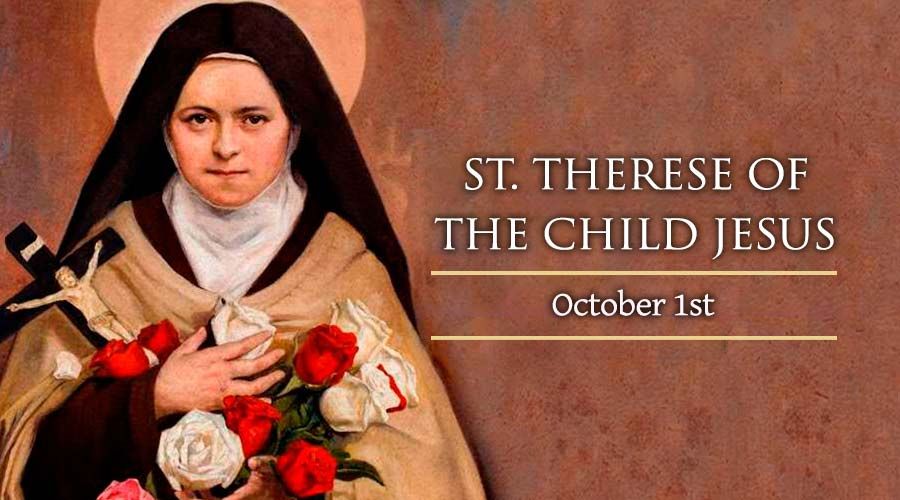
St. Thérèse of the Child Jesus

Therese_01OctoberToday is the Memorial of Saint Thérèse of the Child Jesus, virgin and doctor of the Church. On October 1, Catholics around the world honor the life of St. Thérèse of the Child Jesus, or St. Thérèse of Lisieux on her feast day.  She is popularly known in English as “The Little Flower of Jesus”, or simply “The Little Flower.”

Continue reading

The Family as Kingdom

This coming Sunday is the 27th in Ordinary Time of Year B. The gospel is taken from Mark 10:2-12 and involves a question about divorce whose real intent is to bring Jesus into conflict with what the Pharisees regard as the clear teaching of Holy Scripture. In the verses that immediately follow the focus changes from Mosaic law, divorce and adultery to the image of family: And people were bringing children to him that he might touch them, but the disciples rebuked them.  When Jesus saw this he became indignant and said to them, “Let the children come to me; do not prevent them, for the kingdom of God belongs to such as these. Amen, I say to you, whoever does not accept the kingdom of God like a child will not enter it.” Then he embraced them and blessed them, placing his hands on them. (Mark 10:13-16)

It is fitting that a passage on children should follow one on marriage since both were especially vulnerable in first century society. But this passage first addresses the Kingdom of God and what prevents people from being included. The Pharisees and scribes had already been rebuked for substituting the traditions of men for God’s law and intention. Jesus made an example of service to a little child to overturn the disciples’ arguments about which of them was the greatest in 9:33–37. That episode was followed by the disciples’ trying to prohibit an outsider from using Jesus’ name (9:38–39). This episode begins with the disciples’ attempting to enforce the standard social norms that children are not deserving of attention or time.

There are two sides to this teaching: (a) the disciples who need to not keep excluding folks but to open the gates to all, and (b) to all those to whom the Kingdom is opened, to realize that it is all gift – and to received it as would a child.

This passage is not only well placed with the passage affirming the sanctity of marriage, but serves as a bridge to next week’s gospel when the man comes to Jesus asking what he must do to receive eternal life: “Jesus, looking at him, loved him and said to him, ‘You are lacking in one thing. Go, sell what you have, and give to the poor and you will have treasure in heaven; then come, follow me.’ At that statement his face fell, and he went away sad, for he had many possessions.

Perhaps the man had earned much, but would not accept what he had not earned. He did not understand the gift. Can he be saved? “For human beings it is impossible, but not for God. All things are possible for God.” It is the gift; children have no problems receiving gifts.

Afterwards

This coming Sunday is the 27th in Ordinary Time of Year B. The gospel is taken from Mark 10:2-12 and involves a question about divorce whose real intent is to bring Jesus into conflict with what the Pharisees regard as the clear teaching of Holy Scripture. Jesus has answered the real question that the Pharisee had asked: not one about divorce, but one about authority. The disciples apparently did not pick up on the nuanced answer, and so “In the house the disciples again questioned him about this. He said to them, “Whoever divorces his wife and marries another commits adultery against her; and if she divorces her husband and marries another, she commits adultery.” (Mark 10:9-11)
Continue reading

Under the Fig Tree

Today is the Feast of the Archangels with a reading from the Gospel of John in which Jesus encounters Nathaniel under a fig tree. It is only at the end of the reading that angels get a mention: “you will see heaven opened and the angels of God ascending and descending on the Son of Man.” (John 1:51) Otherside, Jesus is involved in the calling of the disciples, having found Peter, Andrew and Philip at work. He finds Nathaniel sitting under a fig tree. Micah 4:3-4 and Zechariah 3:10 suggest that “under a fig tree” may be a place of contemplation. It may be that Nathanael was a “thinker”. He wouldn’t accept anything at face value, but he would question and contemplate everything until he was sure of its truthfulness. On the other hand, sitting in the shade, eating the free figs, might indicate that he was just a lazy bum. Continue reading

Into the heart of the storm

This coming Sunday is the 27th in Ordinary Time of Year B. The gospel is taken from Mark 10:2-12 and involves a question about divorce whose real intent is to bring Jesus into conflict with what the Pharisees regard as the clear teaching of Holy Scripture. Jesus has answered their questions. The Pharisee do not seem to question the distinction Jesus makes, indicating that they understood that the real question is whether they are able to truly discern God’s will.

Thus, Jesus moves the dialogue to deeper question and asks about what God intended in the creation:  “But from the beginning of creation, ‘God made them male and female.  For this reason a man shall leave his father and mother (and be joined to his wife), and the two shall become one flesh.’ So they are no longer two but one flesh.  Therefore what God has joined together, no human being must separate.” (Mark 10:7-9)

Jesus has posed a question to the Pharisees that puts before them a choice between preserving the Law as they understood it or discerning and doing God’s will. The former is a legislation that is based upon fallen human history. But is there something that precedes that history that will reveal God’s intent? Jesus is also appealing to the Torah in his reference to the creation account in Genesis. Many scholars have offered that the Law given to Moses was part of a covenant with the people of Israel for a specific time in history. That covenant was broken and “subsumed” into the larger Davidic covenant. But the covenant in Genesis is timeless and is revealed in Creation. Paul seems to make the similar argument that the Mosaic law was but an ‘inset’ into God’s earlier purpose and covenant of grace, which is eternal (Gal. 3:17).

Jesus clearly has two passages in mind:

  • God created man in his image; in the divine image he created him; male and female he created them. (Gen 1:27)
  • That is why a man leaves his father and mother and clings to his wife, and the two of them become one body. (Gen 2:24)

Jesus describes the union of husband and wife as a bond rooted in the very nature of Creation, one that takes priority over the other divinely intended relationship: family. As close as the parent-child relationship is, the husband-wife relationship is closer. They are not to act as though one, they are to become one. And this union is the action of God, therefore, humans are not to separate what God has joined. Jesus’ final pronouncement grounds the sanctity of marriage in the authority of God himself. This is consistent with the biblical perspective, which never considers husband and wife alone but always in the presence of God, subject to his commands and aided by his grace.

At one level, Jesus’ is repeating his charge against the Pharisees for substituting human tradition and understanding for the commandment of God (7:9–13). Perkins [643] writes: “The conclusion Jesus draws from the Genesis passage is consistent with the picture of Jesus and the Law already presented in the Gospel. God intended men and women to be permanently joined in marriage, so no human tradition can claim the authority to override that fact (v. 9). Jesus exploits the metaphoric possibilities of Gen 2:24, ‘they become one flesh,’ to exhibit the absurdity of thinking that divorce ‘law,’ whatever conditions it sets down, represents God’s will. Divorce would be like trying to divide one person into two.”

A Note About Annulments. If the Divine intent was that husband and wife become one person, then on what grounds does the Catholic Church consider annulments. The most common question asked: isn’t an annulment, just “Catholic divorce?” While not attempting a complete answer (and not close to it!), let me point out a few things for consideration.

Marriage as a sacrament was instituted by Christ; nothing changes that, but what changes in time is the Church’s plumbing the depths of the meaning of the sacrament. It is easily seen in the context, legislation, and language the Church has used during different times in its history.

In the first three centuries the marriages of Christians were not legislated in any official manner; people married according to the customs of the place they lived. The fourth and fifth centuries saw legislation enacted by local Church councils that addressed pastoral problems associated with marriage. It was in this period that the blessing of the marriage by a priest began to replace the blessing of the father of the bride. In this same period, St. Augustine began to work out a systematic treatment of marriage – but one colored by his view that there were inherent dangers in sex that were compensated by the “goods” of children.

From the fifth century on there was an increasing stress upon the ecclesial dimension of marriage. In this age, theologians debated what constituted “marriage:” consent, the blessing of the Church, or consummation. It was in the 12th century, along with the rise of standardized “canon law” or “ecclesial law,” that the idea of a marriage “contract” arose – pointing to rights, duties, and obligations. There were several other major categories that arose, but it was “contract” that prevailed until the 2nd Vatican Council, where the Church Fathers insisted on a return to a more biblical and intrinsic understanding of marriage as covenant (Pastoral Constitution on the Church in the Modern World, §48) . In that understanding, what is key is consent of the man and woman. (Foster, 38-41)

Today, people marry according to local customs, there is the presence of a civil contract, but the Church’s concern is to ensure that unburdened consent is present in both parties to the covenant. Where the consent was burdened, there are possible grounds for considering an annulment because what is in question is was the covenant bond of marriage was formed. (Disclaimer: I am not a canon lawyer, do not play one on television, nor did I stay at a Holiday Inn express last night) No doubt I have not done justice to the topic of annulment, but if you want a one sentence summary: “Did the couple share in the divine intent of the Creator?”