
 Next Sunday is the 4th Sunday of Lent, Year B. You can read a full commentary here.
14 And just as Moses lifted up the serpent in the desert, so must the Son of Man be lifted up, 15 so that everyone who believes in him may have eternal life.” 16 For God so loved the world that he gave his only Son, so that everyone who believes in him might not perish but might have eternal life. 17 For God did not send his Son into the world to condemn the world, but that the world might be saved through him. 18 Whoever believes in him will not be condemned, but whoever does not believe has already been condemned, because he has not believed in the name of the only Son of God. 19 And this is the verdict, that the light came into the world, but people preferred darkness to light, because their works were evil. 20 For everyone who does wicked things hates the light and does not come toward the light, so that his works might not be exposed. 21 But whoever lives the truth comes to the light, so that his works may be clearly seen as done in God. (John 3:14-21)
 In the
  It has been about a year since “social distancing” became an all too familiar expression. No doubt we can all look back on the year past and collect our own anecdotes. This post is from a year ago. It is eerily accurate and still funny. Enjoy.
 One aspect of Francis’ changing life that has attracted recent attention is the movement of Francis from solitary figure, living a quasi-hermetical life for four to five years, now beginning to live in a growing community of brothers – all of whom are looking to Francis for spiritual and communal leadership. There was something attractive about Francis, his way of following the gospel, and perhaps the recent “commissioning” by Pope Innocent III gave a certain cache of legitimacy to this way of being Christian in the world. Eventually many people came to join the Franciscan movement, which soon enough became a religio and eventually an ordo, but those demarcations are eight to ten years in the future ahead of the Spring of 1209.
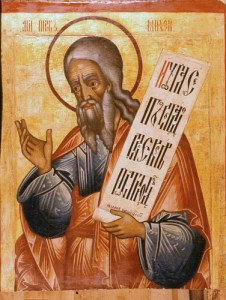 The prophet Micah preached to Jerusalem, but he was not from the city. He was an outsider from the farming village of Moresheth in the Judean foothills. You can imagine how the people, priests, and temple prophets received his prophecies of death, doom, pestilence and punishment. I am sure they would have liked to cast him away, tossed outside the city walls.
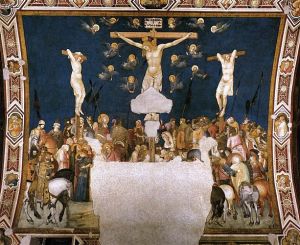 One of the famous pieces of Franciscan art can be found in the left transept of the Lower Church of San Francesco in Assisi. It is a fresco done by Pietro Lorenzetti and is one of 17 frescoes he created in the church. This fresco is located lower on the transept wall under Lorenzetti’s masterpiece, The Crucifixion. The fresco is known as Our Lady of the Sunsets.
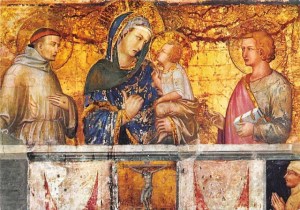 In the scene the Virgin Marry is holding the Child Jesus. The other two figures in the fresco are St. John the Evangelist (right) and St. Francis of Assisi (left), both of whom are looking at what is unfolding in the center of the scene. There Mary and Jesus are focused on each other, and Mary has a unique gesture, holding her thumb up pointing back to Saint Francis.
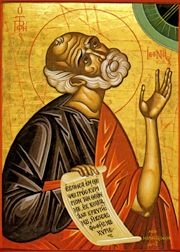 “10 When God saw by their actions how they turned from their evil way, he repented of the evil that he had threatened to do to them; he did not carry it out.” (Jonah 3:10) Great! The Ninevites repented, God relented, and Jonah’s prophetic mission is complete. As mentioned, that would have been an “they all lived happily ever after” ending. But there is another chapter in the story whose first verse gives us an idea that the story’s ending is anything but happy.
 This is part two of my day-off-curiosity about voting. As noted in the
  friarmusings