In writing these columns over the last several years, it seems to me that several themes are reoccurring, namely: belonging, gratitude, and commitment. I think we assume people who are faithful then display a sense of belonging, gratefulness, and commitment. But it is actually a bit the other way around. People who find an abiding sense of belonging to a worshipping community and are committed to that community, become people of deeper faith. People who intentionally practice gratitude, become more faithful and committed. Continue reading
Testing a King: Imagio Dei
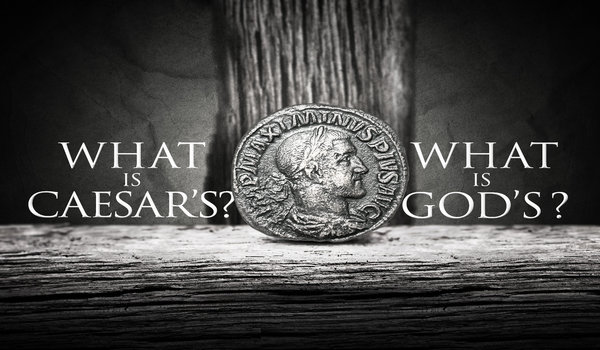
An Underlying Thought. Jesus’ answer calls into question the basic presupposition behind their question, that there is an essential incompatibility between loyalty to the governing authority and loyalty to God. This was precisely Judas the Galilean’s position as explained by Josephus (War 2.118 and Ant. 18.23): to pay the tax was to tolerate a mortal sovereign in place of God. It was loyalty to God which was the basis for Zealot objections to Roman taxation, but Jesus, without reducing the demands of loyalty to God, indicates that political allegiance even to a pagan state is not incompatible with it. This is not a rigid division of life into the ‘sacred’ and the ‘secular’, but rather a recognition that the ‘secular’ finds its proper place within the overriding claim of the ‘sacred’. Continue reading
Testing a King: why?
Matthew 22:15–22 15 Then the Pharisees went off and plotted how they might entrap him in speech. 16 They sent their disciples to him, with the Herodians, saying, “Teacher, we know that you are a truthful man and that you teach the way of God in accordance with the truth. And you are not concerned with anyone’s opinion, for you do not regard a person’s status. 17 Tell us, then, what is your opinion: Is it lawful to pay the census tax to Caesar or not?” 18 Knowing their malice, Jesus said, “Why are you testing me, you hypocrites? 19 Show me the coin that pays the census tax.” Then they handed him the Roman coin. 20 He said to them, “Whose image is this and whose inscription?” 21 They replied, “Caesar’s.” At that he said to them, “Then repay to Caesar what belongs to Caesar and to God what belongs to God.” 22 When they heard this they were amazed, and leaving him they went away. Continue reading
Testing a King: taxes and faith
The question of authority continues to play out in this and the following controversy narratives. In this scene the Herodians have been added to the playing field as a counterpoint and yet similar view as the Pharisees. Boring (Matthew, The New Interpreters Bible) comments: Continue reading
Testing the King: context
Matthew 22:15–22 15 Then the Pharisees went off and plotted how they might entrap him in speech. 16 They sent their disciples to him, with the Herodians, saying, “Teacher, we know that you are a truthful man and that you teach the way of God in accordance with the truth. And you are not concerned with anyone’s opinion, for you do not regard a person’s status. 17 Tell us, then, what is your opinion: Is it lawful to pay the census tax to Caesar or not?” 18 Knowing their malice, Jesus said, “Why are you testing me, you hypocrites? 19 Show me the coin that pays the census tax.” Then they handed him the Roman coin. 20 He said to them, “Whose image is this and whose inscription?” 21 They replied, “Caesar’s.” At that he said to them, “Then repay to Caesar what belongs to Caesar and to God what belongs to God.” 22 When they heard this they were amazed, and leaving him they went away. Continue reading
Careful
In Jesus’ parable, the King has prepared the feast – all is ready, the invitations sent … and resent, and yet amazingly, people don’t come. In our reading it says that people ignored the invitation. The underlying word in Greek means to ignore in a way that is careless – or perhaps, not being sufficiently careful with treasures with which we have been charged.

Parables are meant to get you to stop and think about what you have just heard. Why would people pass up on this extraordinary invitation: it comes from a king, it involves a lavish feast for the wedding of his son. The invitation is issued several times. Who could refuse it? Who would be careless with it? Why don’t they show up? I guess their lives were filled with other things – other than the great feast. Continue reading
Growing Accustomed
Back in the day, I was part of a small advanced team that began the turn-over process for a fleet ballistic missile submarine as one crew relieved another crew. Our small team from the Gold Crew rode a tug into outer Apra Harbor, Guam, where we transferred to the submarine and were taken down the hatch. As soon as we were below, we instantly knew something was wrong. We had descended from the clear Pacific island breezes into the “locker room from hell.” It was though the fragrance from every high school football locker room had been concentrated in the confined space of a submarine. While you might think that description is exaggerated or part of a “sea story,” let me just say, the locker room analogy was kind compared to actual ambiance. Continue reading
Many are invited…
13 Then the king said to his attendants, ‘Bind his hands and feet, and cast him into the darkness outside, where there will be wailing and grinding of teeth.’ 14 Many are invited, but few are chosen.”
The Elect of God. The judgment seems harsh, but Matthew is thinking not of an actual wedding party, but of the last judgment. The language “weeping and gnashing of teeth” corresponds to 8:12; 13:42, 50; 24:51; 25:30, an apocalyptic expression (cf. Luke 13:28) that became a favorite of Matthew’s to picture the terror of condemnation at the last judgment. Continue reading
The Wedding Garment
11 But when the king came in to meet the guests he saw a man there not dressed in a wedding garment. 12 He said to him, ‘My friend, how is it that you came in here without a wedding garment?’ But he was reduced to silence.
What to Wear. Scholars are of mixed opinion about the urgency of the “feast is ready” in v.8 as it applied to those invited when the servants scour the main road. One line of thought offers that these royal wedding feasts were several days in the making and even more in the execution. Not all guests came at the beginning nor stayed until the end. There was a great deal of coming-and-going during it all. There is no reason to suppose that, once invited, these people have no time to go home, to change their clothes, and to borrow clothes from their neighbors, if necessary. Continue reading
Community Called: Good and Bad Alike
7 The king was enraged and sent his troops, destroyed those murderers, and burned their city. 8 Then he said to his servants, ‘The feast is ready, but those who were invited were not worthy to come. 9 Go out, therefore, into the main roads and invite to the feast whomever you find.’ 10 The servants went out into the streets and gathered all they found, bad and good alike, and the hall was filled with guests. Continue reading