Passion Sunday: crucified

Crowning-with-Thorns-lowfThe King Is Scourged and Mocked (27:26-31a) The Gospel reading for Palm Sunday of the Lord’s Passion is quite lengthy and so will not be included here. It can be found at the USCCB website.

Where the religious trial ends by mocking Jesus as the Christ, the secular trial ends with Jesus being mocked as king with a scarlet cloak (a soldier’s cape) parodying the emperor’s purple robe, a reed representing a royal scepter, and the crown of thorns. Jesus is thus enthroned as king, and offered the homage of kneeling which a Hellenistic ruler required. In this scene Matthew continues to redefine what kingship means. If this scene is a coronation, then the cross will be the throne. Continue reading →

Holy Week – have you tried it?

I have been a Catholic all my life, and yet somehow Holy Week was not part of the landscape of my Catholicism growing up. Years later as an adult I was living in Northern Virginia and worshipping at a church out in a rural town northwest of Washington D.C. The town was in the rolling hills of the Catoctin – the first ridge of the Blue Ridge Mountains. Continue reading →
Palm Sunday of the Passion: condemned

Jesus-Pilate2Jesus Is Condemned (27:11-25) The Gospel reading for Palm Sunday of the Lord’s Passion is quite lengthy and so will not be included here. It can be found at the USCCB website.

This is the official trial of Jesus, and yet the description sounds less like a formal judicial hearing than an example of oriental bargaining. Pilate, as prefect of Judea, had the sole authority to acquit or to condemn, and to determine the sentence. There is a perfunctory attempt at a formal examination of the prisoner, but increasingly the dominant force is not the official role of the governor but the demands of the Jewish leaders, backed by ‘the people’. It is here that the focus of Matthew’s attention falls, so that Pilate’s role is as a cast extra on the movie set whose sole role is at best a catalyst which helps to define unequivocally the people’s stance towards the Messiah. Continue reading →

Palm Sunday of the Passion: trials, failures, and betrayals

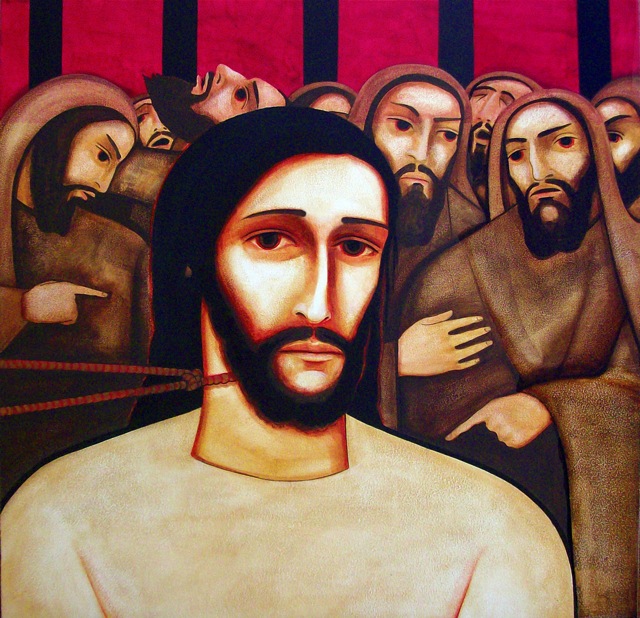
Jesus Condemned by michael o'brianThe Jewish Trial Before the Sanhedrin (26:57-68) The Gospel reading for Palm Sunday of the Lord’s Passion is quite lengthy and so will not be included here. It can be found at the USCCB website.

R.T France (2007, p.1016) writes, “This is the point at which Jesus’ death is sealed; all that follows involving the Roman prefect is only the formal implementation of a verdict already decided by the Jewish authorities.” This is a conflict that has been growing unabated since the beginning of Jesus’ public ministry and has reached the point where the religious authorities are simply looking for the basis upon which they can seal Jesus’ fate. But for the moment he is in their power and he Jesus has preciously little to say. The events unfold and Jesus appears as helpless before the hearing by Jewish religious leaders. It is not likely that this is a formal trial that occurs at Caiaphas’ house, but rather an ad hoc meeting of senior people to agree on, first, the need to have Jesus executed (this being a matter of Jewish law), and secondly, an appropriate tactic to induce the Roman governor to impose the death penalty (which would, of course, require a charge of which Roman law could take cognizance). The formal Jewish trial begins, as suggested by 27:1, later when the whole Sanhedrin has assembled. Whatever the official status of the gathering, the Evangelists leave us in no doubt that it was not an unprejudiced hearing, but was convened specifically to “put him to death.” Continue reading →

Passion Sunday: the sheep scatter

Jesus arrestedJesus Predicts Desertion and Promises Reunion (26:30b-35) The Gospel reading for Palm Sunday of the Lord’s Passion is quite lengthy and so will not be included here. It can be found at the USCCB website:

One of the curious “tests” that some scholars apply to a passage regarding “authenticity” (by which they really mean historicity) is “would it embarrass the early church?” If it would, then it must be so “authentic” and compelling that the sacred writer includes it even though it is embarrassing. Jesus’ prediction that all the disciples would abandon him in his hour does not reflect well on the future leaders of the nascent Christian movement. Continue reading →

Palm Sunday of the Passion: a last meal

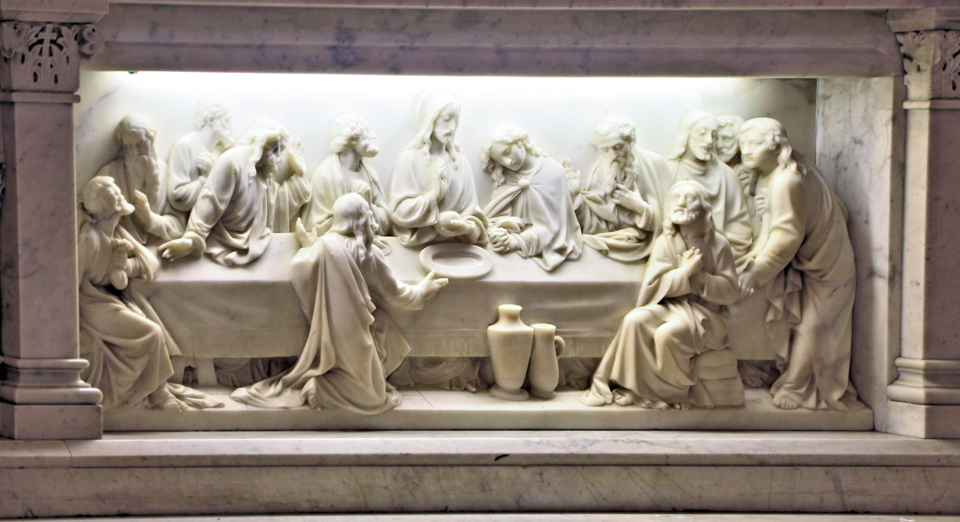
Altar-1The Gospel reading for Palm Sunday of the Lord’s Passion is quite lengthy and so will not be included here. It can be found at the USCCB website:

Jesus Inaugurates the Eucharist (26:26-30a) As Joachim Jeremias and other scholars have shown in looking at all the received Eucharistic traditions (Paul in 1 Corinthians and the synoptic gospel writers), Jesus follows the form and outline of the Passover Seder. The thanksgiving over the bread and the cup recorded in vv. 26 and 27 will therefore be a regular part of the main section of the Passover meal (making this the third of the four cups of the Passover), and we may reasonably assume that Jesus used the traditional words of thanksgiving. But it worthwhile to point out that said the blessing refers to blessing God, not blessing the bread. Continue reading →

Palm Sunday of the Passion: betrayer and betrayed

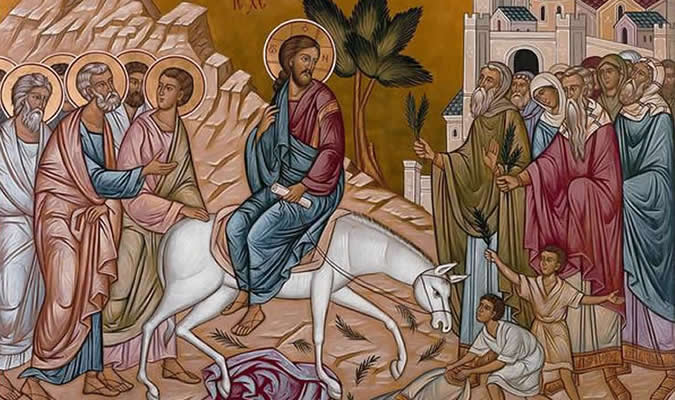
Entry_Into_Jerusalem1The Gospel reading for Palm Sunday of the Lord’s Passion is quite lengthy and so will not be included here. It can be found at the USCCB website:

Commentary. This very long narrative will be broken into small passages that may help the reader to focus and reflect on specific sections. The general outline listed in the previous post is provided for you to locate these smaller passages within the larger framework. The narrow framework is taken from Boring’s outline of the Matthean Passion narrative. Continue reading →

Palm Sunday of the Passion: context

Entry_Into_Jerusalem1Context. The climactic events that have been repeatedly predicted since the Galilean ministry are now about to unfold (12:38–40; 16:4, 21; 17:12, 22–23; 20:17–19; 21:38–39; 23:32). Jesus was aware of the forces arrayed against him (26:2), yet he did not resist doing the will of the Father despite the suffering that would be involved (26:36–46). Ironically, the very religious leaders who opposed and sought to destroy Jesus were the unwitting instruments God used to fulfill his plan to exalt Jesus. Continue reading →

Choosing to trust

Death is always untimely. It comes crashing headlong into our lives and into our families. Even if death’s inevitability has been forecasted and known, its arrival remains untimely. There is always more we wanted to do or say. There is never enough time, only the time given us.

The time death reaches your life can be filled with grief, anger, denial, and a whole cauldron of emotions. The time you are beginning to more fully realize the loss of someone you dearly loved. While a part of the shared life resides in memories, stories, and pictures, a part has been taken away – their presence, their touch, the experience of their laugh, and so much more. We mourn for the one we loved so deeply and we are awash in the cauldron of memory, love, regret, doubt, hope and hope lost, and emotions that will only rise to the surface in the time that follows. It is the universal experience. Continue reading →

Catholics studying the Bible

It was a simple e-mail. The writer said that she was committed to reading and studying the Bible. For her first time through, she wanted to accomplish it in a two-year period. She had already researched the Internet for Bible study plans and discovered there are tons of plans, lots of perspectives, and advice a plenty. So much so, it was hard to sort through it all. And such was the genesis of the e-mail asking for advice on “the plan.” Continue reading →