 At 6:02 am this past Monday morning, I received an email from the bishop’s office announcing, “With great joy we announce that His Holiness, Pope Francis, has appointed Most Reverend Bishop Gregory L. Parkes, Bishop of Pensacola-Tallahassee, Florida, as the fifth bishop of the Diocese of St. Petersburg, Florida! Bishop Parkes succeeds the retiring Bishop Robert N. Lynch, who has served as Bishop of St. Petersburg since his installation in 1996.”
Already on that same day people have called and asked, “What is the new Bishop like?” Answer: I don’t know, I have never had the privilege of meeting him. I can tell you that he is 6’8” tall – the tallest bishop in the United States! A former banker, a pastor in the Orlando Diocese, FSU graduate, canon lawyer… and did I mention he is very tall? I believe he is 54 years old (I can’t believe I am older than my bishop! Yikes!).
People have also asked, “What will this mean for the Diocese?” Specifically, I have no idea, but know this – he is not new to the episcopal leadership of a diocese or even a Florida diocese at that. I think that bodes very well for the Diocese. I am sure there will be a period when, like any new leader, he scouts out the landscape of the Diocese, meets his pastoral center staff, comes up to speed on the projects and issues, begins to meet his priests, and the parish council leaders. New Presidents are measured by the first 100 days in office, and I suspect bishops are measured on a scale of years of pastoral leadership. So, what will this mean for the Diocese? Ask me a year from now – I may not have a better answer, but I suspect we will begin to see his style of pastoral leadership emerge.
Here is what I can tell you about these changes – I am a hopeful and optimistic person about such things. Last century, I was a member in the pews of a wonderful little parish in the foothills of the eastern ridges of the Blue Ridge mountains. About a year after I began to worship there, the pastor Fr. Guy was leaving. People were not happy – “How could they do this? What will happen to us?” What happened was Fr. Scott arrived. And you know what – he was just the thing our parish needed.
The area was beginning to change as we became less a country county and more a far suburb of Northern Virginia and Washington, D.C. As the area dynamically grew, Fr. Scott led the charge. He got the new church built after 40 years of fund raising and with our new facilities, new ministries flourished and grew. It was a fun time to be in the parish. And, of course, one day – too soon for most – Fr. Scott announced he was being transferred. People were not happy – “How could they do this? What will happen to us?” What happened was Fr. John arrived and led a busy parish into an era of spiritual growth. Fr. Martin followed him – he was the last Franciscan pastor. Msgr. Cassidy came next, and then Fr. Steve…And every time God provided that once-little parish with the pastor they needed for the times they faced.
As I said, I am an optimist about such things. Bishop Lynch has done a great job; he did what was his to do – it is now time for him to enjoy a slower pace. Bishop Parkes will do what is his to do for the greater glory of God. Please keep them both in our prayers. And may God bless them in their new ministries.

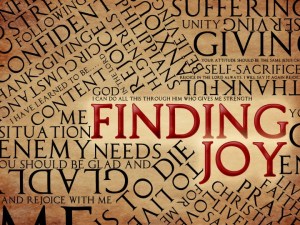 During the holiday season with winter storms roaring about, one can be quite happy that the airplane finally got off the ground; yesterday in Chicago, 1000 flights were cancelled. So if you got airborne, you were indeed happy. A new round of happiness came when the pilot finally found smooth air. And even if it was 6 hours late, you are happy that you have arrived. When you finally get off the plane, pass thru security, and at last see your spouse, your kids, your parents or grandparents, your fiancé, or whomever you have longed to see…. that is not happy. That is Joy. You hear it in the tone and energy of the voices, the embraces, and the hugs. And even when the reunion is right in the middle of everyone else’s way, when the reunion is clogging up the entire flow of foot traffic trying to get somewhere, you can’t help but notice even the most curmudgeon-y of travelers, however reluctantly, is giving evidence of a smile. Joy is embedded in the warp and woof, in the very fabric of relationships. Just like Mary and Elizabeth. Continue reading
  There are lots of different ways to wait. Scripture has over 162 verses that describe all sorts and manners of waiting. I suspect you are familiar with a good portion of the different kinds of waiting – after all, we all wait. In the military, the common experience was to “hurry up and wait.” We all wait. It is a common experience, and yet there are differences in waiting. There is a difference between expectant, on the edge of your seat, waiting; the patient “it will happen in its own good time and there is nothing I can do about it” waiting; and the waiting of dread, tedium, and despair. I think our, “Are we ever gonna’ get there waiting,” because a flight to Europe can take 8+ hours, would fall on deaf ears for our ancestors who traveled months on boats to reach these distant shores. But things change, the world has sped up. Our culture demands fast food, fast cars, and fast answers. We are accustomed to having a world of information at our fingertips with laptops and smart phones. We expect pills that will immediately take the pain away…yesterday. We are not accustomed to waiting, and we do not like it.
  A reflection for an Advent becoming Christmas
  The Immaculate Conception – Francis of Assisi, Bonaventure, Anthony of Padua, and John Duns Scotus
 Matthew 11:2-11. 7 As they were going off, Jesus began to speak to the crowds about John, “What did you go out to the desert to see? A reed swayed by the wind? 8 Then what did you go out to see? Someone dressed in fine clothing? Those who wear fine clothing are in royal palaces. 9 Then why did you go out? To see a prophet? Yes, I tell you, and more than a prophet. 10 This is the one about whom it is written: ‘Behold, I am sending my messenger ahead of you; he will prepare your way before you.’ 11 Amen, I say to you, among those born of women there has been none greater than John the Baptist; yet the least in the kingdom of heaven is greater than he.
  “Repent, for the kingdom of heaven is at hand!” – so cried out John the Baptist to those gathered in the desert of Judea. It is a scene we are all familiar with – but it doesn’t seem very much in the Christmas spirit. It is not in tune with the décor of the stores, malls, offices, and homes. It does not match the seasonal music available on radio, Pandora, or other streaming services. I can’t imagine receiving one of those talking Christmas card that would shout out “Repent!!” when it should play a pleasant and familiar holiday standard.
  11 I am baptizing you with water, for repentance, but the one who is coming after me is mightier than I. I am not worthy to carry his sandals. He will baptize you with the holy Spirit and fire.While vv. 8–10 may be understood at least in part as continuing the address to the Pharisees and Sadducees, now John’s address is specifically to those whom he is actually baptizing.
 friarmusings