
Thanksgiving Blessings to you and your family!
Image
4

This coming Sunday is the first Sunday in Advent. In yesterday’s posts we considered the pastoral concerns of the gospel; concerns that sometimes get lost amid all the attention to an “apocalyptic” fervor around the reading. In today’s post we’ll look at Matthew’s emphasis that the disciples will not know the day – no one knows – but that does not remove the need to stay awake – a key theme of Advent.
Our gospel combines several pictures in order to describe the arrival of the Son of Man (v. 37). The Noah parable (vv. 37–39) contrasts Noah and the other people of his generation. The flood came upon them suddenly and had dire consequences for many. The pictures of the two men in the field (v. 40) and the two women grinding meal (v. 41) emphasize the suddenness of the coming and the separation that it will bring. Since the exact hour of the coming is unknown, the only appropriate attitude is constant watchfulness (v. 42). This attitude is encouraged further by the story of the homeowner (v. 43). If a homeowner knows when a thief is coming, he exercises watchfulness at that time. But since the time of the Son of Man’s coming remains unknown, the watchfulness must be constant (v. 44).
Continue readingI am grateful for a day in which we, as a people, pause to give thanks. And who do we have to thank for this holiday? Your answer is likely “The Pilgrims.” You would not be wrong, but then not completely correct, either. Certainly, Thanksgiving and the religious response of giving thanks to God is as old as time. When one considers enduring cultures, one always finds men and women working out their relationship to God. There is almost always a fourfold purpose to our acts of worship: adoration, petition, atonement, thanksgiving. Such worship is part and parcel of life. And yet, there is still a very human need to specially celebrate and offer thanksgiving on key occasions and anniversaries. Since medieval times, we have very detailed records of celebrations marking the end of an epidemic, liberation from sure and certain doom, the signing of a peace treaty, and more. Continue reading
From the Office of Readings for the Day – a homily attributed to Saint Macarius, bishop (Hom. 28: PG 34, 710-711). A note: while we often think of the word “woe” as pertaining to accusation and condemnation, the biblical meaning is most often as a lament, a sadness or mourning over an instance or circumstance.
Woe to the soul that does not have Christ dwelling in it
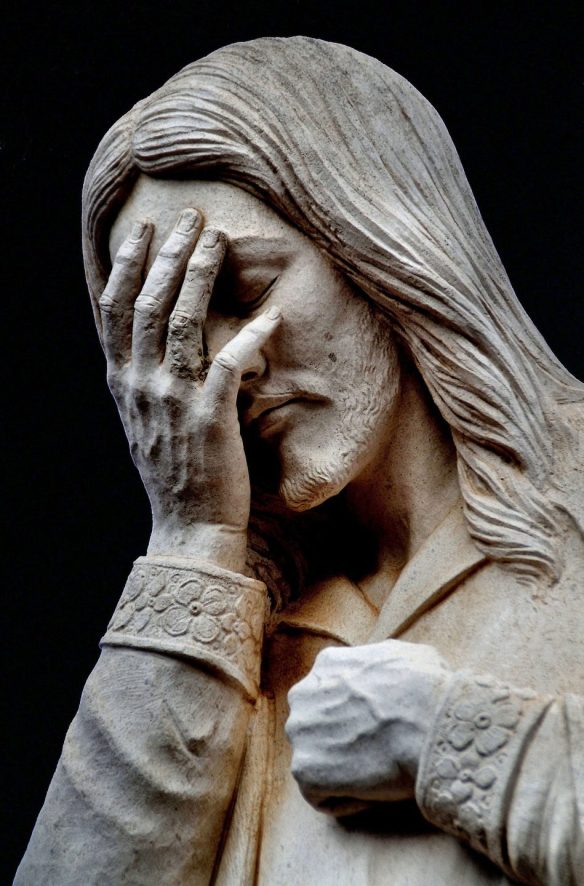
And Jesus wept…
When God was displeased with the Jews, he delivered Jerusalem to the enemy, and they were conquered by those who hated them; there were no more sacrifices or feasts. Likewise angered at a soul who had broken his commands, God handed it over to its enemies, who corrupted and totally dishonored it. When a house has no master living in it, it becomes dark, vile and contemptible, choked with filth and disgusting refuse. So too is a soul which has lost its master, who once rejoiced there with his angels. This soul is darkened with sin, its desires are degraded, and it knows nothing but shame.
Woe to the path that is not walked on, or along which the voices of men are not heard, for then it becomes the haunt of wild animals. Woe to the soul if the Lord does not walk within it to banish with his voice the spiritual beasts of sin. Woe to the house where no master dwells, to the field where no farmer works, to the pilotless ship, storm-tossed and sinking. Woe to the soul without Christ as its true pilot; drifting in the darkness, buffeted by the waves of passion, storm-tossed at the mercy of evil spirits, its end is destruction. Woe to the soul that does not have Christ to cultivate it with care to produce the good fruit of the Holy Spirit. Left to itself, it is choked with thorns and thistles; instead of fruit it produces only what is fit for burning. Woe to the soul that does not have Christ dwelling in it; deserted and foul with the filth of the passions, it becomes a haven for all the vices.
When a farmer prepares to till the soil he must put on clothing and use tools that are suitable. So Christ, our heavenly king, came to till the soil of mankind devastated by sin. He assumed a body and, using the cross as his ploughshare, cultivated the barren soul of man. He removed the thorns and thistles which are the evil spirits and pulled up the weeds of sin. Into the fire he cast the straw of wickedness. And when he had ploughed the soul with the wood of the cross, he planted in it a most lovely garden of the Spirit, that could produce for its Lord and God the sweetest and most pleasant fruit of every kind.
Image credit: Flevit super illam (He wept over it) | Enrique Simonet (1892) | Museo del Prado, Madrid | Wikimedia Creative Commons
This coming Sunday is the first Sunday in Advent. In the posts from yesterday we reviewed the context of the gospel as used in Advent and in the larger context of a unified gospel. In today’s post we pick up the idea that Matthew’s primary concern is pastoral so that the community continues in its discipleship even if the end is delayed.
John Meier (Matthew,291) notes that a good part of Ch. 24 in Matthew is spent in attempting to calm off-based eschatological (end-time) fervor and calculation. Something that even in our day has become a cottage industry as folks pore over Daniel and Revelation attempting to “crack the code” about the end-time when/where. The three rapid-fire parables in our gospel reading attempt to establish a proper eschatological fervor (watchfulness). The three parables (the generation of Noah, the two pairs of workers, and the thief in the night) announce the major theme of the second part of the discourse: vigilance and preparedness for the coming [parousia] of the Son of Man.
Continue readingToday’s readings place before us two very powerful images of history. In the first reading from the Book of Daniel, is the scene in the Book of Daniel when he is asked to interpret a dream of King Nebichadnezzar. In the dream there is a statue of gold, silver, bronze, iron, and clay; understood as giant empires rising and falling. In Luke’s Gospel, Jesus foretells the destruction of the Temple, a building so magnificent that people were “admiring how it was adorned with costly stones” (Lk 21:5). In both readings, we are reminded of the fragility of earthly things, passing things – even the things we think are permanent
All earthly kingdoms pass away. Daniel interprets Nebuchadnezzar’s dream: a statue of dazzling appearance, representing the great powers of the world. But Daniel also says: “A stone was hewn from a mountain without a hand being put to it… and it struck the statue… and crushed them” (Dan 2:34–35). And then Daniel gives the meaning: “The God of heaven will set up a kingdom that shall never be destroyed… it shall stand forever” (Dan 2:44).
Empires rise; they fall. New powers come; they fade. What looks permanent at the time ends up being temporary. We need that reminder today: nothing in this world—no nation, no power, no economy, no institution—is eternal. Only the kingdom of God lasts.
We are not to be dazzled by earthly splendor. In the Gospel, some people marvel at the beauty of the Temple. It was truly magnificent—one of the wonders of the ancient world. But Jesus says: “The days will come when there will not be left a stone upon another stone that will not be thrown down” (Lk 21:6). Even the Temple, the holiest place in Israel, would fall. Jesus is not trying to frighten us. He is trying to reorient us. He is reminding us that beauty and power are not the same as holiness and eternity. God invites us to place our trust not in the structures or successes of this world, but in Him alone.
Because God’s kingdom is already breaking into our world. When the stone in Daniel’s vision strikes the statue, Daniel says: “The stone… became a great mountain and filled the whole earth” (Dan 2:35). The Fathers of the Church saw this stone as a symbol of Christ. The Cornerstone rejected by the builders, yet chosen by God. And so Christ’s kingdom has already begun in His death and resurrection. And even as nations rise and fall, even as there are “wars and insurrections… earthquakes, famines, and plagues” (Lk 21:9,11), the kingdom of God continues to grow quietly, steadily, like a mountain that fills the earth. Not through force. Not through power. But through the holiness of God’s people, through the sacraments, through acts of mercy, forgiveness, and love.
What does this mean for us today? It means that the Christian life is not about predicting the end, nor about reading the “signs” with fear. Jesus specifically says: “Do not be terrified” (Lk 21:9). We don’t follow Christ to secure ourselves against worldly catastrophes. We follow Him because He alone is the kingdom that does not pass away.
So the question for us today is simple: Where is my heart anchored? In the things that pass away—or in the One who stands forever? When our hearts are anchored in Christ, even the storms of history cannot shake us. Even when earthly certainties collapse, our hope remains firm.
The great empires of Daniel’s vision are long gone. The stones of the Temple Jesus described have long since fallen. But the kingdom of Christ endures. And we are invited to belong to that kingdom—now, today, in this Eucharist.
May the Lord give us the wisdom to cling to what is eternal, to seek first the kingdom that “shall never be destroyed” (Dan 2:44), and to live unafraid, trusting in the One who reigns forever.
The One who is King of the Universe.
Image credit: Flevit super illam (He wept over it) | Enrique Simonet (1892) | Museo del Prado, Madrid | Wikimedia Creative Commons | PD-US
The first reading today is the scene in the Book of Daniel when he is asked to interpret a dream of King Nebuchadnezzar. In the world of eschatology (the part of theology concerned with death, judgment, and the final destiny of the soul and of humankind) this is one of the passages that fascinates all manner of interpretation
Key verses in the dream are:
| Tradition | Four Kingdoms | Stone / Mountain |
| Rabbinic Jewish | Babylon, Media, Persia, Greece | God’s final kingdom / restoration of Israel |
| Patristic Christian (2nd-5th century AD) | Babylon, Medo-Persia, Greece, Rome | Christ / Church / eternal kingdom |
| Modern Critical (Protestant & Reformed) | Babylon, Media, Persia, Greece | God’s intervention after Antiochus IV |
| Dispensational Futurist (Evangelical etc.) | Babylon, Medo-Persia, Greece, Rome → revived Roman empire | Christ at Second Coming, millennial kingdom |
| Catholic | Either traditional (Rome) or historical-critical (Greece) | Christ’s kingdom, both present and future |
These verses and its elements form a basis of a “dispensational” view of time. In this context, the “dispensations” are times in history vis-a-vis the Kingdom of God. When considered from an eschatology perspective there are some basic questions, whose answers means that “dispensationalism” is not monolithic. Differences appear when when discerning if the “Kingdom” is now, even if only partially revealed; does the visible Church on earth represent (or even part of) the Kingdom; what are the four empires; what is the relationship of kingdom of the 2nd Coming of Jesus; and the list goes on…
Within Dispensationalism there are distinct schools of interpretation of Daniel 2 (and prophetic texts generally). They agree on certain basics—the four kingdoms end with a revived Roman empire, the stone is Christ at His Second Coming, the Church is not the kingdom of Daniel 2, etc.—but there are real differences.
| Dispensational View | Stone = Christ’s Kingdom? | Is It Already Present? | Ten Toes? | Church in Daniel 2? |
| Classical | Second Coming only | No | Literal 10 kings | No |
| Revised/Modified | Second Coming | No (or partial) | Literal or symbolic | No |
| Progressive | Inaugurated now, fulfilled later | Yes (but not fully) | Symbolic for final rulers | No |
| Apocalyptic Literalist | Dramatic Second Coming | No | Literal 10-nation confederacy | No |
| Two-Phase Roman Empire | Second Coming | No | Literal or flexible | No |
This coming Sunday is the first Sunday in Advent. In an earlier text from today, we introduced the two-fold character of Advent. In this post we consider Matthew’s perspective of the End Time. The post is on the longer side and deals more with the text in a larger context and less so about its use in Advent.
Eugene Boring (Matthew, 457-58) notes Matthew 24 is not an “eschatological discourse” that presents Matthew’s or Jesus’ doctrine of the end, but is part of chaps. 23-25, whose aim is pastoral care and encouragement. Although he has included the “little apocalypse” of Mark 13 into this larger framework, Matthew (affirms but) reduces the significance of apocalyptic per se, subordinating it to other, more directly pastoral concerns. Matthew’s focus is judgment and warnings on Christian discipleship oriented toward the ultimate victory of the reign of God represented in Christ.
Matthew focuses on this by a variety of pictures that are sometimes at odds and sometimes in agreement. No one picture can do justice to the transcendent reality to which it points. There are basically two types of pictures:
“Beware of men, for they will hand you over to courts and scourge you in their synagogues, and you will be led before governors and kings for my sake as a witness before them and the pagans” (Mt 10:17-18)
Today we celebrate the martyrdom of Fr. Andrew-Dung-Lac and Companions. The title of the memorial is a bit misleading – its title follows the tradition of the General Roman Calendar. But in other places and times the name of the celebration is known as a feast dedicated to the Vietnamese Martyrs, the Martyrs of Annam, the Martyrs of Tonkin and Cochinchina, or the Martyrs of Indochina.
What is being remembered today is perhaps the most deadly of all Catholic persecutions. During a period from 1745-1862, the Vatican estimates that 300,000 to 400,000 of the faithful were martyred.The final 30 years were particularly brutal. There are 117 names that are known, and alphabetically Andrew Dung-Lac begins the list.
The letters and example of Fr. Théophane Vénard (Paris Foreign Mission Society) inspired the young Saint Thérèse of Lisieux to volunteer for the Carmelite nunnery at Hanoi, though she ultimately contracted tuberculosis and could not go.
The tortures these individuals underwent are considered by the Vatican to be among the worst in the history of Christian martyrdom. The torturers hacked off limbs joint by joint, tore flesh with red hot tongs, and used drugs to enslave the minds of the victims. Christians at the time were branded on the face with the words “tả đạo” meaning “sinister religion”. Families and villages which professed Christianity were obliterated. “The souls of the just are in the hand of God, and no torment shall touch them. (Wisdom 3:1).
When I read of the faithful and heroic people such as these, I often recall the words of St. Francis of Assisi: “It is a great shame for us, the servants of God, that the Saints have accomplished great things and we only want to receive glory and honor by recounting them.” (Admonition 6)
Pope John Paul II canonized the 117 martyrs together on June 19, 1988. At the time, the Vatican said, the communist government of Vietnam did not permit a single representative from the country to attend the canonization. But 8,000 Vietnamese Catholics from the diaspora were there, “filled with joy to be the children of this suffering Church.” (Catholic News Agency)
Image credit: This work of art was displayed at St. Peter’s on the occasion of the Vatican’s Celebration of the Canonization of 117 Vietnamese Martyrs on July 19, 1988. | Credit: Public domain
This coming Sunday is the first Sunday in Advent and the first Sunday of the new liturgical year, Cycle A, in which the Gospel of Matthew is the anchor text for the next 12 months. The readings are not very “Chrismassy” nor are they intended to be. Advent is a different season. Advent has a two-fold character: as a season to prepare our hearts for Christmas when Christ’s first coming is remembered with joy and as a season when that remembrance directs the mind and heart to await Christ’s second coming at the end of time. Advent is thus a period of devout and joyful expectation with an element of repentance as part of the preparation.
The readings for the First Sunday of Advent serve as a transition from the celebrations of Christ the King Sunday into the new year. The readings are replete with a strong theme of “staying awake” and being “prepared” for the days to come when the promises to Israel will be fulfilled.
This text is part of the fifth discourse in Matthew (24:1-25:46), which centers on the coming of the Son of Man – and that does not necessarily imply “end times” as in end-of-the-world. The theme for the 1st Sunday in Advent (for all three years) is preparedness – in the everyday of life as well as for the end of life. What is common to all times is the victory of the reign of God.
Continue reading friarmusings