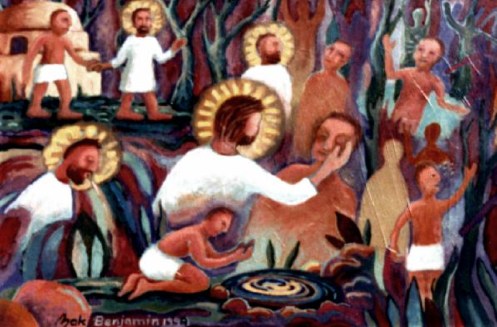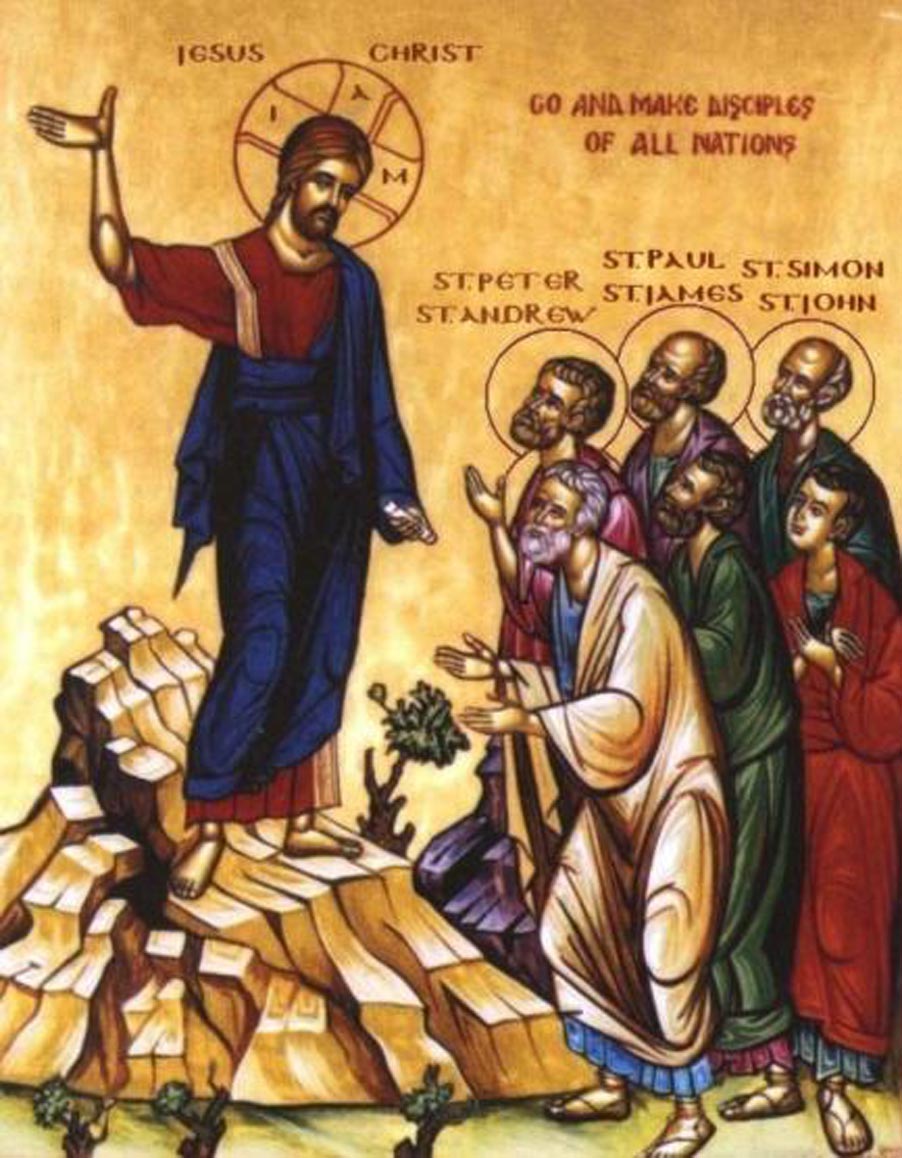
The 4th Sunday (Year A) and All Saints Day includes (a) the setting of the entire discourse and (b) the opening section, universally known as the Beatitudes. Beatitudes are found elsewhere in Matthew (11:6; 13:16; 16:17; 24:46) and more frequently in Luke. They are based on a common form of expression in the poetical books of the Old Testament (e.g. Pss. 1:1; 32:1–2; 40:4; 119:1–2; 128:1), but nowhere in the Old Testament or other Jewish literature is there so long and carefully constructed a series as here. A beatitude (Latin) or makarism (Greek) is a statement in the indicative mood beginning with the adjective makarios, declaring certain people to be in a privileged, fortune circumstance. It is not original to Jesus but occurs frequently in the OT as well as in non-Scriptural Jewish and pagan writings. Used here, the beatitudes reflect the Jewish use and setting: wisdom and prophecy. Continue reading
Beatitudes: context
This coming weekend, the Catholic Church will celebrate the Solemnity of All Saints. The readings for that celebration are a departure from the lectionary cycle of the Gospel according to Mark.
The Sermon on the Mount
1 When he saw the crowds, he went up the mountain, and after he had sat down, his disciples came to him. 2 He began to teach them, saying: 3 “Blessed are the poor in spirit, for theirs is the kingdom of heaven. 4 Blessed are they who mourn, for they will be comforted. 5 Blessed are the meek, for they will inherit the land. 6 Blessed are they who hunger and thirst for righteousness, for they will be satisfied. 7 Blessed are the merciful, for they will be shown mercy. 8 Blessed are the clean of heart, for they will see God. 9 Blessed are the peacemakers, for they will be called children of God. 10 Blessed are they who are persecuted for the sake of righteousness, for theirs is the kingdom of heaven. 11 Blessed are you when they insult you and persecute you and utter every kind of evil against you (falsely) because of me. 12 Rejoice and be glad, for your reward will be great in heaven. Continue reading
Being merciful
“Jesus, son of David, have pity on me.” (Mark 10:47). Is “pity” what we desire in our lives? Do you want to be pitied? When I ask people about the word “pity,” how we understand and use it, despite what the Merriam-Webster dictionary says, “pity” does not have a positive connotation in everyday usage. Pity is that thing that we shower upon the unfortunate, a distant regret for their plight, a thankful prayer that it is not us. Continue reading
The between times
Life can be a whirl and flurry to things to do, places to go, people to see – and every one of them good and holy. As you can imagine, the Mass of Belonging took a good amount of effort, attention, and energy. The work and planning began about 4-5 months ahead of the celebration, took a lot of attention of the staff, and the commitment of almost 300 volunteers. While first meeting with the staff and making sure we were committed to the endeavor, I noted that this would be like “trying to rewire a house while keeping the lights on at all times.” Continue reading
Faith that saves: asking
The Petition. 51 Jesus said to him in reply, “What do you want me to do for you?” The blind man replied to him, “Master, I want to see.” 52 Jesus told him, “Go your way; your faith has saved you.” Immediately he received his sight and followed him on the way.
Jesus replied, “What do you wish me to do for you?” One might note that either I miscopied v.51, but the astute student will know that I am citing v.36 when James and John ask for the places of honor. In both verses the verb is thelō. Again Mark is drawing our attention to the differences, this time between Bartimaeus and the disciples. Where they ask for glory, power, and prestige, the blind ask for mercy and healing. The blind man’s faith was recognized by the Lord as an affirmation of confident trust in the gracious mercy of God and his power to heal (cf Mark 5:34). The healing was immediate. Continue reading
Faith that saves: mercy
A Cry for Mercy. In other healing scenes, the one healed is told to “go” and not say anything about the miracle. This phenomenon is described as the Mark’s “messianic secret.” There are many speculations as to why Jesus does not want word of his mighty deeds know far and wide. The one in which I hold to be more likely is the one in which Jesus does not want people’s perception of his Glory to be seen in the miracles and mighty deeds, but wants them to see the Glory fully revealed on the cross when they can see that God’s love for them has no limits. Now that they are close to the time of the cross, Jesus will not tell Bartimaeus to remain silent. Any attempt to silence the blind man falls to the crowd. Continue reading
Faith that saves: on the way
The passage is the last healing and miracle in the Gospel of Mark. It is easily passed over as another miracle among many, but the story of Bartimaeus (bar-Timeaeus; lit. Son of Timeaus) is in some ways the most significant since it is the one miracle not recorded in the Hebrew Scriptures. There are general promises in Isaiah that promise healing and deliverance (Isaiah 29:1; 32:1-3; 35:1-10) along with specific promises that in the day of the Messiah the blind will have their sight restored (Is 42:18; 61:1-4). Continue reading
Faith that saves: context
46 They came to Jericho. And as he was leaving Jericho with his disciples and a sizable crowd, Bartimaeus, a blind man, the son of Timaeus, sat by the roadside begging. 47 On hearing that it was Jesus of Nazareth, he began to cry out and say, “Jesus, son of David, have pity on me.” 48 And many rebuked him, telling him to be silent. But he kept calling out all the more, “Son of David, have pity on me.” 49 Jesus stopped and said, “Call him.” So they called the blind man, saying to him, “Take courage; get up, he is calling you.” 50 He threw aside his cloak, sprang up, and came to Jesus. 51 Jesus said to him in reply, “What do you want me to do for you?” The blind man replied to him, “Master, I want to see.” 52 Jesus told him, “Go your way; your faith has saved you.” Immediately he received his sight and followed him on the way. (Mark 10:46-2) Continue reading
Finding the Source
Are you smarter than a 5th grader? OK, what is the longest river in the world? Gotta’ be the Nile River, right? It flows 1,700 miles from Khartoum, Sudan to the Mediterranean Sea – and that is just where the White and Blue Niles meet. You can follow the White Nile south to Lake Victoria bordering Uganda… and then the arguments begin on what is the source of any river. Clearly rivers, streams, and the like flow into Lake Victoria – do you get to keep following the water flow? Even as recently as 2006 the geographers and cartographers were seeking the “headwaters of the Nile River.” The most recent claim is a muddy hole in Nyungwe Forest in southwest Rwanda. The forest area is spectacular, the muddy hole not so much. Personally, I would have taken Lake Victoria as the headwater. Think about it: a great lake giving greatness to the greatest river. Continue reading
What ever you do…
Earlier in the calendar year, here in this column, we talked about belonging as the gateway to a life of faith as an individual, as a family, and as a believing community. While we are prone to think the people of faith are the ones who belong, in fact, it is people who find an abiding sense of belonging to a worshipping community that become people of faith. In fact, that sense of belonging imbues and precedes almost every aspect of community life: faith, worship, stewardship, volunteering, and so much more. In the weeks since our celebration of the Mass of Belonging, consider the way in which people continue to talk about their experience of the Mass. Part of that conversation has been the experience of seeing so many people under one roof, so many voices raised in praise to God, and knowing this is family. Belonging. Continue reading