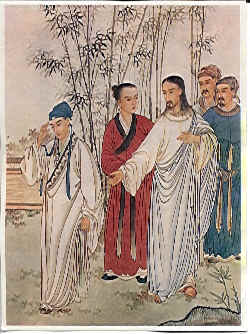
The desert: driven

christ+in+the+wilderness12 At once the Spirit drove him out into the desert, 13 and he remained in the desert for forty days, tempted by Satan. He was among wild beasts, and the angels ministered to him.

The account of the baptism moves immediately into Jesus’ test in the wilderness (eremos) as seen in the phrase “At once.” Jesus’ expulsion into the desert is the necessary consequence of his baptism; it is the same Spirit who descended upon Jesus at his baptism who now forces him to enter more deeply into the wilderness. In Mark, the Spirit is “casting out” or “throwing out” (ekballo) Jesus into the wilderness. (Matthew and Luke are a bit less graphic with the Spirit “leading” [anago & ago] Jesus.) In the wilderness Jesus is to be tested (peirazo) by Satan (Mk) or the Devil (Mt & Lk). Continue reading

Shrove Tuesday

Shrove TuesdayShrove Tuesday is the day preceding Ash Wednesday. The day is observed by many Christians, including Anglicans, Lutherans, Methodists and Roman Catholics, who are called to make a special point of self-examination, of considering what wrongs they need to repent, and what amendments of life or areas of spiritual growth they especially need to ask God’s help in dealing with – and then carry those reflections into the season of Lent.

The idiom “short shrift”means brief and unsympathetic treatment.Shrift comes from the archaic verb shrive, meaning to obtain absolution for one’s sins by way of Confession and doing penance. Shrove Tuesday shares that linguistic origin. In its original form short shrift referred to a brief period of penance granted to a person condemned to death so he or she could be cured of immorality before execution.This original meaning has little relation to the modern sense of short shrift, which usually bears negative connotations. One usually does not want to be given short shrift.

May we priests not give “short shrift” to penitents seeking to draw closer to God. May all of God’s faithful not give “short shrift” to our reflections and on-going conversion in this Lenten season.

The desert: context

christ+in+the+wilderness12 At once the Spirit drove him out into the desert, 13 and he remained in the desert for forty days, tempted by Satan. He was among wild beasts, and the angels ministered to him. 14 After John had been arrested, Jesus came to Galilee proclaiming the gospel of God: 15 “This is the time of fulfillment. The kingdom of God is at hand. Repent, and believe in the gospel.” Continue reading

Outside the camp

jesus-healing-leperHe shall dwell apart, making his abode outside the camp.” For me these are frightening and dreadful words. Spoken to a person in the wilderness, a person on the Exodus betwixt and between the slavery of Egypt and the promised land of Palestine. These are words spoken about brothers, sisters, mothers, and fathers – now shunned to a life apart, a life without. No longer part of the only social fabric they had known. They are words which mean that you do not belong; and may soon not be remembered. Continue reading

Belonging: pew communities

Belonging_crSix weeks ago I started a series in this column space that began to explore what it means to say “I belong to Sacred Heart.” I hope you have been following the flow of musings and thoughts – if not – let me touch upon a few points. There are almost 3,000 households that are registered, but then “registered” is not the kind of belonging we are thinking about. There is a group of 500 (or so) households that volunteer, serve, minister, open parish emails, give in an identifiable way, and contribute to the annual appeal. This smaller group certainly demonstrates more of the characteristics that would seem to point to a greater sense of belonging. But along the way, we made the point that all these great external characteristics are the result of belonging, not the precursor to belonging. Continue reading

Be made clean: silence

jesus-healing-leper45 The man went away and began to publicize the whole matter. He spread the report abroad so that it was impossible for Jesus to enter a town openly. He remained outside in deserted places, and people kept coming to him from everywhere.

The Man Responds. This incident has an important position in the Marcan outline. It serves to terminate the preaching tour of the Galilean villages and provides the point of transition to the five accounts of controversy which follow (Ch. 2:1–3:6). The pericope establishes the surpassing nature of the salvation which Jesus brings, for while the Law of Moses provided for the ritual purification of a leper it was powerless to actually purge a man of the disease. In all of the OT only twice is it recorded that God had healed a leper (Num. 12:10 ff.; 2 kings 5:1 ff.), and the rabbis affirmed that it was as difficult to heal the leper as to raise the dead. The cleansing of the leper indicates the new character of God’s action in bringing Jesus among men. Salvation transcends cultic and ritual regulations, which were powerless to arrest the hold that death had upon the living, and issues in radical healing. Continue reading

Be made clean: Jesus

jesus-healing-leper

41 Moved with pity, he stretched out his hand, touched him, and said to him, “I do will it. Be made clean.” 42 The leprosy left him immediately, and he was made clean. 43 Then, warning him sternly, he dismissed him at once. 44 Then he said to him, “See that you tell no one anything, but go, show yourself to the priest and offer for your cleansing what Moses prescribed; that will be proof for them.”

Jesus’ Actions. The treatment of Jesus consisted of a gesture and a pronouncement. The touch of Jesus was significant from two points of view. From the perspective of the leper it was an unheard-of act of compassion which must have moved him deeply and strengthened him in his conviction he had not asked for help in vain. From the perspective of Jesus’ relationship to the cultic and ritual system, it indicated that he did not hesitate to act in violation of its regulations when the situation demanded: “the ceremonial law gives place to the law of love when the two come into collision.” Jesus’ touch and his sovereign pronouncement mean the same thing: “I do will it. Be made clean.” This was not a priestly pronouncement, as is made clear in verses 43–44, but a declaration that healing would follow immediately and completely. The text describes an instantaneous radical healing which was visible to all who met the man. Continue reading

Be made clean: the man

jesus-healing-leper40 A leper came to him (and kneeling down) begged him and said, “If you wish, you can make me clean.” 41 Moved with pity, he stretched out his hand, touched him, and said to him, “I do will it. Be made clean.” 42 The leprosy left him immediately, and he was made clean.

Leprosy and the Man. The identification of the man who came to Jesus as “a leper” is not as precise as at first glance it may seem. Medical researchers who have examined the biblical data in Lev. 13–14 feel certain that the biblical term “leprosy” is a collective noun designating a wide variety of chronic skin diseases, one of which may have been interpreted in the modern sense of the word. Continue reading

Be made clean: context

jesus-healing-leper40 A leper came to him (and kneeling down) begged him and said, “If you wish, you can make me clean.” 41 Moved with pity, he stretched out his hand, touched him, and said to him, “I do will it. Be made clean.” 42 The leprosy left him immediately, and he was made clean. 43 Then, warning him sternly, he dismissed him at once. 44 Then he said to him, “See that you tell no one anything, but go, show yourself to the priest and offer for your cleansing what Moses prescribed; that will be proof for them.” 45 The man went away and began to publicize the whole matter. He spread the report abroad so that it was impossible for Jesus to enter a town openly. He remained outside in deserted places, and people kept coming to him from everywhere. Continue reading

Hands of compassion

TheAnnunciationThe story of Job is the well-known biblical account in which a person’s life goes from prosperity and security, from joy to despair – and Job is the one who asks aloud what some of us only whisper – where is God in all of this? Job watches while his life unravels losing prosperity, family and feeling that the entirety of his life under assault. He has looked into his life and his heart, searching for his sin, then at least he imagines he can reconcile what has happened to him. But he is a blameless and upright man. Just when he thinks he had suffered and so much taken from him, then the assault encompasses his own body and he grows sick and covered with sores. No wonder he laments: My days … come to an end without hope. …. I shall not see happiness again. Continue reading