
 Pope Francis has announced a Year of Mercy that began last Tuesday, December 8th . The Holy Father has asked that it be a church-wide celebration and reflection on God’s mercy, so that we can intentionally be sources of that Mercy in the world.
The logo of the celebration comes from Luke 6:36, “Be merciful as the Father is merciful,” that appears alongside an image that deserves some inspection and reflection. The logo is oddly shaped – rather looking like an almond. The almond shape, called a mandorla, was a feature of early and medieval iconography. When used with the image of Christ, it invites the viewer to reflect on the two natures of Christ, divine and human. The differing color bands of blue, increasingly darker as one moves inward is also a recurring theme in these icons. It reflects what is called the “apophatic way” on reflecting on God. In the apophatic way, it acknowledges that there is mystery at the center of the way – a mystery that is, in the end, impenetrable, but nonetheless calls us ever inward in reflection. At the center of the darkest color, where Jesus’ feet are positioned, is the great mystery of the Incarnation – that in the person of Jesus, humanity and divinity are joined: “And the Word became flesh and made his dwelling among us, and we saw his glory, the glory as of the Father’s only Son, full of grace and truth.” (John 1:14) Continue reading

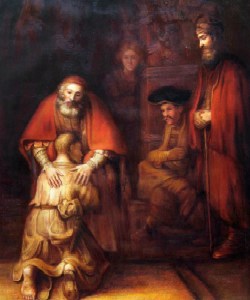 Final Thoughts (from Culpepper, 304-5)

 This past May I was visiting friends and relatives in the Washington DC area. I got to spend a couple of days out in Loudoun County, Virginia, to the north and west out along the Potomac River. I used to own a home out in those parts in a little hamlet two wrong turns off the dirt road. After growing up in Florida and always living near the ocean, suddenly I was inland and living on the first ridge of the Blue Ridge Mountains. I also managed to set up house in a country without a public swimming pool. After I-can’t-remember-how-many years of swimming, I suddenly needed a new sport.

