“He went throughout (the) whole region of the Jordan, proclaiming a baptism of repentance for the forgiveness of sins” (Luke 3:3)
The basic meaning of the verb baptizo is “to wash,” which is how it is translated in Luke 11:38 (re: ritual washing before meals). The word often also carries, in context, ritual or purifying aspects to the washing. This image is used by Luke in Acts 22:16: “Get up, and have yourself baptized (baptisai) and your sins washed away (apolouo), calling on his name.” When one surveys the reports in the Gospels concerning John’s baptism (Mark 1:2–6), the origin and significance of which was debated (Matt 21:25; Mark 11:30; Luke 20:4), one notices: Continue reading →
In today’s reading from Isaiah 25:6-10, the prophet begins with the image of a banquet: “On this mountain, the LORD of hosts will provide for all peoples a feast of rich food and choice wines.” This is not a night out at the Ponderosa; it is more than mean. It is the banquet symbolizing God’s desire to gather His people – all people – into communion with Him. It is a vision of abundance, joy, and unity. In a world often marked by scarcity and division, this image reassures us of God’s boundless generosity and the inclusivity of His Kingdom. All are invited—there is no one excluded from His loving embrace.
This coming Sunday is the 2nd Sunday in Advent. Just as in so many instances in the Old Testament, the gravity of the moment is captured, as it is here in Luke, with the direct proclamation: “…the word of God came to John the son of Zechariah in the desert.” The phrase serves to call to the fore the expression in 3:2, “the word of God came.” At the beginning of the public ministry Luke ensures we are clear regarding his core and central focus: the action and desire of God in the world. In this he echoes the proclamation from the prophet Isaiah: “So shall my word be that goes forth from my mouth; It shall not return to me empty, but shall do what pleases me, achieving the end for which I sent it.” (Is 55:11) What God has promised, He will achieve in his Son, Jesus. Continue reading →
The entire first reading (Isa 11:1-10) gives us a prophetic vision of the coming Messiah, a figure who will bring justice, peace, and harmony to all creation. Today’s first reading also offers two quite famous verses we have all encountered:
“But a shoot shall sprout from the stump of Jesse, and from his roots a bud shall blossom.” (Isaiah 11:1)
“The wolf shall be a guest of the lamb, and the leopard shall lie down with the young goat..” (Isaiah 11:6)
1 In the fifteenth year of the reign of Tiberius Caesar, when Pontius Pilate was governor of Judea, and Herod was tetrarch of Galilee, and his brother Philip tetrarch of the region of Ituraea and Trachonitis, and Lysanias was tetrarch of Abilene, 2 during the high priesthood of Annas and Caiaphas, the word of God came to John the son of Zechariah in the desert.
The chronological data of these verses reflects the conventions of Greco-Roman historiography as well as a pattern found in some Jewish prophetic books (Jer 1:1-3; Ezek 1:1-3; Hos 1:1; Isa 1:1). Luke seeks to place his “orderly account” (Lk 1:1) within the context of “world” history. In addition, this writing, addressed to “Most Excellent Theophilus” (Lk 1:3), places the events within the context of the rulers and times (and some historiographic forms) that Theophilus would know. It is likely that he was some type of Roman official. Continue reading →
The first readings for these beginning days of Advent are all taken from the Book of Isaiah. It is a complex book in many ways and it is one of the most cited books of the Old Testament by New Testament writers indicating the importance and esteem it holds in the scriptural imagination. You can read a short introduction to the book here.
Today the first reading is taken from Isaiah 2:1-5, whose opening is duplicated almost exactly in Micah 4:1–3. Like Isaiah, Micah was an eighth-century prophet of the southern kingdom. Both prophets held Mount Zion to be a sacred mountain, the center of the earth, and important for the whole world – the same sentiment expressed in Psalms 46–48.
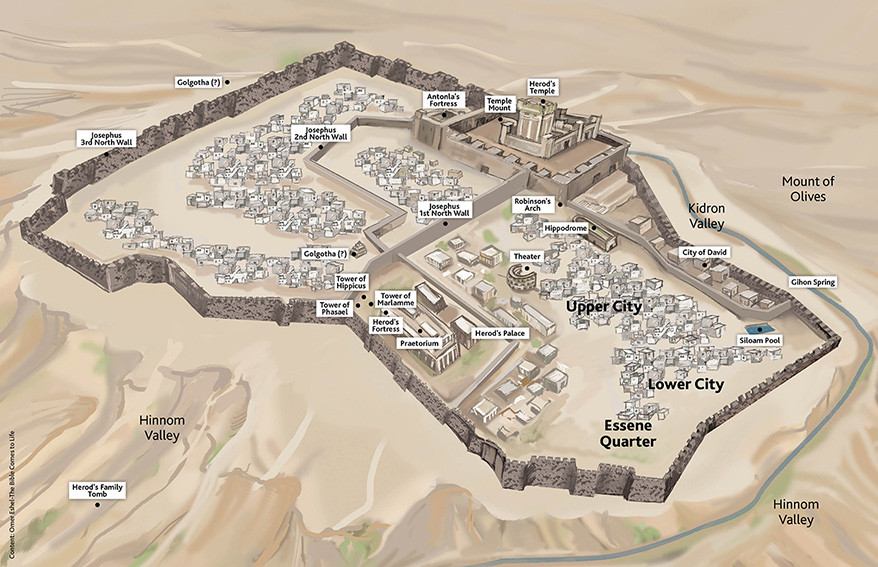
In the course of reading Scriptures you will often encounter the terms “Mt. Zion”, “Jerusalem”, and the “City of David.” Are the terms identical? Are they all actual locations? Do they carry symbolic meaning? Perhaps it is good to offer a brief post on what this all means.
Originally, Mount Zion referred specifically to the Jebusite fortress that King David conquered and made his capital (2 Samuel 5:7): “But David did capture the stronghold of Zion, which is the City of David.” The City of David is located south of what in our day is referred to as the “Old City” of Jerusalem, in a ridge area. The term “City of David” is often synonymous with the earliest settlement of what became Jerusalem.
In his efforts to unify all the tribes on Israel into one nation, David relocated the Ark of the Covenant to Zion indicating that God’s presence among His people was not centered on Zion and in the City of David: “The Ark was brought into the City of David with great rejoicing.” (2 Samuel 6:12-19). While David offered to build the Lord a “house,” construction of the Temple fell to David’s son, Solomon. The Temple was built on Mount Moriah, a part of the broader Zion area (1 Kings 8:1).
Zion is repeatedly described as a place of refuge and a symbol of God’s kingship over Israel (Ps 2:6). Today’s first reading holds the prophetic promise that the Law and the Word of the Lord will come forth from Zion, promising the possibility of divine wisdom and peace. “From Zion shall go forth instruction, and the word of the LORD from Jerusalem.” (Isa 2:3)
Zion is envisioned as the site of the Messiah’s reign, bringing justice and peace to all nations: “Rejoice heartily, daughter Zion… See, your king shall come to you.” (Zechariah 9:9) Zion is identified with the heavenly city, the ultimate destination of God’s faithful. In Revelation, the Lamb (Christ) stands victorious on Mount Zion with His redeemed people: “Then I looked, and there was the Lamb standing on Mount Zion, and with him a hundred and forty-four thousand.” (Rev 14:1)
There are several theological themes that are thus associated with Zion
God’s Presence: Zion represents God’s dwelling among His people, through the Ark, the Temple, and ultimately through Christ.
Redemption and Restoration: Zion is a symbol of hope, where God restores His people and fulfills His promises.
Eschatological Hope: The heavenly Zion is a vision of eternal communion with God. In the New Testament, associated with the heavenly Jerusalem (Hebrews 12:22)
Where does Jerusalem fit into all of this? It doesn’t “fit it” but rather surrounds it all. As the capital of Israel grew, it outgrew the City of David and expanded to encompass the ancient settlement and Mount Zion. Jerusalem then took on all the historical and theological significance from both the City of David and Mount Zion and then served as the central city in biblical history and prophecy.
On the previous Sunday, the first Sunday in Advent, we considered a passage taken from the stream of Luke’s discourse on the destruction of the Jerusalem Temple, the signs of the end, warnings about the coming persecutions, the Great Tribulation, and finally the gospel passage about the coming Son of Man (all from Luke 21). The text included: “People will die of fright in anticipation of what is coming upon the world, for the powers of the heavens will be shaken. And then they will see the Son of Man coming in a cloud with power and great glory.” (Luke 21:26-37). To our modern mind, a rather odd choice for the first Sunday of Advent. But then our modern minds think of Advent as the gateway to prepare for Christmas. And therein lies the problem. As explained previously, Advent begins in the shadow of the celebration of Christ as King of the Universe. Considering that, suddenly the reading for the first week of Advent makes sense – we are to prepare for the Second Coming of Jesus, what the prophets called “the day of the Lord.” Continue reading →
“The days are coming…[when] Judah will be made safe and Jerusalem shall dwell secure.” Such was the promise of the prophet Jeremiah to the beleaguered people of the City of David under the ominous cloud of war and death – the power of the Egyptian King Neco to the south and the armies of the Babylonian King Nebuchadnezzar to the north and east. That was then. Where are the prophets now when Jerusalem is a divided city and the missiles of Hezbollah, Hamas and Iran have the City of David within their reach. Are the prophets now replaced by the anti-missile technology of the Iron Dome? The system promises to protect Israel, but it cannot promise to save Israel, to make Jerusalem safe and secure. Continue reading →
Advent is the liturgical season that precedes and prepares for Christmas. It is a season of hope and of longing, of joyful expectation and of peaceful preparation. Many symbols and traditions are associated with Advent, especially the Advent Wreath with its four colored candles (three purple and one pink), but also Advent calendars, special Advent music, food, processions, and other traditions that may vary from one culture or region to the next. Here are a few interesting things to know about Advent: Continue reading →

 friarmusings