
Descent from the Cross

Museum of the Bible in Washington DC has a beautiful exhibition, Descent from the Cross. This exhibition explores how 21 artists across five centuries, multiple genres, and mixed media have visualized the scene in The Gospel of John, chapter 19, the moment Jesus is removed from the cross. This moment, traditionally called “Deposition” or “Descent from the Cross,” is not described in the Bible. There are no details explaining the process or who was present. Because of this, artists across the centuries have interpreted this emotional moment in unique and varying ways, each filling in the blanks with what they think might have happened. It has become a popular scene in art history, and thus a part of our shared visual language.

The earliest-known renderings of the scene appeared in the ninth century and soon became part of a cycle through the life of Christ and his passion, later known as the Stations of the Cross. But perhaps the most influential depiction was painted by Flemish master painter Rogier van der Weyden in 1435. The unique shape of the composition and the cramped “box” that the characters occupy create a theatrical look, like that of a stage play or a diorama. The sharp angles and rich details reflect the late Gothic, early Renaissance styles of northern Europe, and the crossbows seen in the corners honor the patron of this piece, the Leuven Guild of Archers.

Museum of the Bible
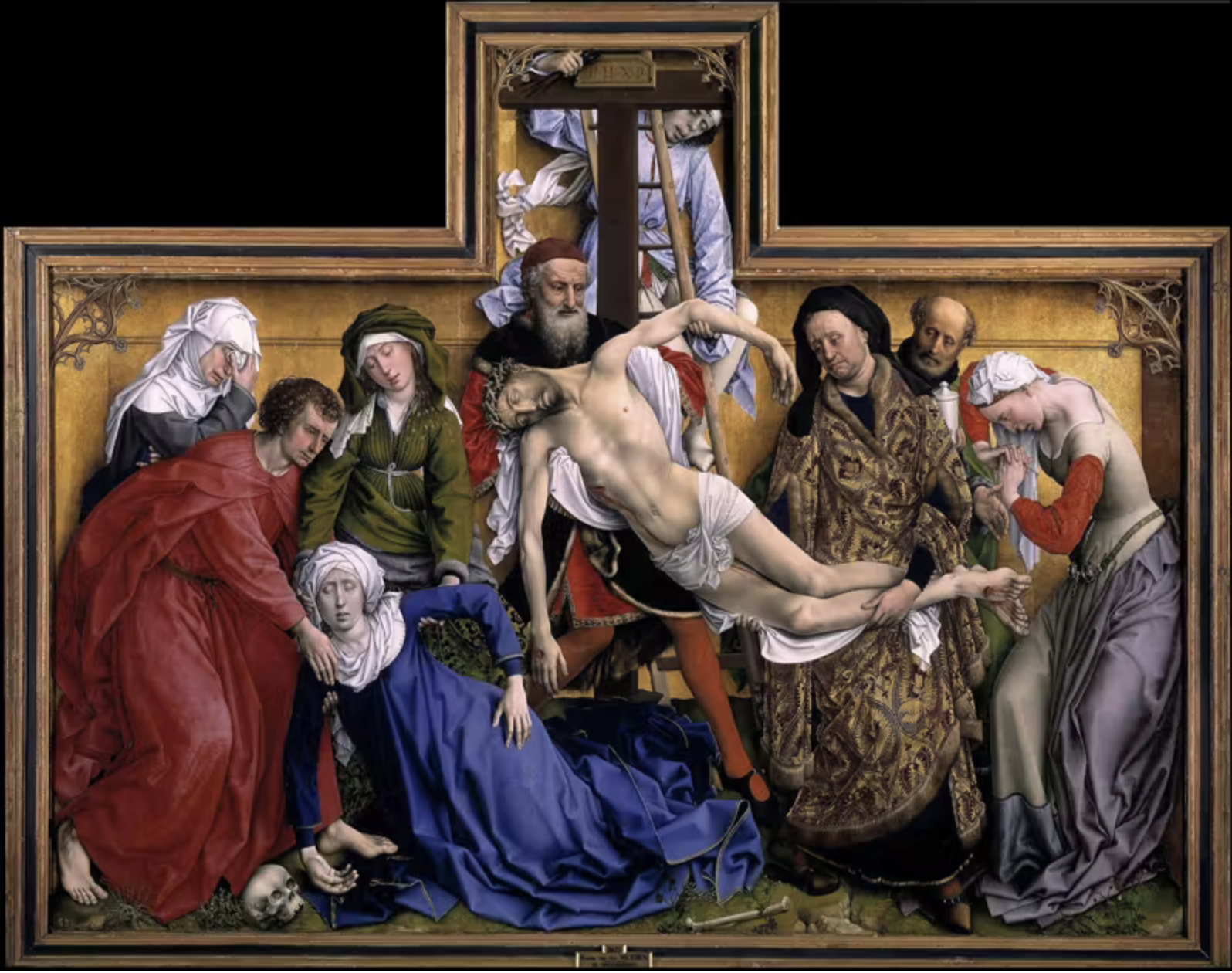
You can see the exhibit virtually at the Museum’s website by clicking the button below.


Image credit: Descent from the Cross | Rogier van der Weyden, ca. 1435 | Museo del Prado, Madrid | PD-US
Our Cross

The English language is a colorful landscape of idioms, expressions and all manner of this and that. Sometimes it is like exploring the attic in your grandparent’s house. Never know what you’ll find. I have always enjoyed exploring the etymology, that is, the origins of words and expressions. One of our common expressions is used when we see someone who has to accept or is stuck in an unpleasant situation or responsibility because there is no way to avoid dealing with it. We remark “that’s their cross to bear.” Continue reading

The True Cross

The image above is a painting, “Finding of the True Cross” by Agnolo Gaddi. It came to mind when preparing for this reflection and as a popular expression came to mind: “that’s their cross to bear.” What that means  is that the person must accept an unpleasant situation or responsibility because there is no way to avoid dealing with it.  What’s more, it’s a situation or responsibility that can’t be shared or passed along to someone else.  The idiom is used to refer to an emotional or mental burden that brings with it a marked amount of stress and suffering, and generally does not refer to a physical burden. Continue reading

Pope Francis: a reflection on the Cross

From the September 4, 2014 Angelus reflection by Pope Francis:

On 14 September the Church celebrates the Feast of the Exaltation of the Holy Cross. Some non-Christian person might ask: why “exalt” the Cross? We can respond that we do not exalt any cross whatsoever or all crosses: we exalt the Cross of Jesus, because in it God’s love for humanity was fully revealed. That’s what the Gospel of John reminds us of in today’s liturgy: “God so loved the world that He gave his only Son” (3:16). Continue reading

Crucible

Today’s “Word of the Day” from Merriam-Webster is “crucible.”  I like to see if I can guess at the etymological origin of the words. My guess for “crucible” was founded on the Latin cruc (“cross”). Alas it was not. It is based on the Medieval Latin crucibulum, a noun for an earthen pot used to melt metals, and in English it first referred to a vessel made of a very heat-resistant material (such as porcelain) used for melting a substance that requires a high degree of heat. But It’s possible that the resemblance between cruc- and crucible encouraged people to start using crucible to mean “a severe trial,” as that sense is synonymous with one meaning of cross.

Nearsighted

Whoever does not carry his own cross and come after me cannot be my disciple.” It is one thing to carry a cross that is your own, but this cross thrust upon him unjustly. It the cross of someone else’s making. Why would he or she carry it, have to carry it, or even willingly carry it?

In 1982 Thomas Webb III moved from Chicago to Norman, Oklahoma. As best he could see, it seemed like a reasonable move. There wasn’t a lot happening for him in Chicago and a friend said there was opportunity and fun in and around the University of Oklahoma campus.  Why not? In 1983 he was convicted of rape, burglary, and other crimes and sentenced to 60 years in prison. He always maintained his innocence but he had been picked out of lineup on two separate occasions. The victim was unshakeable in her identification. Continue reading

From seeing to believing

In today’s gospel we see Jesus in an encounter with the Pharisees as time rapidly approaches the events we know as Holy Week. The Pharisees and other religious leaders have had about three years of reports, stories, encounters and more about this itinerant preacher from Galilee. How is it that the son of a carpenter is so well versed in Scripture and such a gifted orator? What about the reports of healings, driving out demons, healing leprosy, and all the demonstrations over the power of nature? The pieces of the puzzle are all there waiting to be joined into one clear mosaic. He is the one who teaches with new authority, who commands the power of the sea, the one who implies he has the power to forgive sin! But they just can’t put it together. They just can’t see it. Continue reading

Picking up the Cross

“Whoever wishes to come after me must deny himself, take up his cross, and follow me.” (Mt 16:24) That is a key verse in today’s gospel. Part of the American idiom is having a cross to bear but I thing it most often points to the presence of a difficult responsibility or burden that someone must handle on their own or just tolerate as best as one can. But has the expression lost its sense of pointing to or working for the glory of God. Continue reading

Learning to see

Simon-Sinful-WomanIt seems that Hurricane Hermine is going to be a cross for more than just the Florida Big Bend area. The jet stream and a high pressure ridge are conspiring to make Hermine sit off the east coast of the Middle Atlantic states and bring record rains. We should especially pray for the areas affected.

It will be their cross to bear. Sadly, in an all too familiar way to the folks in Baton Rouge. Friends of mine saw the waters of Amite River rise into their home. They could see the “cross” coming, suffer its immediacy, but also see beyond it to when the waters receded and life will return to normal.

Mother Teresa will become a Saint today. She was one for whom Jesus pointed out the cross and asked her to bear it. If you have read her diary, you know that what kept St. Teresa going was her ability to see beyond the life in the slums of Kolkata to the promises of Christ. Maybe its that kind of vision that makes for a saint.

No all of us can see beyond our cross.

In 1982 Thomas Webb III moved from Chicago to Norman, Oklahoma. As best he could see, it seemed like a reasonable move. There wasn’t a lot happening for him in Chicago and a friend said there was opportunity and fun in and around the University of Oklahoma campus.  Why not? In 1983 he was convicted of rape, burglary, and other crimes and sentenced to 60 years in prison. He always maintained his innocence but he had been picked out of lineup on two separate occasions. The victim was unshakeable in her identification.

Whoever does not carry his own cross and come after me cannot be my disciple.” It is one thing to carry a cross that is your own, but this cross thrust upon him unjustly. It the cross of someone else’s making. Why would he carry it, have to carry it, or even willingly carry it? Continue reading