For Whom Are You Looking: a final thougth

Matthew 11:2-11. 2 When John heard in prison of the works of the Messiah, he sent his disciples to him 3 with this question, “Are you the one who is to come, or should we look for another?” 4 Jesus said to them in reply, “Go and tell John what you hear and see: 5 the blind regain their sight, the lame walk, lepers are cleansed, the deaf hear, the dead are raised, and the poor have the good news proclaimed to them. 6 And blessed is the one who takes no offense at me.” 7 As they were going off, Jesus began to speak to the crowds about John, “What did you go out to the desert to see? A reed swayed by the wind? 8 Then what did you go out to see? Someone dressed in fine clothing? Those who wear fine clothing are in royal palaces. 9 Then why did you go out? To see a prophet? Yes, I tell you, and more than a prophet. 10 This is the one about whom it is written: ‘Behold, I am sending my messenger ahead of you; he will prepare your way before you.’ 11 Amen, I say to you, among those born of women there has been none greater than John the Baptist; yet the least in the kingdom of heaven is greater than he..

Some Final Thoughts. Within the narrative of Matthew, John the Baptists helps establish the identity of Jesus – something especially key during the Advent Season. “Whose birth are we preparing for, anyway?”  And this is as important a question for us in our day as it was in the life and time of John the Baptist. Continue reading

For Whom Are You Looking: the herald

Jesus meets John the Baptist


The Third Sunday of Advent


Matthew 11:2-11. 2 When John heard in prison of the works of the Messiah, he sent his disciples to him 3 with this question, “Are you the one who is to come, or should we look for another?” 4 Jesus said to them in reply, “Go and tell John what you hear and see: 5 the blind regain their sight, the lame walk, lepers are cleansed, the deaf hear, the dead are raised, and the poor have the good news proclaimed to them. 6 And blessed is the one who takes no offense at me.” 7 As they were going off, Jesus began to speak to the crowds about John, “What did you go out to the desert to see? A reed swayed by the wind? 8 Then what did you go out to see? Someone dressed in fine clothing? Those who wear fine clothing are in royal palaces. 9 Then why did you go out? To see a prophet? Yes, I tell you, and more than a prophet. 10 This is the one about whom it is written: ‘Behold, I am sending my messenger ahead of you; he will prepare your way before you.’ 11 Amen, I say to you, among those born of women there has been none greater than John the Baptist; yet the least in the kingdom of heaven is greater than he.


Jesus’ View of John. John’s preaching had created a sensation (see 3:5), and the movement into the wilderness had been a remarkable phenomenon. Jesus now examines its motives, to show the real significance of John. The series of three questions and answers suggests motives progressively closer to a true understanding of John. A reed shaken by the wind is a metaphor for a weak, pliable person; John was not such a person, and the implied answer is ‘Of course not’. It was John’s rugged independence which attracted a following. Nor was he dressed in fine clothing; far from it, as 3:4 shows. It was as a man conspicuously separate from the royal palace that attracted them. (There may be an ironical reference to his present residence in a ‘royal palace’—as a prisoner of conscience in Herod’s fortress) His rough clothing in fact points to his real role, as a prophet (see 3:4), and the crowds would gladly have accepted this description of John. But even that is not enough. Continue reading

For Whom Are You Looking: tell what you see and hear

Icon of Jesus Christ from the Cathedral of Hag...


The Third Sunday of Advent


Matthew 11:2-11. 2 When John heard in prison of the works of the Messiah, he sent his disciples to him 3 with this question, “Are you the one who is to come, or should we look for another?” 4 Jesus said to them in reply, “Go and tell John what you hear and see: 5 the blind regain their sight, the lame walk, lepers are cleansed, the deaf hear, the dead are raised, and the poor have the good news proclaimed to them. 6 And blessed is the one who takes no offense at me.” 7 As they were going off, Jesus began to speak to the crowds about John, “What did you go out to the desert to see? A reed swayed by the wind? 8 Then what did you go out to see? Someone dressed in fine clothing? Those who wear fine clothing are in royal palaces. 9 Then why did you go out? To see a prophet? Yes, I tell you, and more than a prophet. 10 This is the one about whom it is written: ‘Behold, I am sending my messenger ahead of you; he will prepare your way before you.’ 11 Amen, I say to you, among those born of women there has been none greater than John the Baptist; yet the least in the kingdom of heaven is greater than he..


Commentary. The Baptist, whose proclamation introduced Matthew’s presentation of the Messiah (3:1–12), is now appropriately called as the first witness to the meaning of Jesus’ ministry. Yet John’s response is equivocal, positive but uncertain. Nonetheless his is a preparatory role for the true time of fulfillment. John remains the one who points forward, even if uncertain. Continue reading

For Whom Are You Looking: Context

Icon of Jesus Christ from the Cathedral of Hag...

The Third Sunday in Advent

Matthew 11:2-11. 2 When John heard in prison of the works of the Messiah, he sent his disciples to him 3 with this question, “Are you the one who is to come, or should we look for another?” 4 Jesus said to them in reply, “Go and tell John what you hear and see: 5 the blind regain their sight, the lame walk, lepers are cleansed, the deaf hear, the dead are raised, and the poor have the good news proclaimed to them. 6 And blessed is the one who takes no offense at me.” 7 As they were going off, Jesus began to speak to the crowds about John, “What did you go out to the desert to see? A reed swayed by the wind? 8 Then what did you go out to see? Someone dressed in fine clothing? Those who wear fine clothing are in royal palaces. 9 Then why did you go out? To see a prophet? Yes, I tell you, and more than a prophet. 10 This is the one about whom it is written: ‘Behold, I am sending my messenger ahead of you; he will prepare your way before you.’ 11 Amen, I say to you, among those born of women there has been none greater than John the Baptist; yet the least in the kingdom of heaven is greater than he.

Context. The “works of the Christ” (Mt 11:2), which have been set out in chapters 5–10, provoked different responses from different groups. These responses, most of which consist of misunderstanding if not outright rejection, are examined in chapters 11–12, and explained in the parables of chapter 13. Further examples of the response to Jesus will occur in chapters 14–16, until the true response is found in Peter’s confession in 16:13–20, which will bring the second main part of Matthew’s Gospel to its climax. This is the thread which runs through these chapters. Through them we are led from a view of Jesus as others saw him to the true confession of him as Messiah which eluded most of his contemporaries, conditioned as they were by erroneous or inadequate ideas of the Messiah. Continue reading

In those days: some notes

Bible, Latin; St. Jerome’s Prologue with histo...Matthew 3:1-12. 1 In those days John the Baptist appeared, preaching in the desert of Judea 2 (and) saying, “Repent, for the kingdom of heaven is at hand!” 3 It was of him that the prophet Isaiah had spoken when he said:“A voice of one crying out in the desert, ‘Prepare the way of the Lord, make straight his paths.’”  4 John wore clothing made of camel’s hair and had a leather belt around his waist. His food was locusts and wild honey. 5 At that time Jerusalem, all Judea, and the whole region around the Jordan were going out to him 6 and were being baptized by him in the Jordan River as they acknowledged their sins. 7 When he saw many of the Pharisees and Sadducees coming to his baptism, he said to them, “You brood of vipers! Who warned you to flee from the coming wrath? 8 Produce good fruit as evidence of your repentance. 9 And do not presume to say to yourselves, ‘We have Abraham as our father.’ For I tell you, God can raise up children to Abraham from these stones. 10 Even now the ax lies at the root of the trees. Therefore every tree that does not bear good fruit will be cut down and thrown into the fire. 11 I am baptizing you with water, for repentance, but the one who is coming after me is mightier than I. I am not worthy to carry his sandals. He will baptize you with the holy Spirit and fire. 12 His winnowing fan is in his hand. He will clear his threshing floor and gather his wheat into his barn, but the chaff he will burn with unquenchable fire.”

Notes. Our look at the text so far has “leaned into” an Advent understanding of things. If you are interested in Matthew 3:1-12 apart from Advent, these notes should supply some insight. Continue reading

In those days: the kingdom at hand

Jesus meets John the Baptist

Matthew 3:1-12. 1 In those days John the Baptist appeared, preaching in the desert of Judea 2 (and) saying, “Repent, for the kingdom of heaven is at hand!” 3 It was of him that the prophet Isaiah had spoken when he said:“A voice of one crying out in the desert,‘Prepare the way of the Lord, make straight his paths.’”  4 John wore clothing made of camel’s hair and had a leather belt around his waist. His food was locusts and wild honey. 5 At that time Jerusalem, all Judea, and the whole region around the Jordan were going out to him 6 and were being baptized by him in the Jordan River as they acknowledged their sins. 7 When he saw many of the Pharisees and Sadducees coming to his baptism, he said to them, “You brood of vipers! Who warned you to flee from the coming wrath? 8 Produce good fruit as evidence of your repentance. 9 And do not presume to say to yourselves, ‘We have Abraham as our father.’ For I tell you, God can raise up children to Abraham from these stones. 10 Even now the ax lies at the root of the trees. Therefore every tree that does not bear good fruit will be cut down and thrown into the fire. 11 I am baptizing you with water, for repentance, but the one who is coming after me is mightier than I. I am not worthy to carry his sandals. He will baptize you with the holy Spirit and fire. 12 His winnowing fan is in his hand. He will clear his threshing floor and gather his wheat into his barn, but the chaff he will burn with unquenchable fire.” Continue reading

Why the Incarnation?

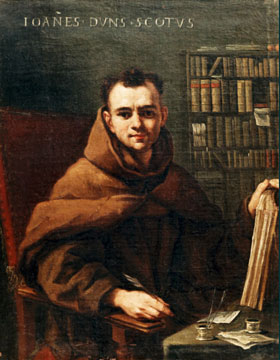
Duns Scotus1On November 8th the Church and the Franciscan world celebrates the feast of Blessed John Duns Scotus, a friar and medieval theologian/philosopher.  Not a household name, Scotus is best known for his philosophical writings, but it is his theological perspective that has left the most impact.  His theological writings on Mary form the basis for how we understand the Feast of the Immaculate Conception and his writings on the preeminence of Christ are the basis for the celebration of the Solemnity of Christ the King.

But it is also his reflection on the primacy of Christ that led to his asking about the Incarnation, or more specifically, why did the Word of God, the second Person of the Holy Trinity, become flesh.  “In the beginning was the Word, and the Word was with God, and the Word was God… and the Word became flesh and lived among us and we have seen his glory.”  (John 1:1,14)  Certainly those verses and others, e.g. Phil 2:5-7, clearly speak to Jesus taking on our humanity, becoming one with us.  But it doesn’t necessarily answer why. Continue reading

Finding the Lost…and then what?

Zacchaeus in the Sycamore Awaiting the Passage...


Zacchaeus was the chief tax collector and a wealthy man. In his day and age these were not things that would endear him to his fellow Jews. Zacchaeus worked for the occupying Roman government, extorted taxes and fees from his own countrymen, and became wealthy in the process.  He was not part of the Roman world. He was not part of the Jewish world. He is betwixt and between. He is lost


For the Son of Man has come to seek and to save what was lost.”  The story of Jesus and Zacchaeus is a story of the seeker encountering the lost. And in that encounter, what was lost is found.  A heart was changed. The one whose choices in life led to exclusion from his people and family seems to have made an abrupt about-face.  Choices were being unmade and consequences of choices were bring undone. Continue reading

Jesus and Zacchaeus – Saving What Was Lost

Zacchaeus in the Sycamore Awaiting the Passage...Luke 19:1-10. 1 He came to Jericho and intended to pass through the town. 2 Now a man there named Zacchaeus, who was a chief tax collector and also a wealthy man, 3 was seeking to see who Jesus was; but he could not see him because of the crowd, for he was short in stature. 4 So he ran ahead and climbed a sycamore tree in order to see Jesus, who was about to pass that way. 5 When he reached the place, Jesus looked up and said to him, “Zacchaeus, come down quickly, for today I must stay at your house.” 6 And he came down quickly and received him with joy. 7 When they all saw this, they began to grumble, saying, “He has gone to stay at the house of a sinner.” 8 But Zacchaeus stood there and said to the Lord, “Behold, half of my possessions, Lord, I shall give to the poor, and if I have extorted anything from anyone I shall repay it four times over.” 9 And Jesus said to him, “Today salvation has come to this house because this man too is a descendant of Abraham. 10 For the Son of Man has come to seek and to save what was lost.

Salvation. Jesus’ words in v. 9 are literally: “Today salvation has happened to/in this house(hold), because also this one is a son of Abraham.” Continue reading

A Warning About Cheap Grace

Bonhoeffer-1932The story of the encounter between Jesus and Zacchaeus is always seen as a moment of grace. Is it possible to be too gracious? Should Jesus have told Zacchaeus to straighten up his act before he invited himself to his house? Couldn’t Jesus’ actions have been interpreted as condoning the tax collector’s sinfulness? Isn’t that the accusation against the Christian Churches of Germany after WWII? Dietrich Bonhoeffer (The Cost of Discipleship) at the advent of WWII wrote famously on “cheap grace.” Continue reading