
…and we continue with some historical context and background for our consideration of the accounts of St. Francis and the Leper.
By the spring of 1213, four years after the founding of the “order,” Francis’ reputation had risen to the attention of the Italian aristocracy – not just in Assisi but throughout central Italy. The order was beginning to attract men from the higher social classes. Sons of merchants like Francis, sons of the landed wealthy, sons of ruling households, men with established careers in law, music and the arts, and also ordained priests. They joined the already formed group of men from middle and lower backgrounds and joined in on the muddling through what it meant to follow Christ in the manner of Francis. G.K. Chesterton’s later definition of the Catholic Church – “here comes everybody.” Broadly speaking, apart from their spiritual gifts, these were “company men.” How many friars joined the fraternity in those years? It is impossible to say, but we do know this: in 1217 the annual meeting (called a “chapter”) made the decision to send out missions across the Alps into northern Europe, the Baltic states, and to the Crusader States in the eastern Mediterranean. Within Italy, six provinces were established; outside of Italy, five provinces were established: Spain, northern and southern France, Germany, and Syria. Some scholars have written that the number of brothers exceeded 700 men. Continue reading

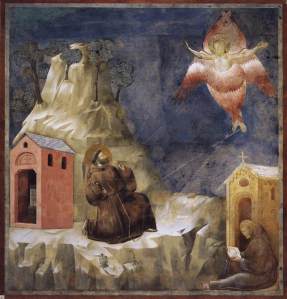 After Francis’ withdrawal from active ministerial leadership of the friars, he witnessed an inevitable evolution of the religious order, which had grown to over 5,000 brothers in 1223 from the humble beginnings in 1209 of Francis and four companions. The evolution of the Order, necessary on a number of levels, also began to change the life of the fraternity. Francis worried that the Spirit of prayer was being compromised and that the necessities of ministry were leading the brothers to increasing ties to material possessions. He lived and suffered in a “Time of Doubt,” as described in the previous article.
 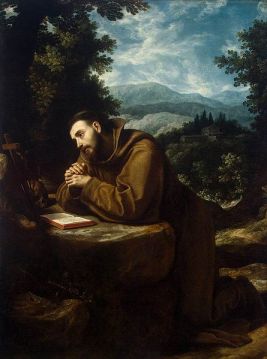 In the short span of 12 years (1209-1221), the Franciscans had grown from a small, Assisi-based fraternity consisting of Francis and four other brothers, to a large, “multi-national,” religious order with an approved Rule of Life, a Cardinal Protector (who would soon become Pope), and more than 5,000 brothers. There was nothing in Francis’ life that prepared him for leadership of such a far-flung fraternity, which was already spanning the European continent and parts of the Middle East and North Africa. He had been a spoiled dilatant, a would-be knight, a wounded warrior, a solitary figure, living a quasi-hermetical life, and now he was the “leader” of a growing, international community of brothers. In the beginning, things just seemed to unfold, signs appeared along the way, and Francis followed the path in faith. And people followed Francis. Now most Franciscans had never met Francis and Francis’ model of leadership by example, which worked in 1209, but was not the one needed in 1221. And so he stepped down as leader, leaving the Order in the care of the Church – at least as far as discipline and administration. Yet it was also clear that he hoped to preserve a superior authority, of a spiritual type, demonstrated in the way in which he lived the Rule of Life.
  The year is 1220 and Francis has just announced his decision to step down as “leader” of the Franciscan brothers. In last week’s installment, I described Francis’ reason for stepping down. Francis had already seen the effects of a vacuum in spiritual authority brought about by his year-long absence while in the Middle East. It is in leaving to his “vicar” and to the Roman Church the care of making decisions of a normative or disciplinary type that he could hope to preserve a superior authority, of a spiritual type, that would only have been diminished in the heat of daily administration.
  If you have been following the daily gospel readings, you have read about the growing opposition to Jesus. He has been performing miracles, casting out demons, curing the sick, and yet people are hesitant to believe. In some cases, they outright refuse, and in the most extreme, they recognize the supernatural but attribute it to being in league with Satan. The people resist, the authorities accuse, and in today’s gospel it seems as though Jesus’ family wants to see him. Unsaid, but its seems as though they want to have an intervention.
