Pushing out into deep waters…

PFrancis-on-loggiaHere on the anniversary of Pope Francis (happy anniversary, Holy Father!) there is growing speculation that there may be some change in the pastoral approach to divorced and civilly remarried Catholics. One only need glance at national newspapers and on-line sources here in the United States to know that it is a topic that is continually asked of Bishops.  And there is a context for the interviewer’s question. Last month the Cardinals of the Catholic Church met in Rome for a meeting on family life in our times. Pope Francis invited Cardinal Walter Kasper of Germany to give the opening remarks for the gathering. The Pope’s choice of Cardinal Kasper was enough to begin the speculation. While the opening speech will be published later this March (in German and Italian), there have been many reports regarding the content of the talk. Continue reading

Being Intentional

SwimmingSomeone asked me why I get up most mornings for 5:30 swim practice – wouldn’t I like an extra hour or so of sleep, or maybe be able to stay up a little later the evening before? Extra sleep – sure. Stay up a little later – maybe. But the basic reason I get up so early is because I am intentional about having some semblance of a balanced life and that includes physical exercise. Once I am back at the parish, the course of the day may go as planned…or not, but I am free to respond without wondering if I can squeeze in a workout later in the day. It is liberating, even if a little bleary-eyed. Continue reading

Witness and Watching

HomelessThere is folk wisdom which says never argue with a fool because a third person will not be able to tell the difference. Myself, I am partial to the wisdom from the West of Kenya which says, if you are bathing in the stream and someone steals your clothes don’t chase them. I had to think about that one at first – but in thinking about what the third person sees – it then became clear. Continue reading

Being Salt and Light

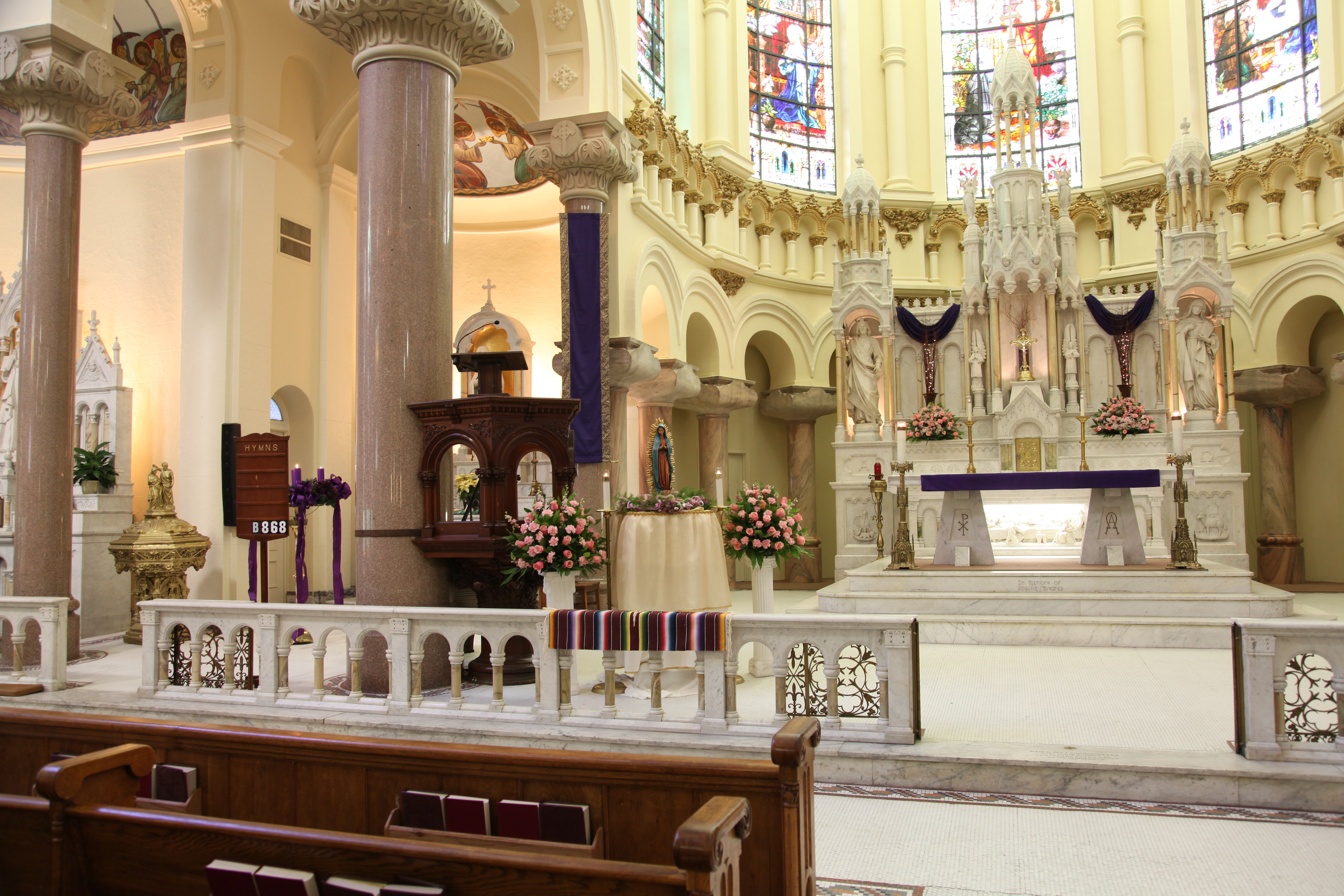
Sacred Heart, Tampa - ready for the Feast of Our Lady of Guadalupe

Last week I wrote about the Sermon on the Mount, which contains the Beatitudes and is one of the great discourses in the Gospel according to Matthew.  I thought I would provide some more food for thought as our Sunday gospel continues with the Sermon on the Mount – better described as the Discourse of Discipleship.

In our reading today, Jesus uses two of the most well-known metaphors:  “You are the salt of the earth.” and “You are the light of the world.” (Mt 5:13-14)  Two things that are vital to human life – not nice, but vital.  Several years ago, NPR aired a report about an isolated area of Myanmar (Burma) with no natural salt deposits – at least my memory says Myanmar (my search of NPR failed to uncover the story).  This very fertile land was unoccupied because of that reason until an earthquake moved a mountain and a road was opened to the region.  At least then people could live there and travel to market to buy salt.  Salt is that vital to human life.  But beyond the life-sustaining aspect, salt gives flavor and is used to preserve, to prevent corruption.

You are the salt of the earth.”  This is what Jesus proclaims to the disciples, to the ones who have already responded to his call to follow him.  And all of this is in connection with the Sermon on the Mount’s focus of letting disciples know the demands of the kingdom.  Disciples of Christ need to be life-giving, need to add the distinctive flavoring of being “blessed,” and to preserve others for life in the eternal kingdom.

Disciples, if we are true to our calling, make the earth a purer and a more palatable place.  But we can do so only as long as we preserve our distinctive character:  tasteless salt has no value.  The Rabbis commonly used salt as an image for wisdom (cf. Col. 4:6), which may explain why the Greek word translated as “lost its taste” actually means “become foolish.”  A foolish disciple has no influence on the world; a foolish community makes no difference in its locale.

It raises the questions whether as a community or individuals – are we salt for the earth?  What is distinctive about us as disciples?  Our church buildings are very distinctive.  But are we? If we are not, then we are simply foolish.

Voice of the Florida Faithful

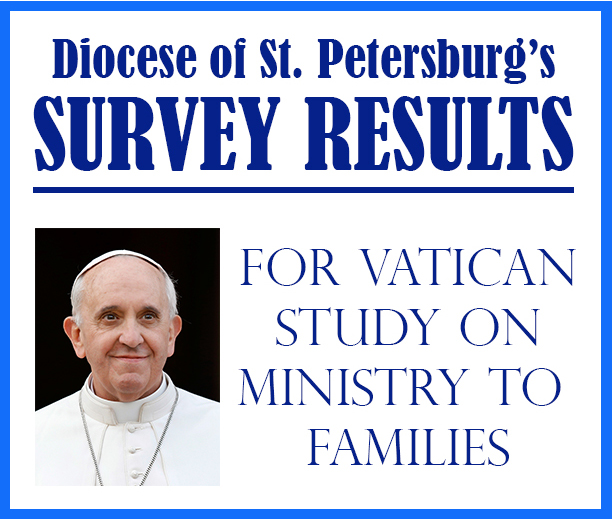
2014_Vatican_Survey_dospHere in the Diocese of St. Petersburg, Florida, our ordinary, Bishop Robert Lynch, actively promoted input from the pew for the Vatican survey on “Ministry to the Family.” He promised that he would summarize the results and publish what people had to say from the pews. Although I do not know for sure, I inferred from Bishop Lynch’s blog that of the seven Florida dioceses we were the only ones that solicited the voice of the faithful. I hope that is not true.  What a lost opportunity.

Bishop Lynch’s blog offers a summary as well as links to a more detailed report. I read both last evening – its a lot to wade through. It is notable that the “average” respondent was 50-65 years old, married, and attends Mass each Sunday and Holy Day.  Think about that a bit: what would you expect to see for survey results?  You can read the bishop’s summary and reflection here.  Interesting results – at least I think so.

Let me go in peace.

LastWordsLast words. We have always place a special emphasis on last words. There are websites dedicated to recording the last words of famous people. Some are profound, some hilarious, and some ironic. Movies highlight the last words of the dying. I guess it is that we believe that for the person, this is their last shot at figuring things out, summing things up. We assume that at death’s doorway there is no need nor desire for pretense or fabrication, but only moments of deep, abiding truth and wisdom – and we hang on the edge of our seats. Continue reading

David and Bathsheba

david-and-bathsheba-chagallThe first reading for today’s Mass was the famous account of David and Bathsheba from 2 Samuel 11. It is paired with the Mark 4:26-34 which includes the account of the sowing of seeds, the parable of the mustard seed, and musing on the Kingdom of God.

King David is, it seems to me, an example of an individual (although the same analogy could apply to a small community of faith, a parish, a religious order, etc.) who is ever in need of a Divine Horticulturist. At different times in his life he has been “good soil,” “rocky ground,” “soil with brambles,” and all manner of well- and ill-prepared soil. The Word came to David, as it does us, and the fruitfulness of the seed was only as good as the ground which received it.  Even when the mustard seed is planted, it only has the potential to be shade covering for all the birds of the sky. Between seedling and “the largest of plants” lies weather, soil conditions, weeding, fertilizing, pruning, and all kinds of care and tending.

On our worst days we ignore, avoid, and all together pass on the work of the Divine Horticulturist. On our best days, we seek Him out and, in humility, and undergo the necessary pruning, watering, and all manner of converting care. And it is on those days, we perhaps best understand our Psalm:

Let me hear the sounds of joy and gladness;
the bones you have crushed shall rejoice.
Turn away your face from my sins,
and blot out all my guilt.
Be merciful, O Lord, for we have sinned.

Today’s account was one of David’s worst days. But with the help of Nathan he encountered the Mercy of God.  That was a good day.

May your day be as good.  May you hear the sounds of joy and gladness. It is only a pruning away

So…what are your plans?

beatitudes1This weekend the Feast of the Presentation of the Lord (Feb 2nd) falls on a Sunday – and so we celebrate that event in the life of Christ.  When the Feast falls on Sunday, it replaces the Ordinary Time celebration and the associated Gospel, which happens to be “The Sermon on the Mount.”  The Sermon contains the listing of the Beatitudes and is one of the great discourses in the Gospel according to Matthew.  I thought I would at least provide some food for thought here in the column. Continue reading

Baptized, Sent, and Falling Short

Homa Bay, on Winam Gulf, Lake Victoria, Kenya;...

Homa Bay,Kenya

You’ve seen the movies: a person is in danger, slipping off a cliff or a building or some other perilous perch. Another person grasps them by the hand and desperately tries to pull him or her to safety. That is the image Isaiah gives us: God grasps the chosen servant by the hand and hangs on for dear life.  “I have grasped you by the hand; I formed you, and set you as a covenant to the people” (Is 42:6). It is an image that  Pope Benedict XVI sees in his book Jesus of Nazareth. Jesus, the sinless one, plunges into the waters of our life, grasps a new covenant people by the hand, rises from the waters, all the while hanging on for dear life – our life.  And we are baptized into Christ, raised toward eternal life, commissioned to journey through this life.  Baptized and sent.

18 years ago, on the 2nd day of my mission to Kenya, I found myself in the back seat, traveling by car from Kisumu to Homa Bay on a mostly rough, uneven, dusty and rock-strewn dirt road only meters from Lake Victoria. The land was dry, parched, and in need of irrigation – all the result of irrigation projects promised but never seemingly a high enough national priority for this out-of-the-way corner of the nation.  Later we were to discover we were between the short rains of December and the long rains of July and August – and in reality, at the beginning of a year-long drought. Continue reading